Overview
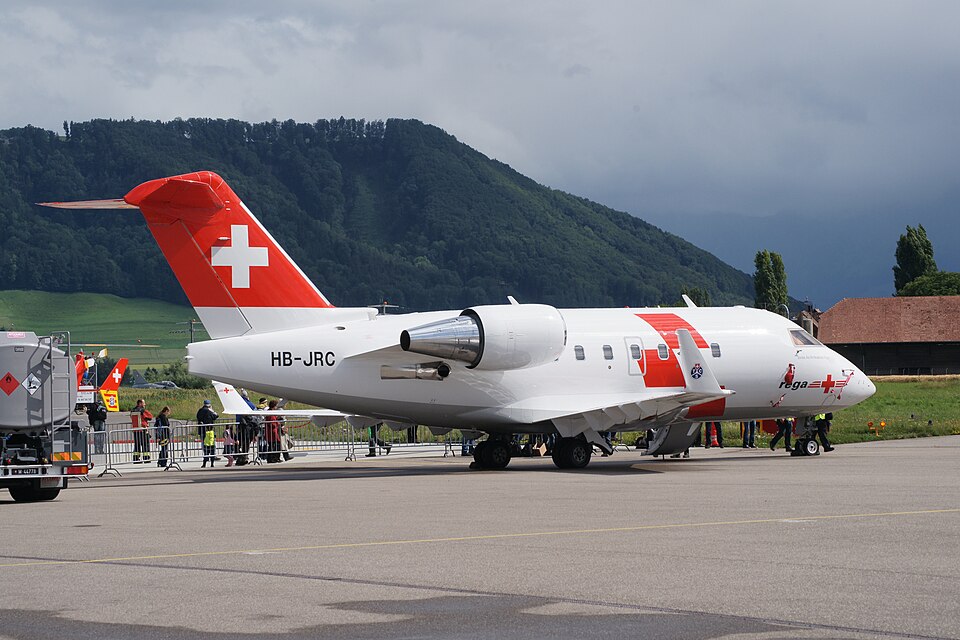
On 26 March 2003 at 14:13 UTC, an airprox (near collision) occurred between two aircraft in the Zurich control zone, approximately 6.6 NM northwest of runway 14 threshold. The aircraft involved were SAZ463, a Canadair CL-604 Challenger (registration HB-JRC) operated by Swiss Air Ambulance, and HB-FKP, a Pilatus PC-6 Turbo Porter operated by Swissboogie.
Flight Details
SAZ463
The crew of SAZ463 had completed an ambulance flight from Nigeria to Milan Linate and were flying an empty leg to Zurich. At 14:03:19, the first officer contacted Approach Control West (APW). The controller cleared the aircraft for a radar-vectored ILS approach to runway 14. At 14:10:48, SAZ463 was cleared for the ILS approach. The crew reported established on the localizer. The controller then issued a traffic advisory about an unknown aircraft at 11 o'clock, 2 NM, crossing left to right at an unknown altitude. The SAZ463 crew reported visual contact with the other aircraft, estimating its altitude at 3800 ft. The controller asked if they could maintain visual separation, and the crew confirmed. After switching to Aerodrome Control (ADC), the first officer reported the other aircraft was a PC-6 with "Breitling" markings.
SWB601 (HB-FKP)
The pilot of HB-FKP had departed Zurich at 13:54:35 on a VFR flight along Route 3, intending to exit the control zone via Attikon. On board were two passengers: a cameraman and a reporter. After passing Attikon, the controller cleared the pilot to change frequency. The pilot then planned to fly via Andelfingen, Rafz, Hohentengen, and Erzingen, remaining below 3000 ft and outside the control zone. The cameraman filmed various clearings, and the aircraft performed some 360° turns for better camera angles. The pilot later stated he had observed the approaching jet but believed he was outside the control zone and below 3000 ft, assessing the distance as sufficient and seeing no collision risk.
Encounter
At 14:13:25, the two aircraft crossed with a horizontal distance of 0.3 NM according to radar data. The SAZ463 crew judged the horizontal separation as 150 m and vertical as 200 ft, while the PC-6 pilot estimated 350 m horizontally and 200 m vertically. The PC-6's transponder was off, so no altitude data was recorded for it. The SAZ463, equipped with functioning ACAS II, could not receive traffic information due to the missing transponder signal. The SAZ463 crew reduced their descent rate and completed the ILS approach visually under good weather conditions.
Findings
- SAZ463 was operating IFR on an ILS approach to runway 14.
- SWB601 was operating VFR on a private press flight.
- The PC-6 pilot remained on the ADC frequency without explicit clearance.
- The SWB601 was inside the control zone without authorization at the time of the incident.
- The PC-6's transponder was switched off.
- The SAZ463 crew had visual contact with the PC-6 and identified it as a yellow/red aircraft with "Breitling" markings.
- The PC-6 pilot observed the jet before the encounter but did not take evasive action.
- Weather conditions were good, with visibility 10 km and scattered clouds.
- The incident occurred in airspace D.
Assessment
The PC-6 pilot considered the flight routine, with over 350 hours on type and familiarity with the Zurich area. Weather allowed uneventful VFR flight, though slight haze existed. The pilot believed he had never been cleared from ADC frequency and remained listening. No explicit evaluation of cause is provided in the source.