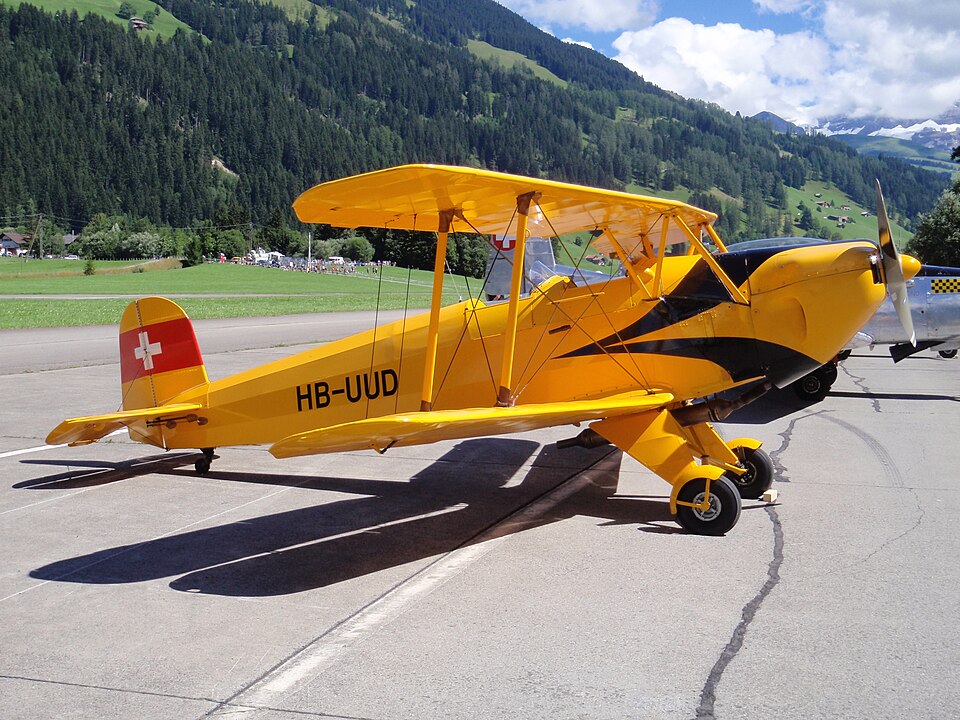
Incident Summary
On 19 March 2016, at 16:32 local time, a Bücker Bü 131 APM (registration HB-UUD) collided with a taxiway marker while taxiing at Thun airfield (LSZW). The aircraft was operated by the Bücker Fan Club and was on a training flight under visual flight rules. The flight was intended to be a season check flight.
Aircraft and Personnel
The aircraft was owned and operated by the Bücker Fan Club, based in Oberhofen, Switzerland. The cockpit crew consisted of a flight instructor and a pilot. The flight instructor, a Swiss citizen born in 1954, held a commercial pilot licence (CPL(A)) issued by the Federal Office of Civil Aviation (BAZL). He had accumulated 4740 total flight hours, including 769 hours on the accident aircraft type, but none in the preceding 90 days. The pilot, a Swiss citizen born in 1953, held a private pilot licence (PPL(A)). He had logged 724 total flight hours, with 50 hours on type, including 27 minutes in the last 90 days.
Circumstances
Earlier that morning, all participants of the Bücker Fan Club general meeting were briefed about the presence of taxiway markers. In the afternoon, the pilot and flight instructor planned to conduct the season check flight. While taxiing to the holding point of runway 32, the aircraft collided with a taxiway marker. The pilot perceived the impact as a rumble and initially believed they had run over a concrete manhole. Despite the collision, they proceeded with the flight as scheduled, noting no changes in flight characteristics.
Damage and Aftermath
After landing, damage was discovered: the fabric covering the underside of the horizontal stabilizer was torn. No further flights were undertaken. The aircraft sustained light damage, and no third-party damage occurred. No injuries were reported among the two crew members or any third parties.
Regulatory Context
The operator subsequently measured the existing taxiway markings, finding the effective taxiway width to be approximately 10.50 metres. The BAZL guideline AD I-002 D on optical aids for unpaved runways and taxiways specifies that taxiway markers should be placed at a maximum distance of 3 metres from the taxiway edge. For aircraft with a wingspan up to 15 metres (Code letter A), the recommended taxiway width is 7.5 metres; for wingspans from 15 to 24 metres (Code letter B), it is 10.5 metres.
The Swiss Transportation Safety Investigation Board (SUST) conducted a summary investigation in accordance with Article 46 of the Ordinance on the Safety Investigation of Transport Incidents (VSZV). The report was prepared with the aim of learning from the occurrence.