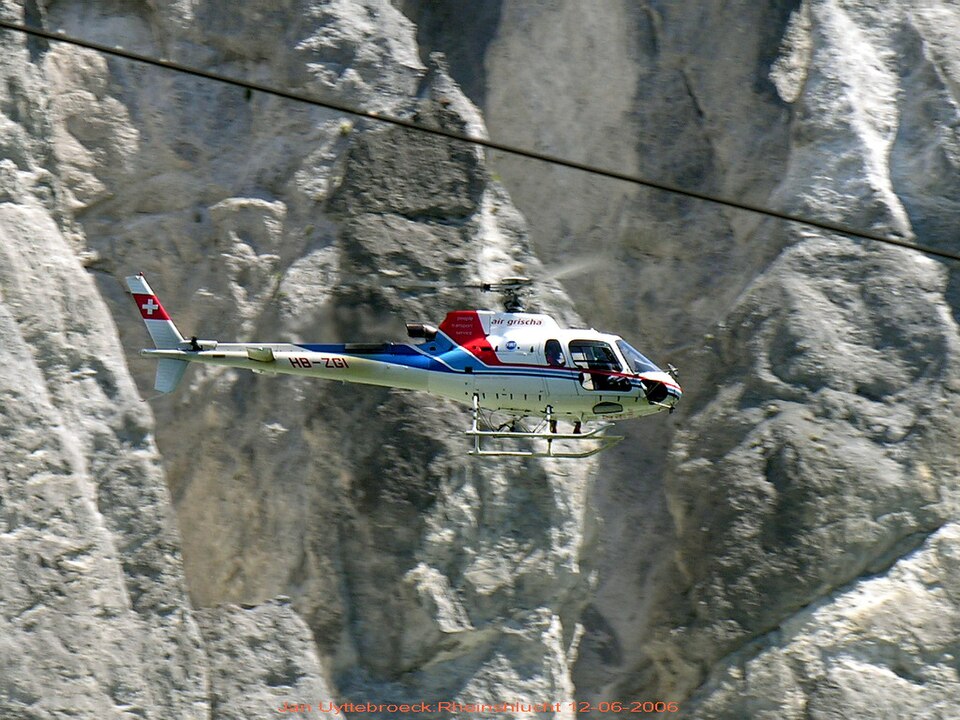
Background
The helicopter involved was a Eurocopter AS 350 B3, registered as HB-ZGI, owned and operated by Air Grischa Helikopter AG. The pilot was a Swiss citizen, born in 1955, holding a commercial pilot license for helicopters (CPL(H)) since 1992, with 3659 total flight hours, including 2682 hours on the accident type. The flight was conducted under Visual Flight Rules (VFR) for commercial filming operations.
Flight
On 7 November 2011, a camera system with a swiveling lens was installed on the left front of the helicopter. The helicopter departed from Samedan Airport at 08:02 LT and landed at 08:15 LT on a closed-off meadow in Ardez, where a final briefing took place. The filming involved a chase on a closed road between Ardez and Ftan, with a sport utility vehicle towing a trailer and a sports car. The helicopter conducted several passes, filming at distances ranging from 200 m to 3-5 m and heights from 150 m down to 3-5 m above the vehicles.
Accident
During the last sequence, while filming at approximately 5 m above the cars and 20 m behind the trailing vehicle, the pilot momentarily lost sight of the sports car as it braked suddenly. As he maneuvered to regain visual contact and maintain filming distance, the main rotor blades struck a rock face at a forward speed of about 30-40 km/h. The helicopter then impacted the road twice and rotated 90 degrees counterclockwise. The cabin remained mostly intact, but the left landing gear was pushed inward and the tail boom was nearly severed by the damaged rotor blades. The pilot shut down the engine and battery, and occupants were able to exit with assistance from stunt drivers. Emergency services were alerted at 09:21 LT.
Injuries and Damage
There were no injuries among the four occupants (one pilot and three passengers). The helicopter was seriously damaged, and no third-party damage occurred.
Probable Cause
According to the Swiss Accident Investigation Board (SUST), the accident was caused by the helicopter's main rotor colliding with a rock face while in flight due to insufficient distance from the terrain, which led to the helicopter's fall.