Incident Overview
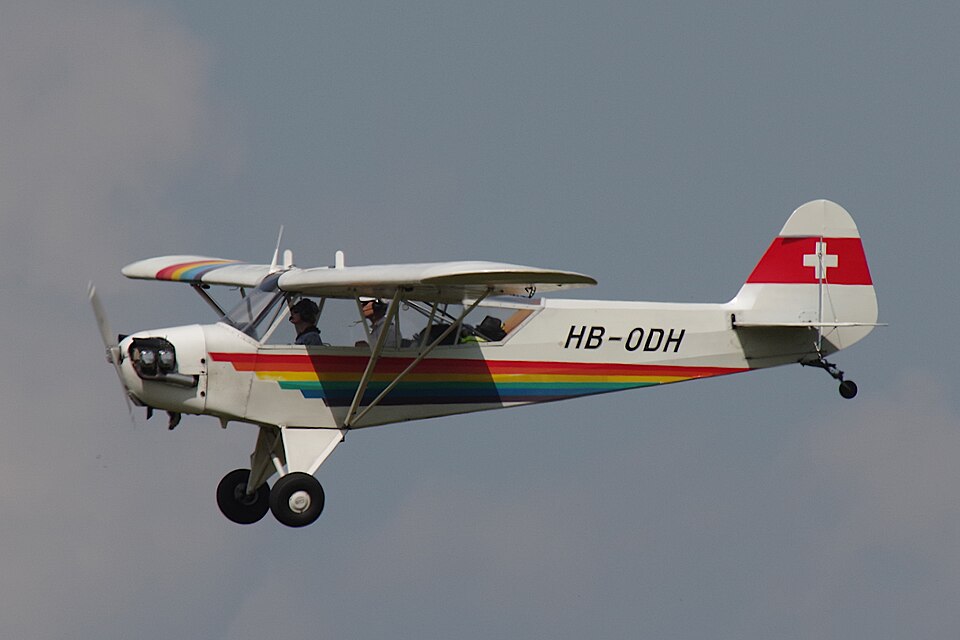
On March 4, 2018, at approximately 15:00 local time, a serious near-miss incident occurred in Class G airspace over Sarnen (OW), Switzerland. The event involved two light aircraft: a Piper J3C-65 / L-4 registered as HB-ODH and a Robin DR 300/180 R registered as HB-EDB. Both aircraft were on final approach to Runway 03 at the Kägiswil airfield (LSPG). The minimum distance between the two aircraft was estimated at approximately 50 meters while they were at the same altitude.
Aircraft and Pilot Details
The Piper L-4 (HB-ODH) was operated by a Swiss pilot born in 1942, holding an FAA Commercial Pilot Licence. He had 13,300 total flight hours, including 2,100 on the accident type. The Robin DR 300/180 R (HB-EDB) was piloted by a Swiss citizen born in 1984 with an EASA PPL(A). He had 805 total hours and 5:06 hours on the accident type. Both flights were conducted under Visual Flight Rules (VFR) for private purposes.
Sequence of Events
The pilot of HB-ODH entered the traffic pattern from the west, executing a steep approach to avoid noise over Sarnen. While performing a right-side slip, he suddenly observed HB-EDB ahead and slightly below, turning into the final approach. The HB-ODH pilot executed a go-around. The HB-EDB pilot, having just completed a tow flight, entered the eastbound traffic pattern and likely turned directly into the final approach via a continuous 180-degree curve. He did not see HB-ODH due to sun glare from the west and low contrast against snow-covered mountains. Post-flight radio checks indicated that HB-ODH's transmissions were difficult to understand due to background noise, and no blind calls from HB-ODH were recorded immediately prior to the conflict.
Contributing Factors
The investigation highlighted several risk factors: 1. Traffic Pattern Confusion: The aircraft used opposite traffic patterns for the same runway, increasing collision risk. 2. Communication Failures: Lack of clear and consistent blind calls on the airfield frequency prevented pilots from establishing a common situational awareness. 3. Visual Obstruction: Sun glare and limited visibility due to the high-wing design of the Piper L-4 during a slip maneuver hindered detection. 4. Procedural Deviation: The HB-EDB pilot may have failed to fly a distinct base leg, preventing a clear view of the extended final approach path. 5. Equipment Disparity: HB-EDB was equipped with Flarm (collision warning), while HB-ODH was not.
Operational Context
Kägiswil is a former military airfield currently in a transition phase. Official Aerodrome Information (AD INFO) and Visual Approach Charts (VAC) were not available from the Federal Office of Civil Aviation (BAZL). Instead, local documents created by the airfield association were used, which may have given pilots a false sense of official standardization.