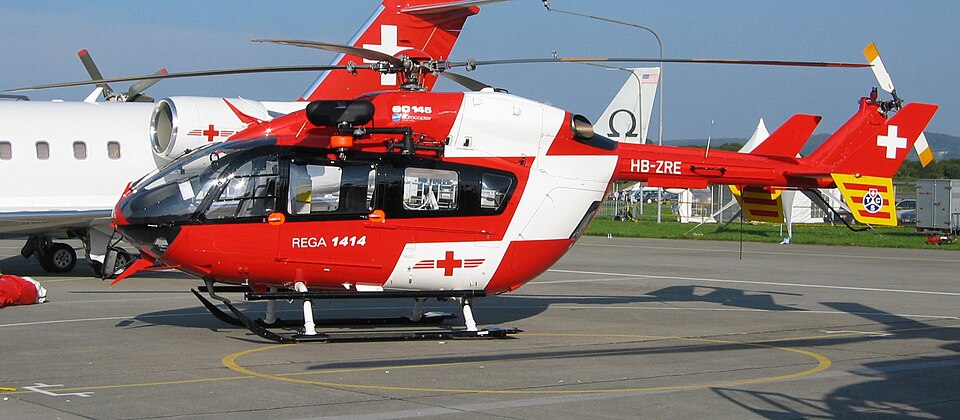
Basic Information
On 7 July 2018, at 17:30 local time, a MBB-BK 117 C-2 helicopter, registration HB-ZRE, operated by Schweizerische Rettungsflugwacht (REGA), was involved in a serious incident at Roc de Veyges in the canton of Vaud, Switzerland. The helicopter was configured for a rescue flight under visual flight rules (VFR), having departed from Lausanne Airport – La Blécherette (LSGL).
The crew consisted of a pilot (Swiss citizen, born 1965, holder of a Commercial Pilot License Helicopter issued by EASA via the Swiss Federal Office of Civil Aviation, with 5738 total flight hours, including 2924 hours on type), a Helicopter Emergency Medical Services (HEMS) crew member, and a physician. All three occupants were uninjured. The aircraft sustained slight damage, specifically to the tail rotor blades.
Occurrence Sequence
Upon arrival at the intervention site, the pilot identified a clearing measuring 40 x 130 meters, suitable for approach. However, the sloping terrain offered limited landing options. After an unfavorable first landing attempt with the right skid on the downhill side, the pilot decided to climb and perform a 180-degree anticlockwise turn in hover around the helicopter's yaw axis to find a more favorable spot. He then moved a few meters toward the forest edge and executed another half-turn, this time clockwise. Through the sliding window on the pilot's side, he suddenly heard a noise lasting 1 to 2 seconds. The pilot interpreted this as a main rotor blade passing and felt no vibrations in the tail rotor pedals.
The pilot subsequently landed the helicopter in the clearing without further incident. After engine shutdown and main rotor stop, he exited and observed damage to the tail rotor blades. The mission was aborted; the patient was transported by ambulance to a more suitable location and then evacuated by another air ambulance helicopter.
Findings
Inspection revealed surface damage on both tail rotor blades. The damage was located on the underside of the blades, between 5 and 10 cm from the blade tips and at two-thirds of the chord from the leading edge. Certified mechanics performed a thorough inspection and replaced the tail rotor blades and the mechanical positioning system on site. No other damage was found.
Analysis and Conclusions
The damage to the tail rotor blades was caused by contact with a tree branch. Under the aerodynamic forces generated by the main rotor and tail rotor downwash, the branch flexed and struck the blades during the last half-turn in hover before landing. No further investigation measures were deemed necessary by the Swiss Transportation Safety Investigation Board (STSB), and the inquiry was concluded with this summary report.