What happened
On July 15, 1998, an Agusta A-109K2 helicopter, registration HB-XWF, was conducting a medical evacuation near a quarry in Lodrino, Switzerland. The mission began after a worker sustained a leg injury at the Sangiorgio quarry. After several successful rotations to deliver medical personnel and equipment, the crew attempted a final approach to pick up the patient.
During this final approach, the pilot attempted to stabilize the aircraft against the wind by maneuvering from the north. During this maneuver, the helicopter struck a 200-meter-long transport cable. The impact caused the cable to snag the nose wheel, which was subsequently sheared off. The sudden loss of stability caused the main rotor blades to strike the tail boom, breaking the tail rotor drive shaft. Left without anti-torque control, the aircraft entered a spin and the pilot was forced to execute an autorotation. Due to nearby power lines and a crane, the pilot landed in a dry torrent bed. The impact was extremely violent, resulting in one fatality and one serious injury.
The investigation
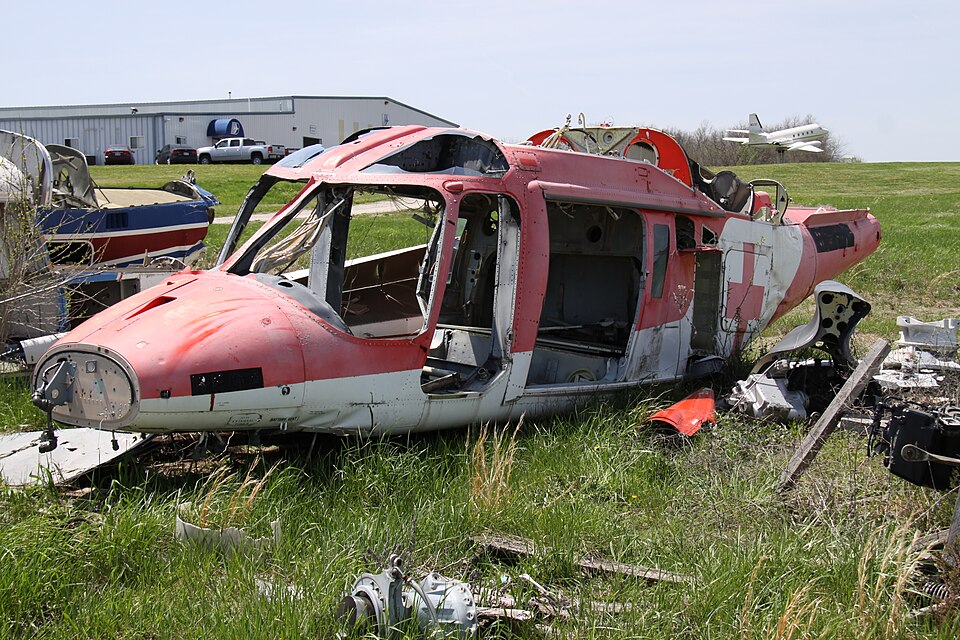
The investigation focused on the sequence of events leading to the collision and the subsequent impact. Investigators examined the wreckage and found that the helicopter's nose wheel fork had been severed by the cable. The investigation also reviewed the status of the transport cable, which had been in place since 1981 but was notably absent from official aeronautical obstacle charts.
Medical examinations revealed that the pilot died from internal injuries and brain swelling caused by the vertical force of the crash. The survivor, a rescuer, sustained severe spinal and leg injuries but survived, likely because their metal seat deformed and absorbed some of the impact energy, unlike the more rigid pilot seat.
Findings
- The primary cause of the accident was a collision with a transport cable which triggered an autorotation and a subsequent hard landing.
- The aircraft was not equipped with cable-cutting devices, which could have prevented the snagging of the nose wheel.
- The transport cable was not recorded on official navigation obstacle maps.
- The pilot's seat lacked an energy-absorbing system, contributing to the fatal nature of the vertical impact forces.