Overview
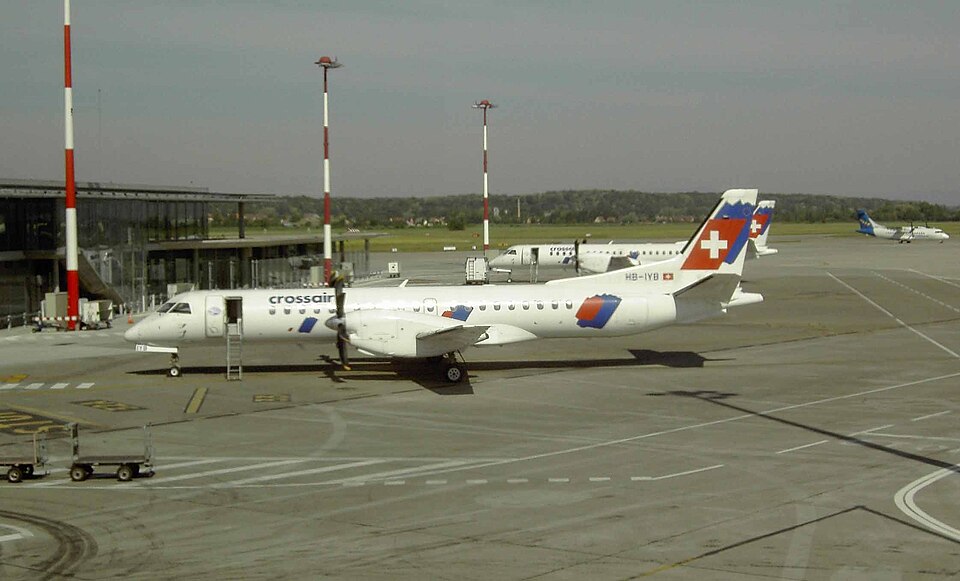
On 29 June 2003 at approximately 09:05 UTC, a SAAB 2000 aircraft, registration HB-IYB, operated by Swiss International Airlines, was involved in a serious incident at Olbia Costa Smeralda Airport in Italy. The aircraft was performing scheduled passenger flight LX 2620 from Lugano to Olbia, carrying 24 passengers and 4 crew members. The Italian National Flight Safety Agency (ANSV) conducted a technical investigation in accordance with ICAO Annex 13, with a representative from the Swiss Bureau of Aircraft Accident Investigation (BFU) accredited to assist.
Flight History
The flight was programmed to depart Lugano at 08:00 UTC and actually departed at 07:59 UTC. The first officer was the pilot flying throughout the sector. At 08:45:24, Marseille Control cleared the aircraft for initial descent from flight level 250 to 200. The commander and first officer conducted an approach briefing for runway 06 based on forecast wind, agreeing that a supplement would be needed if runway 24 became active.
At 08:52:44, Rome Control cleared SWR 2620 to flight level 100, routing via CORSI and SME. At 08:54:34, the first officer contacted Olbia Approach, which authorized landing on runway 24 and instructed the crew to maintain high speed for priority. The crew received meteorological information: calm wind, CAVOK conditions, surface temperature 34°C, dew point 14°C, QNH 1009 hPa. At 08:55:20, the first officer confirmed the instructions and began descent. At 08:56:29, a new approach briefing for runway 24 was performed despite repeated interruptions. At 08:57:57, approximately 16 to 20 nautical miles from the runway, the aircraft was cleared to descend to 4000 feet. At 08:58:14, the commander noted that descent checks were still required and requested them. The serious incident occurred at 09:05 UTC.
Aircraft and Systems
The SAAB 2000 (HB-IYB) was a twin-engine turboprop airliner. The report includes technical descriptions of several aircraft systems. The touchdown protection system is designed to prevent premature ground contact. The anti-skid system prevents wheel lockup during braking. The weight on wheel (WOW) system detects when the aircraft is on the ground. The ground beta and thrust reverser system controls propeller pitch for ground operations. The autoflap retraction (AFR) system automatically retracts flaps after landing.
Crew Information
The flight crew consisted of a commander and a first officer. The report details their flight experience, including total hours and hours on type, but specific numbers are not provided in the excerpt.
Meteorological and Airport Information
The weather at Olbia at the time of the incident was calm wind, CAVOK, temperature 34°C, dew point 14°C, and QNH 1009 hPa. Olbia Costa Smeralda Airport is located in Sardinia, Italy.
Investigation
The ANSV appointed an investigator-in-charge who conducted the on-site inspection on 1 July 2003. The investigation included analysis of flight recorders, examination of the wreckage, technical analysis of system performance, and review of operational documentation. The final report, number 1945, was published by the ANSV.