History of Flight
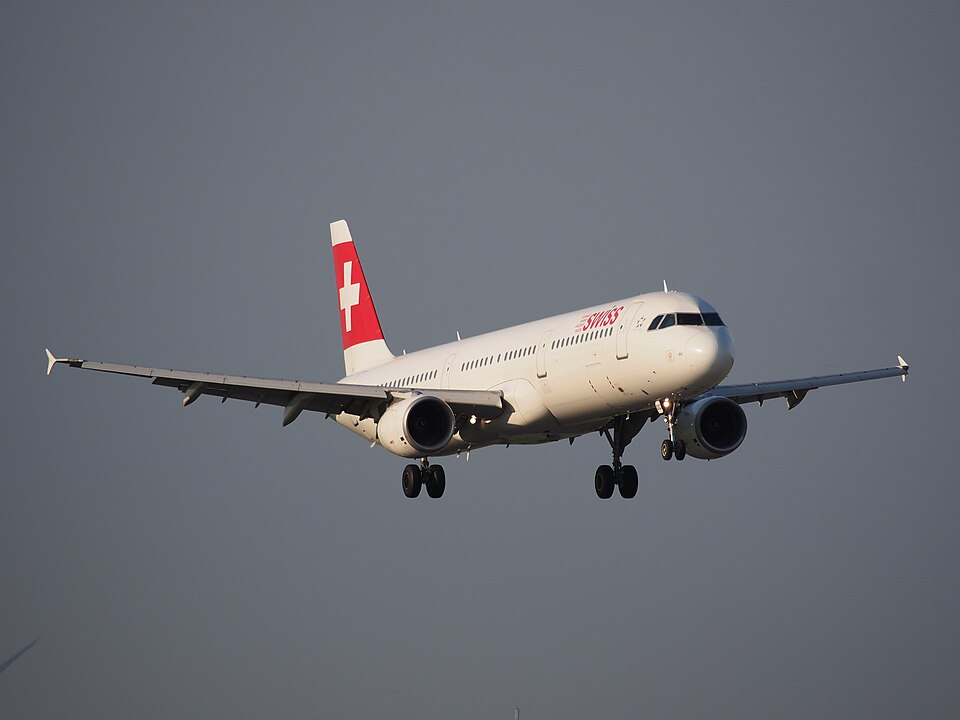
Flight SR831, a scheduled commercial flight from London Heathrow to Geneva, operated by Swissair using Airbus A321-111 registration HB-IOC, departed London and climbed to flight level 290. At approximately 11:05 UTC, the flight and cabin crew heard a loud bang. After checking engine parameters, which appeared normal, the flight continued to Geneva.
During descent into Geneva for runway 05, around 11:46 UTC, vibrations on the right-hand (RH) engine increased and fluctuated, along with the exhaust gas temperature (EGT). A loss of engine power was felt, requiring corrective rudder input. During landing and flare, fire was observed by a crew near the runway, and air traffic control was advised. After landing, the warning light "ENG #2 OIL FILTER CLOGGED" illuminated, and the crew shut down the RH engine. Geneva Apron advised the crew that the engine was on fire and instructed them to stop on the taxiway. The aircraft complied, and both fire extinguisher bottles on the RH engine were discharged. The fire brigade arrived and cooled the engine. The fire ceased as no more fuel was injected due to engine shutdown. Passengers disembarked via stairways on the taxiway; no injuries occurred.
Investigation and Findings
The Swiss Federal Aircraft Accident Bureau opened an investigation. All crew held valid licences. The aircraft had no history of engine problems. Maintenance events days earlier included a popped chip detector indicator on engine #2 (no metallic parts found), N2 vibrations of 2.2 (within limits), and a fault in fire loop "B" (released per MEL). No relation to the incident was found.
Recorded data showed a short drop in power indications on engine #2 at 11:05, followed by a higher EGT (approx. 30°C). Vibration (VIB2) rose to 1.5 units during takeoff roll, then increased to 2 units at cruise. At 11:05, VIB2 dropped below 0.5 units. During descent at 11:35, VIB2 peaked to 0.9 units, then VIB1 rose to 6.7 units and later to 9.0 units before shutdown. EGT reached 837°C. The commander took over control due to strong vibrations.
The disrupted gas flow from damaged blades and fluctuating pressure P3 allowed the flame to move into the exhaust zone, where unburned fuel ignited, visible as fire. The exhaust zone is not protected by a fire warning. The fire went out after unburned fuel was consumed. Initial maintenance inspection revealed that the HP and LP rotors were seized. Disassembly confirmed a defective bearing No. 4.
Analysis
The incident resulted from failure of bearing No. 4 during the flight. Although earlier chip detector events occurred, they were not related; the material removed did not contain bearing No. 4 material. The first audible noise during cruise left engine indications within ranges that did not clearly indicate a problem to the crew. During approach, power setting changes caused engine parameters to shift. At 11:46, a sharp EGT increase, loss of N1 and N2, and low P25/P3 occurred. The engine was shut down only after the oil filter clogged warning on the ground.
Fire was reported by a crew holding short of runway 05, leading to instructions to stop on the taxiway. After both fire extinguisher bottles were discharged and the fire brigade cooled the tailpipe, the fire was extinguished by fuel starvation. The extinguishers were ineffective because their agent did not reach the tailpipe area. The commander decided against slide evacuation, ordering disembarkation via stairs on the left side. Some cabin crew confusion arose regarding arming slides, but the instruction was corrected.
Cause
The incident was caused by the failure of bearing No. 4 of the engine #2 with resulting damage to the HPT blade tips.