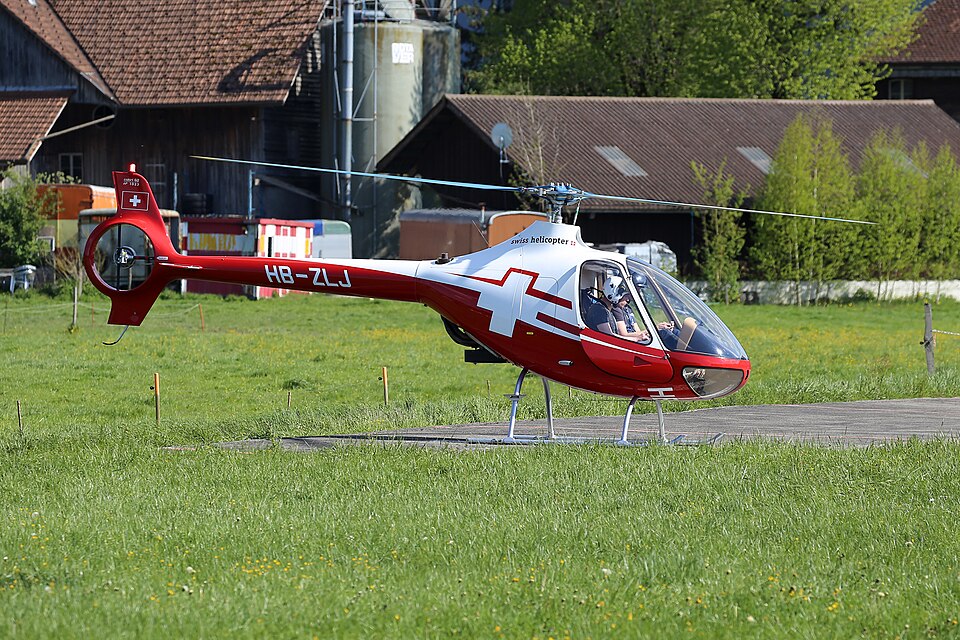
Accident Summary
On 13 July 2013, at approximately 12:25 local time, a Guimbal Cabri G2 helicopter, registered as HB-ZLJ, sustained substantial damage during an emergency landing at Neuhaus, in the municipality of Wichtrach, Canton Bern, Switzerland. The two occupants, a flight instructor and a student pilot, were uninjured.
Sequence of Events
The flight was a training mission that departed from Bern-Belp at 08:50. After completing navigation exercises and practising landings in the Schwarzenegg region, the crew heard a loud bang followed by a smell resembling a cutting disk on metal. The instructor took control and executed an immediate landing. Engine and flight instruments showed normal readings. After shutdown, the instructor inspected the engine compartment but found no anomalies. A mechanic arrived on site and examined the helicopter; he initially suspected a loose strobe light power supply unit, which was secured. After a test flight, an unusual odour was traced to singed coating on the foam air filter. A loose screw on the carburettor preheat flap was tightened. The helicopter then departed for the base. During the climb, the student pilot was controlling the helicopter as it climbed to approximately 4500 ft QNH.
Approximately at 12:10, shortly after takeoff from a landing site near Eriz Bieten, the crew again noticed a strong odour. The instructor decided to return to the previous landing site. During the approach, the cooling system fan disintegrated, causing a sudden engine failure. The instructor performed an emergency landing in a field near Neuhaus. The helicopter sustained substantial damage. No injuries occurred.
Findings
Examination of the helicopter revealed that the cooling system fan had disintegrated in flight. Fragments of the fan were found inside the engine compartment. The investigation determined that the fan failure was due to a combination of inadequate design and a manufacturing defect in the front fan disk. The design did not provide sufficient structural strength, and a manufacturing flaw led to crack initiation and eventual fragmentation.
Probable Cause
The accident was caused by the disintegration of the cooling system fan, which resulted in an engine failure and subsequent emergency landing. The following factors played a direct role in the fan disintegration:
- Inadequate design of the cooling fan.
- Manufacturing defect in the front fan disk.