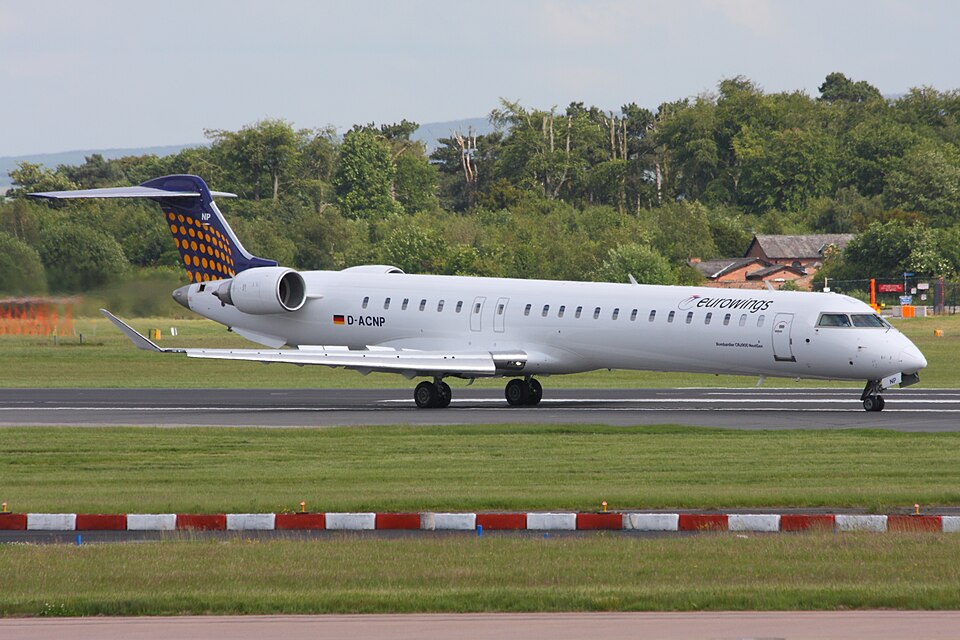
Incident Overview
On the evening of December 10, 2015, a Bombardier CL-600-2D24 (CRJ 900), registered as D-ACNP, operated by Eurowings as flight EWG 30B (commercial flight number EW 1741), was preparing for a scheduled flight from Geneva (LSGG) to Düsseldorf (EDDL). The aircraft carried 44 passengers and 4 crew members.
Sequence of Events
During taxi to the departure runway, the first officer detected an unusual odor on his side of the cockpit. The crew assessed this as a smell that occasionally occurs during aircraft operation and decided to proceed with the flight. Takeoff from runway 23 occurred at 20:02 UTC, followed by a brief south-westerly heading then a turn north into French airspace.
During the climb, the cabin crew also noticed the unusual odor. In the cockpit, the first officer felt increasingly affected by the smell, leading him to don his oxygen mask. At 20:09:27 UTC, flight EWG 30B was transferred from Geneva Area Control Center (ACC) to Reims ACC, at which point the aircraft was at flight level (FL) 170 over the French Jura, still climbing. The climb ended at FL 280 at 20:15 UTC.
After consulting with the cabin crew, the flight crew declared a Pan Pan urgency and initiated a return to Geneva at 20:17 UTC, executing a right turn and descent. Following another right turn, the aircraft was flying southbound under Geneva ACC guidance from 20:21 UTC.
The crew followed air traffic control instructions back to Geneva. During the descent and approach, they discussed the health effects of the odor and possible medical tests. At 20:31 UTC, the captain positioned the aircraft on the extended final approach for the instrument landing system of runway 23. The first officer removed his oxygen mask before landing. The aircraft landed uneventfully at 20:38 UTC, about 36 minutes after takeoff, and was met by fire services. The aircraft was parked at a regular stand; the unusual odor—described by the crew as a "possible oil smell"—was still perceptible in the cockpit. Passengers deplaned via the normal stairs after further discussion.
Odor and Symptoms
During the climb, the first officer experienced increasingly severe headache, throat irritation, dizziness, and difficulty concentrating. He donned his oxygen mask but removed it before landing. He described the odor as unpleasant. Shortly after landing, he still felt slightly dizzy and not fully fit for duty.
Both cabin crew members reported tingling lips and a furry tongue during the flight. They described the odor as unpleasant but noted no visible haze or smoke in the cabin.
The captain also noticed the odor on her side but did not feel impaired and did not use her oxygen mask during the flight.
Most passengers did not perceive the unusual odor.
Immediate post-incident medical assessment was not possible, and later tests could not identify which potentially toxic substances the occupants might have been exposed to.
Communication
After returning to Geneva, the flight crew reported difficulties communicating with firefighting personnel, who spoke only French.
Technical Investigation
On December 11, 2015, troubleshooting was conducted at Geneva airport with the aircraft on the ground. The two air conditioning packs were examined. Engine oil consumption was normal, but an unusual odor was detected around the right pack, which was subsequently taken out of service. Additionally, the air conditioning system controller 1 (ACSC 1) displayed an "internal fault" message, which the manufacturer Bombardier described as a nuisance message. After the ground run, D-ACNP was ferried without passengers to Düsseldorf for further checks; no reports of recurring odor were noted on that ferry flight.
On December 12, 2015, in Düsseldorf, the following work was performed:
- Visual inspection of left and right pack discharge ducts: no signs of oil contamination.
- Visual inspection of both engines and auxiliary power unit: no evidence of oil leaks or surface contamination.
- Inspection of left and right recirculation fan filter cartridges: no oil contamination, but both filters were heavily soiled with dust; cartridges were replaced.
- Replacement of ACSC 1.
- Inspection of right flow control valve: no oil contamination.
- Ground run and tests of propulsion, bleed air, APU, and air conditioning systems: no evidence of unusual odor emission.
No "recirc fan fault" status message was recorded by the Maintenance Diagnostic Computer during the incident flight or in the days before or after.
Conclusions
The investigation concluded that heavy soiling of the recirculation fan filter cartridges was a plausible explanation for the odor, though no definitive cause was established.