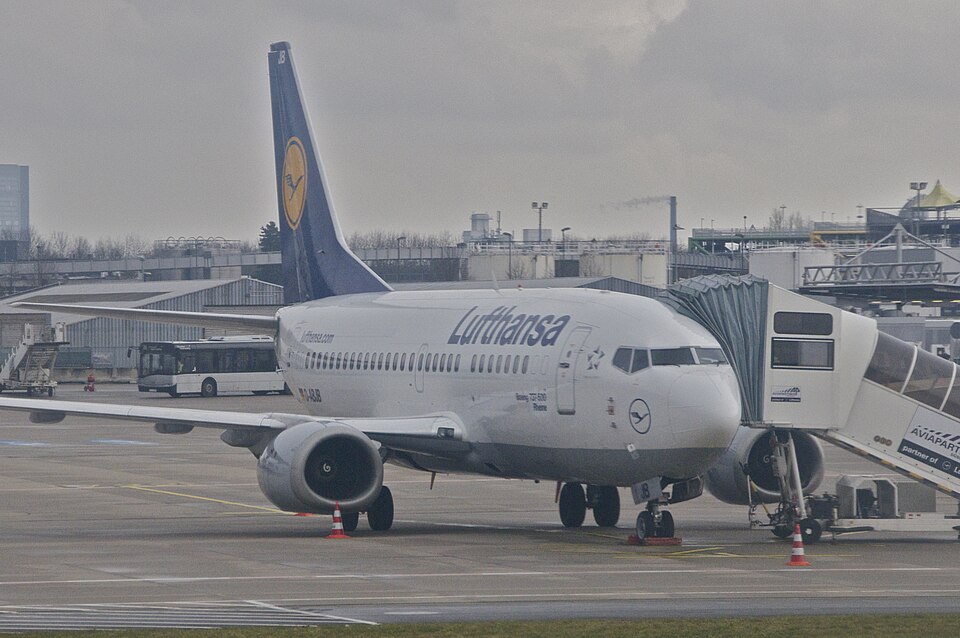
On April 12, 2015, a THE BOEING COMPANY 737-500 (registration D-ABJB) was involved in an aviation accident near Zürich Flughafen (LSZH), ZH, CH. Investigators recorded the probable cause as: Damage in the bearing and seal area of the air cycle machine 1, fed by the left engine, caused oil to leak into the air conditioning system, resulting in oil fumes in the cockpit. This summary draws on records from the Swiss Transportation Safety Investigation Board (STSB / SUST).
On 12 April 2015, a Lufthansa Boeing 737-500 (D-ABJB) diverted to Zurich after crew detected strong engine oil fumes during a ferry flight from Geneva to Frankfurt. The aircraft landed safely with no injuries.
Incident Overview and Aircraft Details On 12 April 2015, a Boeing 737-500 registered D-ABJB, operated by Deutsche Lufthansa AG, was conducting an instrument flight rules (IFR) ferry flight from Geneva Airport (LSGG) to Frankfurt Airport (EDDF). The flight, designated DLH 9921, departed at 09:28 UTC with only the two pilots on board. The aircraft was owned by Lufthansa Leasing Austria GmbH & Co. ## Event Sequence During the initial climb, the crew detected a strong odor of evaporated engine oil. Initially, the pilots suspected the smell might be residual from the right engine replacement performed the previous day. However, as the odor persisted, the crew donned oxygen masks at 09:31 UTC. At 09:39 UTC, the aircraft reached flight level 240, and the crew began the Smoke, Fire and Fumes Checklist. Following the checklist's directive to divert to the nearest suitable airport, the crew decided to divert to Zurich Airport (LSZH). At 09:45:46 UTC, the crew informed air traffic control of the issue, declared an emergency, and requested a divert landing in Zurich. The aircraft was then approximately 3 nautical miles west of the Willisau VOR. Air traffic control cleared the aircraft for descent and vectored it to Zurich. The aircraft landed on runway 14 at 09:58 UTC. Firefighters were on standby, but the crew was able to taxi the aircraft to the stand under its own power. The pilots kept both cockpit windows open and retained their oxygen masks until the engines were shut down, at which point the odor remained noticeable. ## Medical and Technical Investigation Following the arrival in Zurich, the pilots underwent comprehensive medical examinations, which concluded that they were not endangered. On 13 April 2015, a visual inspection of the right engine (engine 2) revealed fresh oil traces on the ground and under the engine cowl. After removing these traces, ground runs of both engines were conducted according to Lufthansa maintenance job cards. During these tests, no odor of evaporated engine oil was detected in the cockpit, and no fresh oil traces were found. The aircraft was then towed to a noise protection hangar for high-power tests. A pneumatic system test was performed, with the air cycle machines fed by the respective engines, simulating cruise conditions. All values remained within limits, and no oil odor was detected. After being released by the Swiss Transportation Safety Investigation Board (STSB), the aircraft was ferried to Frankfurt. ## Findings and Probable Cause In Frankfurt, Lufthansa Technik conducted further tests and successfully reproduced the oil odor, identifying the air cycle machine 1 as the probable emission source. Damage was found in the bearing and seal area, which Lufthansa Technik stated explained the oil leak, noting such damage is not unusual for high operating hours (18,135 hours since the last overhaul). The STSB analysis concluded it is probable that the cockpit fumes were caused by the damaged air cycle machine 1, which is fed by the left engine. The oil traces on the right engine were likely from the previous day's engine change and unrelated to the fumes. The crew's actions were deemed appropriate, and the use of oxygen masks and the decisive diversion prevented self-endangerment.