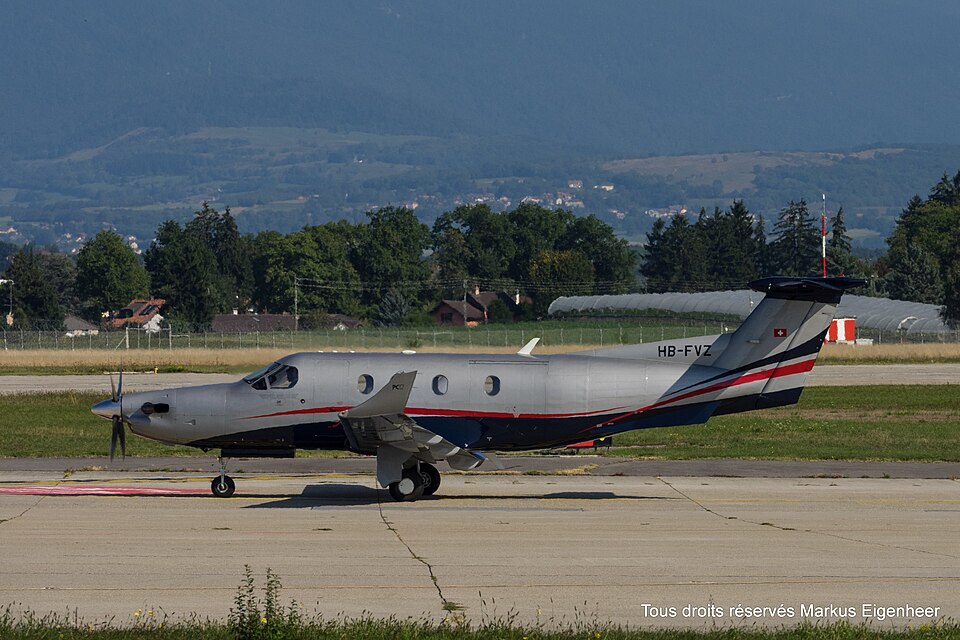
What happened
On June 27, 2007, two Pilatus PC-12/45 aircraft were involved in a serious airprox incident near the KINES waypoint, approximately 80 NM southeast of Geneva. The first aircraft, HB-FVZ, was operating a private IFR flight from Valencia to Geneva. The second aircraft, LX-LAB, was flying a private IFR route from Geneva to Nice.
At 17:12 UTC, the pilot of HB-FVZ received authorization from air traffic control to descend to flight level 220. Although the pilot correctly read back the instruction, they mistakenly set the altitude selector to flight level 200. At the same time, the two aircraft were on converging, opposing tracks, approximately 23 NM apart.
Shortly after, air traffic controllers issued traffic information to both pilots. At 17:14 UTC, the Short Term Conflict Alert (STCA) was triggered on the controller's radar screen as the aircraft were only 4.8 NM apart with a vertical separation of 900 feet. The controller immediately ordered HB-FVZ to turn left to heading 280 degrees and maintain flight level 220. The pilot of LX-LAB was also ordered to turn left to heading 080 degrees, though this instruction was not acknowledged by the pilot.
The two aircraft eventually crossed paths at 17:14 UTC at a horizontal distance of only 1.3 NM and a vertical separation of just 200 ft.
The investigation
The investigation examined the actions of the air traffic controllers, the flight crews, and the aircraft equipment. Investigators reviewed radar tracks, communication transcripts, and meteorological conditions. The investigation confirmed that the air traffic controller had provided correct instructions and that the traffic information provided to the pilots was accurate. The investigation also looked into the functionality of the Traffic Advisory System (TAS) installed on both aircraft.
Findings
- The primary cause of the loss of separation was the unauthorized descent of HB-FVZ to flight level 200, which was 200 feet below the level of the second aircraft.
- The pilot of HB-FVZ attributed the altitude error to a momentary lapse in concentration, describing it as a form of "dyslexia" due to the similar pronunciation of the flight levels.
- The pilot of HB-FVZ failed to notice the discrepancy between the ATC instruction and the altitude selector, a mistake that went undetected due to the lack of a second crew member to cross-check the instruments.
- The pilot of LX-LAB did not acknowledge the controller's turn instruction, continuing on the original course.
- While both aircraft were equipped with TAS, the pilots did not have visual contact with each other due to Instrument Meteorological Conditions (IMC).