History of the Flight
On 12 August 1999, British Airways flight 8412, operated by Maersk Air UK, departed Birmingham at 0825 UTC for a scheduled service to Geneva, Switzerland. During initial climb, cabin crew reported a burning smell without visible signs. The flight crew turned off galley power and switched the right-hand pack to high, after which the smell cleared. Galley power was restored and the pack returned to auto. No further issues were noted until cruise.
At the top of descent (0940 UTC), the copilot, who was flying, reduced speed due to a delayed descent clearance. Immediately, a strong acrid smell reappeared, and smoke began to spread, reducing visibility in the cabin. The flight crew executed memory items for the smoke drill and issued a pan-pan call on Geneva control frequency. They were directed for a direct approach to runway 23. The pilots performed the remainder of the smoke drill, focusing on the air conditioning systems. The smoke slowly dissipated. The commander briefed the purser to prepare for a normal evacuation using the forward airstairs, and the APU was started on final approach to supply power.
After landing, the aircraft stopped on taxiway Charlie. While performing the evacuation checklist, the cockpit crew unintentionally shut down the APU, preventing airstair extension. The commander redirected to deploy evacuation slides. Passengers and crew evacuated via the forward slide; no injuries and no damage to the aircraft occurred.
Personnel Information
The commander held a total of 4150 flight hours, including 1845 on the Boeing 737. The first officer had 7150 total hours, with 1430 on type. The cabin crew consisted of a purser and three attendants.
Aircraft Information
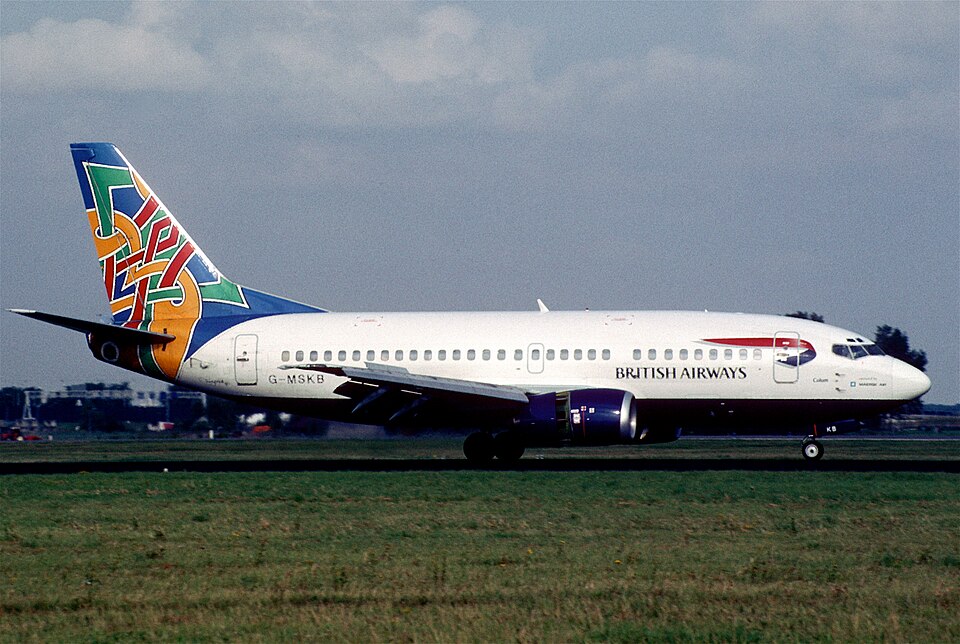
The aircraft was a Boeing 737-500 (registration G-MSKB), serial number 24928, manufactured in 1990. It was operated by Maersk Air UK. At the time of the incident, the airframe had 20,289 hours (16,367 cycles). The right-hand engine (serial 722254) had been replaced on 21 July 1999 and first flew on 31 July, accumulating 46:57 hours until the incident. The night before, the high-pressure bleed valve of the right-hand engine was changed in response to a pilot report about cabin pressure fluctuations during descent. Mass and center of gravity were within limits.
Meteorological and Flight Recorder Information
The aircraft was in VMC day conditions from top of descent to landing. Weather was not significant. The flight data recorder and cockpit voice recorder were installed and working properly.
Tests and Research
Physical search of the aircraft found no traces of fire. Investigation focused on the air conditioning system. By systematic elimination, contamination was traced to the 9th stage high-pressure bleed air manifold of the right-hand engine. This was supported by the fact that contamination began at power reduction, when high-pressure bleed supply cuts in. Boroscopic inspection revealed small black traces of burned oil in the tube connecting the engine housing to the manifold. Changing the right-hand engine resolved the problem.
Conclusions and Findings
The crew held valid licences. The aircraft was properly certified. Oil penetrated the right-hand 9th stage high-pressure bleed air manifold and injected a smoke-like aerosol into the passenger cabin.