Factual Information
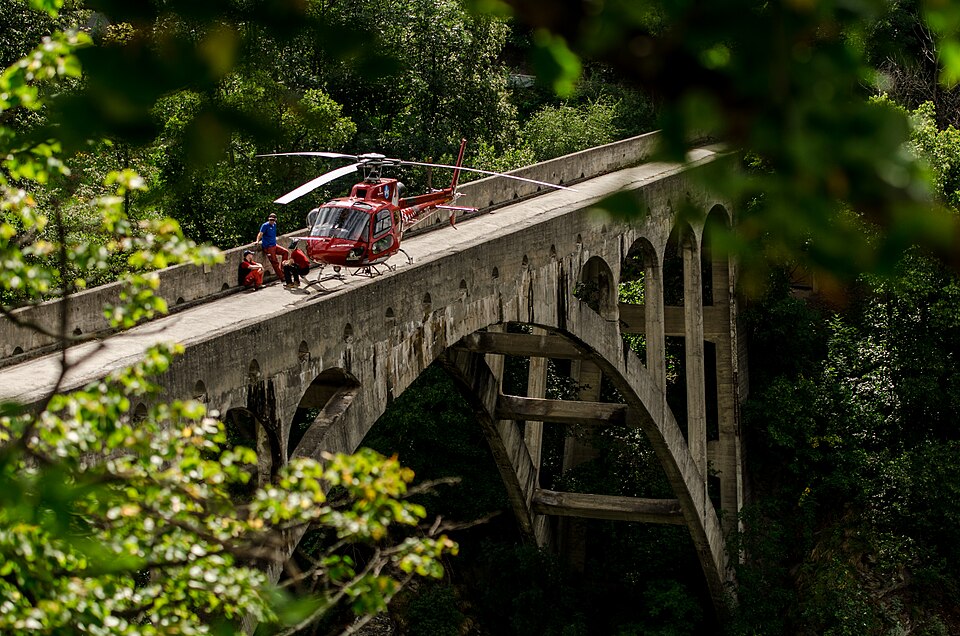
On 29 August 2014, at 11:19 local time, a commercial helicopter flight operated by Air Zermatt AG was underway near Brand, municipality of Eisten, Valais, Switzerland. The helicopter, an AS 350 B3 registered as HB-ZKF, had been tasked with transporting parts of a dismantled walking excavator from a construction site for a pressure pipeline associated with the Siwibach small hydropower plant.
Sequence of Events
Earlier that day, the helicopter crew had completed five missions with about 25 rotations. For the transport of the excavator components, the helicopter had a 24-meter-long cargo sling. At the pickup site – a small terrace at approximately 1700 m elevation on a steep slope – a flight assistant, a mechanic, and the excavator operator were present. The flight assistant, who had been dropped off about 100 m above the site, joined the mechanic and operator at the terrace. The terrace was surrounded by forest, predominantly Swiss stone pines, with a group of five trees at the uphill edge of the terrace. These trees had trunk diameters of 10 to 30 cm and were about 14 m tall.
Before the accident, the helicopter had already transported the excavator's upper structure successfully. For the second lift – the lower structure – the flight assistant attached the sling. As the helicopter lifted the load, the load rotated and scraped the ground on the uphill side. The flight assistant, mechanic, and operator stabilized the load. While the pilot hovered with the load toward a clearing, the mechanic and operator moved away from the danger zone toward Saas-Fee, as they had done previously. The flight assistant moved toward the clearing while keeping the load in sight. As the helicopter gained altitude and departed toward the valley, the flight assistant peripherally noticed the tree group at the upper edge of the terrace beginning to tip over. Simultaneously, he saw the mechanic and operator walking toward him across the terrace. The mechanic stopped in the middle of the terrace to wipe his hands. The flight assistant shouted a warning. Hearing a cracking sound, the mechanic attempted to jump forward but was struck by the falling trees, thrown to the ground, and pinned under a trunk. The flight assistant and operator immediately went to his aid. The mechanic was conscious and suffered severe back injuries.
Damage and Injuries
The helicopter was undamaged. No third-party damage occurred. The mechanic sustained serious injuries. The other two persons on the ground were uninjured.
Meteorological Conditions
The weather conditions were not explicitly described in the source beyond the general situation.
Cause
The accident was caused by the tipping over of a group of trees due to the helicopter's rotor downwash while lifting a load, inflicting serious injuries to a person within the danger zone.