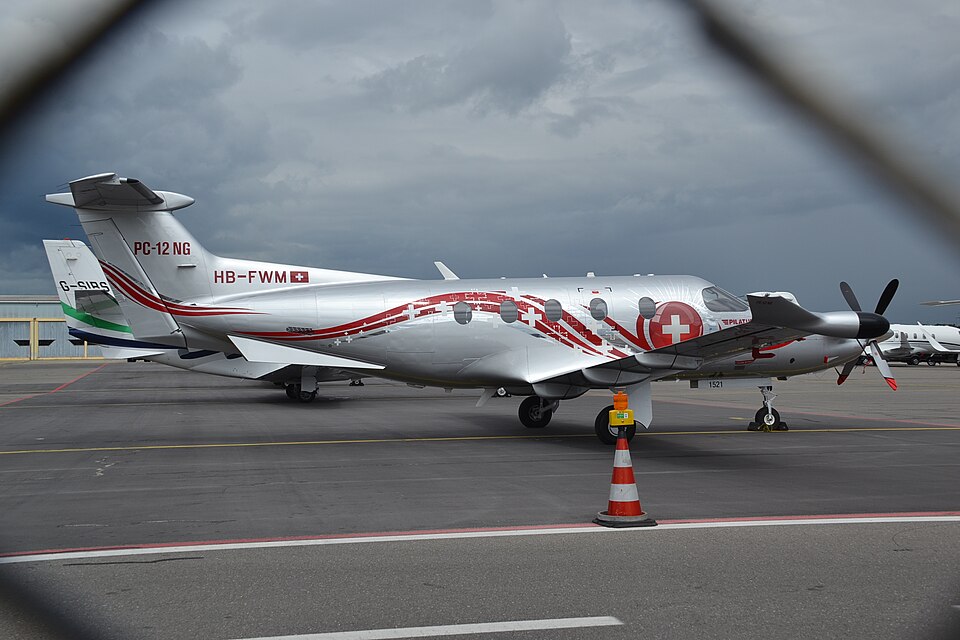
Incident
On 11 April 2016, at 14:28 local time, a Pilatus PC-12/47E, registered as HB-FWM, was involved in a serious incident during landing at St. Gallen-Altenrhein Regional Airport (LSZR). The aircraft had departed from Schwäbisch Hall-Hessental (EDTY), Germany, at 12:43 on a private flight under instrument flight rules. On board were a German private pilot, born 1985, and one passenger.
During the landing with flaps set to 40° on runway 10, the left main wheel tire burst. The aircraft veered left off the runway during the rollout. The pilot managed to steer the aircraft back onto the runway, and it came to a stop approximately 700 meters past the runway threshold. The weather was dry and sunny with a light wind from 270° at 4 knots, temperature 15 °C, and QNH 1010 hPa.
The pilot held a Private Pilot Licence (Aeroplane) issued by the European Union Aviation Safety Agency. He had accumulated 312 total flight hours, with 80 hours on type.
Aircraft and Runway Information
The HB-FWM was equipped with retractable landing gear, a turboprop engine, and a pressurised cabin. The brake system was operated by pressing the upper edges of the rudder pedals with the balls of the feet. No anti-skid system was installed on this aircraft type.
St. Gallen-Altenrhein's hard-surface runway 10 is 1500 m long and 30 m wide, with a displaced threshold of 100 m, resulting in a landing distance available (LDA) of 1400 m. The landing mass of HB-FWM was approximately 7900 lb, and the pilot's handbook indicated a landing distance over a 50 ft obstacle of 555 m and a landing roll of 250 m.
Findings
The aircraft was equipped with a flight data recorder. Data analysis showed that the aircraft touched down smoothly at 73 KIAS about 90 m past the threshold. The touchdown phase lasted about 3 seconds over 200 m, ending at 68 KIAS. Over the next 9 seconds, speed decreased by 28 knots to 40 KIAS over 290 m. Then, the aircraft began to veer left, and the left main wheel left the runway at 20 KIAS, 110 m later. The pilot then maneuvered back onto the runway, coming to a stop just past the halfway point.
Brake marks from the left wheel were visible from the touchdown point to where the wheel left the runway. The right wheel's brake marks were discontinuous. The pilot could not recall his foot position on the pedals and could not exclude unintentional brake application during and after touchdown.
Damage assessment found the left tire burst, the right tire had abrasions, and a dent on the trailing edge of the left flap. The aircraft was recovered by fitting a replacement wheel and then flown to Buochs (LSZC) for flap replacement. On 15 April 2016, the pilot completed a flight with an experienced PC-12 pilot to practice landing technique and brake usage.
Conclusions
The investigation found no evidence of pre-existing technical defects that could have caused or influenced the serious incident. The incident was attributed to operational reasons. Analysis indicated that during touchdown, the wheel brakes were likely lightly applied, causing the tires to scrub unnoticed until the left tire burst, leading to the veer-off.