What happened
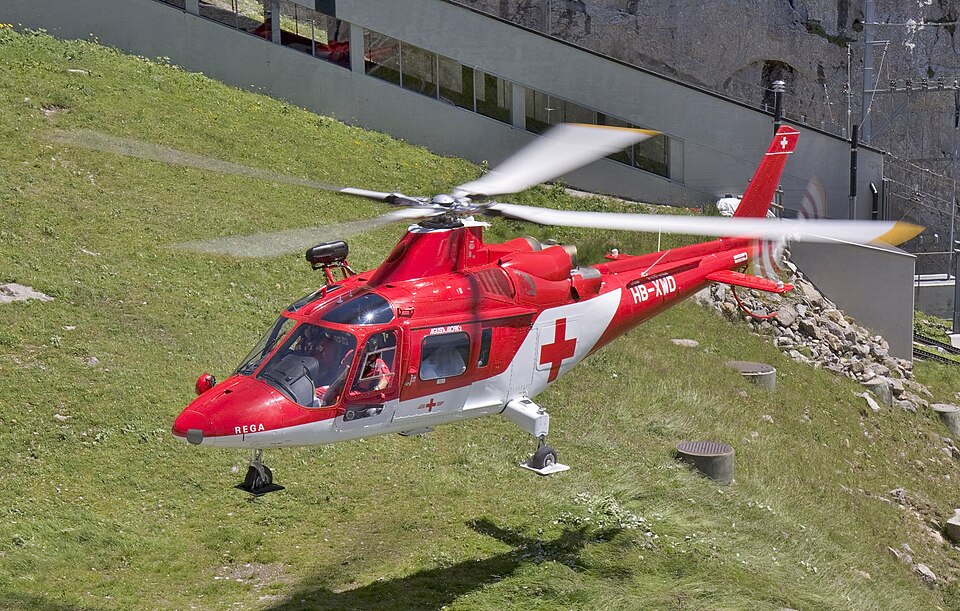
On the morning of June 27, 1996, at approximately 05:11 local time, an Agusta A-109K2 helicopter with registration HB-XWD was involved in a serious incident during a medical evacuation mission near Fribourg, Switzerland. The aircraft, operated by Swiss Air Ambulance Ltd., had been dispatched to assist in the rescue of a young woman who had fallen from a 25-meter cliff onto the shores of the artificial Pérolles Lake.
The initial response involved cantonal police and ambulance personnel, but due to the severity of the victim's injuries and the difficult terrain preventing stretcher access, air evacuation was deemed necessary. The Rega emergency coordination center alerted the helicopter crew based in Lausanne at 04:40. The aircraft took off at 04:50 for what would be its second mission that night.
Upon arrival at the scene, the pilot identified overhead power lines near the accident site but decided to proceed with a hoist operation rather than landing, as the victim required immediate medical attention from a doctor on board. The hoist began with the helicopter nose pointed west. As the doctor descended toward the injured girl in the dim light of dawn, the main rotor downwash affected nearby trees, causing the flight assistant to lose visual contact with the medical personnel.
The crew paused the operation to reposition. During this maneuver, the pilot moved the helicopter right and rearward to pick up the doctor at cabin height. In the process, the pilot forgot about the previously identified power line. The flight assistant spotted the cable and shouted "stop," but the pilot had already initiated a forward pitch movement. At this moment, the tail rotor struck and severed the 17 kV electrical line, which was only 9.4 meters above the water surface. Feeling strong vibrations through the pedals, the pilot immediately landed the aircraft on a small peninsula he had identified earlier.
The investigation
The Swiss Transportation Safety Investigation Board (SUST) examined the circumstances surrounding the collision. Key factual findings included:
- The pilot held a valid professional helicopter license and had 2,719 total flight hours, including 221 hours of night flying experience.
- The aircraft was airworthy and within weight and balance limits.
- The power line in question was not depicted on the 1:100,000 scale obstacle chart, as only cables higher than 25 meters were required to be marked.
- The rescue operation was conducted without night vision goggles or auxiliary lighting, relying on natural dawn light and a flashlight used by ground personnel.
- Neither the pilot nor the flight assistant showed signs of health impairment affecting their performance.
The investigation noted that while police suggested landing for a better visual reconnaissance, the urgency of the victim's condition drove the decision to hoist immediately. The low light conditions, combined with the intense concentration required for a night-like hoist operation near trees and water, contributed to the situational awareness lapse.
Findings
The primary cause of the accident was the collision of the tail rotor with an electrical power line. Although the existence of the line was known to the crew prior to the operation, its presence was forgotten during the complex maneuvering required for the rescue. The difficult operational environment—characterized by low light, proximity to obstacles, and the high cognitive load of a medical hoist—led to this critical oversight.
Safety action
The investigation highlighted that the power line was not charted because it fell below the 25-meter threshold for mandatory obstacle reporting on standard aeronautical charts. This gap in obstacle data may pose risks for low-altitude operations in similar terrain. No specific safety recommendations were issued in this final report beyond the factual findings of the causal chain.