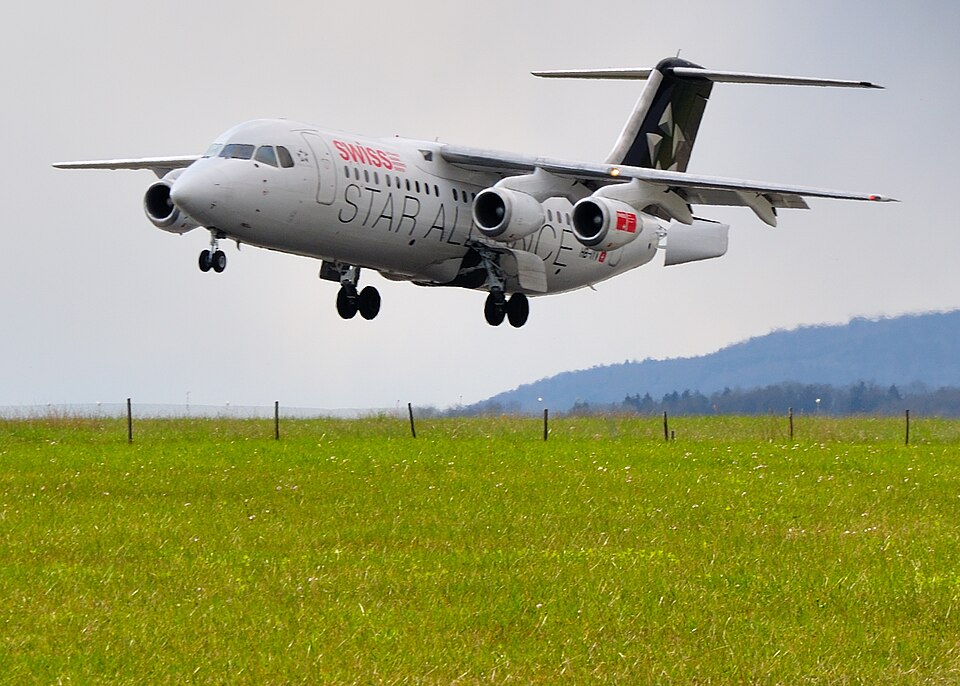
Incident Overview
On 12 July 2016 at approximately 10:35 UTC, a serious incident (Airprox) occurred 4 NM southwest of Zurich Airport (LSZH) involving two commercial aircraft: an Avro 146-RJ100 (registration HB-IYV) operated by Swiss Global Air Lines AG and an Airbus A321-111 (registration HB-IOH) operated by Swiss International Air Lines Ltd. The closest proximity between the two aircraft was 2.9 NM horizontally and 550 ft vertically, which fell below the required minimum separation of 3 NM horizontally or 1000 ft vertically. The Airprox was classified as ICAO Category B.
Sequence of Events
The Avro 146-RJ100, operating under flight number SWR 203L, departed from runway 28 at 10:29:39 UTC and followed the standard instrument departure (SID) DEGES2W. The Airbus A321, operating as SWR 212Z, departed from runway 16 approximately one minute later and followed the SID VEBIT 3S.
After initial contact with departure control, the SWR 203L crew was instructed at 10:32:11 UTC to proceed directly to the waypoint DEGES after passing 5000 ft QNH. The crew maintained a speed of 10 kt above V2 (minimum take-off safety speed) during the initial climb, anticipating a left turn or a heading instruction toward the southwest. The first officer was the pilot flying, and the flight guidance system was in LNAV mode.
At around 10:33:15 UTC, upon reaching 5000 ft QNH, the pilot flying instructed the pilot monitoring to sequence the direct-to-DEGES route in the flight management system. The standby track line to DEGES appeared on the navigation display.
Meanwhile, the SWR 212Z crew was instructed at 10:33:28 UTC to turn to a heading of 260 degrees to facilitate uninterrupted climb. After passing 5000 ft, the SWR 203L pilot flying began accelerating to 210 kt to retract flaps and directed the after-takeoff checks. The departure controller observed on radar that SWR 203L had taken a more northerly course than intended after its left turn.
At 10:34:40 UTC, the short-term conflict alert (STCA) activated. The controller immediately instructed SWR 203L to turn right to a heading of 100 degrees. At about the same time, the traffic alert and collision avoidance system (TCAS) on both aircraft issued traffic advisories. The closest point of approach occurred at 10:34:58 UTC, with 2.9 NM horizontal and 550 ft vertical separation. Both aircraft continued to their destinations without further incident.
Background
The design of the two SIDs (DEGES 2W and VEBIT 3S) does not guarantee horizontal separation of at least 3 NM southwest of Kloten VOR. The controller regularly intervenes to manage departures from runways 16 and 28, typically issuing direct-to instructions beyond 5000 ft or heading changes to maintain separation. A review of eastbound departures from runway 28 on the day of the incident revealed lateral dispersion of up to 5 NM. Between 1 January 2014 and the date of this Airprox, approximately 35 separation minima incidents were recorded on runway 28 SIDs, of which about 90% involved the DEGES 2W departure and about 20% involved Avro 146-RJ100 aircraft with low climb performance.
Meteorological Conditions
At the time of the incident, a trough extended from Iceland to the Pyrenees, with a waving cold front over central Europe. Zurich Airport and its vicinity were under the influence of the frontal zone. Dense cirrus clouds obscured lower cloud layers. The aircraft were mostly in clouds between 5700 and 6300 ft AMSL. Moderate rain showers were present. Cloud cover at Zurich Airport: 1/8 to 2/8 at 600 ft, 3/8 to 4/8 at 1800 ft, and 5/8 to 7/8 at 5500 ft above aerodrome elevation. Visibility varied in clouds. Wind at 6000 ft was 270 degrees at 15 kt. Temperature and dew point were both 10 °C, with QNH 1016 hPa.
Conclusions
The crew of SWR 203L maintained climb speed in anticipation of an early left turn from 5000 ft QNH, which was a commonly applied practice. The design of the SIDs and the need for regular controller intervention were noted as contributing factors to the occurrence of conflicting traffic situations. The investigation did not specify a probable cause for the Airprox.