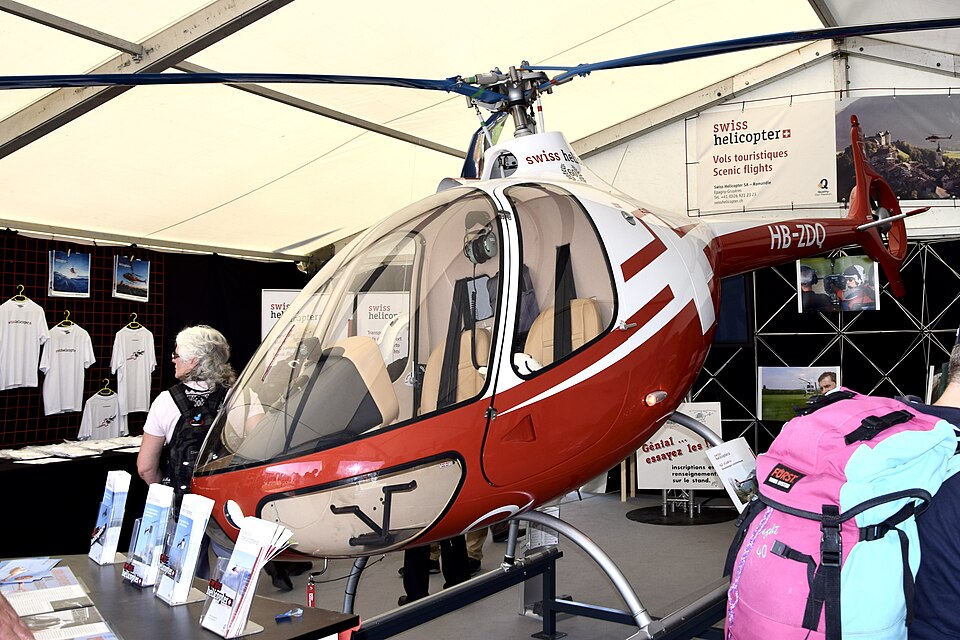
Incident Overview
On 1 July 2020, at 10:20 local time, a Guimbal Cabri G2 helicopter, registration HB-ZDQ, operated by Swiss Helicopter, experienced a canopy burst during a training flight in the vicinity of Vaulruz, Switzerland. The flight was conducted under visual flight rules (VFR) as a local training sortie from Gruyères Aerodrome (LSGT). The aircraft was occupied by a student pilot (born 1999, no license, 2:26 hours total flight time) and an instructor (CPL(H) holder, 3701:56 hours total, 1234:42 hours on type). Both occupants sustained slight injuries to the face, hands, and legs.
Sequence of Events
The student pilot took off at 09:35 with both doors left ajar and secured by strings. After approximately 45 minutes of flight, the instructor initiated a high-speed descent from 5500 ft AMSL towards Bulle to demonstrate the helicopter's behavior near its never-exceed speed (Vne) of 119 kt at 5500 ft pressure altitude. At an indicated speed of 110 kt, the plexiglass canopy suddenly burst. Debris entered the cockpit, tearing off the headsets and glasses of both crew members. One headset remained connected to the aircraft via its cable, but both pairs of glasses were lost. The instructor reduced speed, put on a spare pair of glasses from his pocket, and decided to land as soon as possible. The helicopter landed at 10:25 near the Colombettes – Vuadens football field. The deflagration from the canopy rupture triggered the emergency locator transmitter.
Findings
The canopy was a single-piece plexiglass component with a thickness of 2 mm, bonded and fixed to the fuselage only around its perimeter. It was designed to withstand aerodynamic loads, particularly at high speeds. On the incident aircraft, a suction cup mount was attached to the canopy, intended for mounting a camera. Such installations are not approved by the manufacturer and can introduce additional stresses, weakening the canopy. Neither pilot was wearing a helmet with a visor. The injuries were superficial and did not impair the instructor's vision.
Conclusion and Probable Cause
The serious incident was due to the canopy bursting during flight near Vne. The installation of a camera mount system contributed to the unexpected rupture. The helicopter manufacturer issued Service Letter SL 20-001 A prohibiting the use of suction cup mounts on the canopy. Airbus Helicopters also issued safety promotion notice No. 3587-P-00 recommending systematic helmet use. The Swiss Transportation Safety Investigation Board concluded the investigation with this summary report.