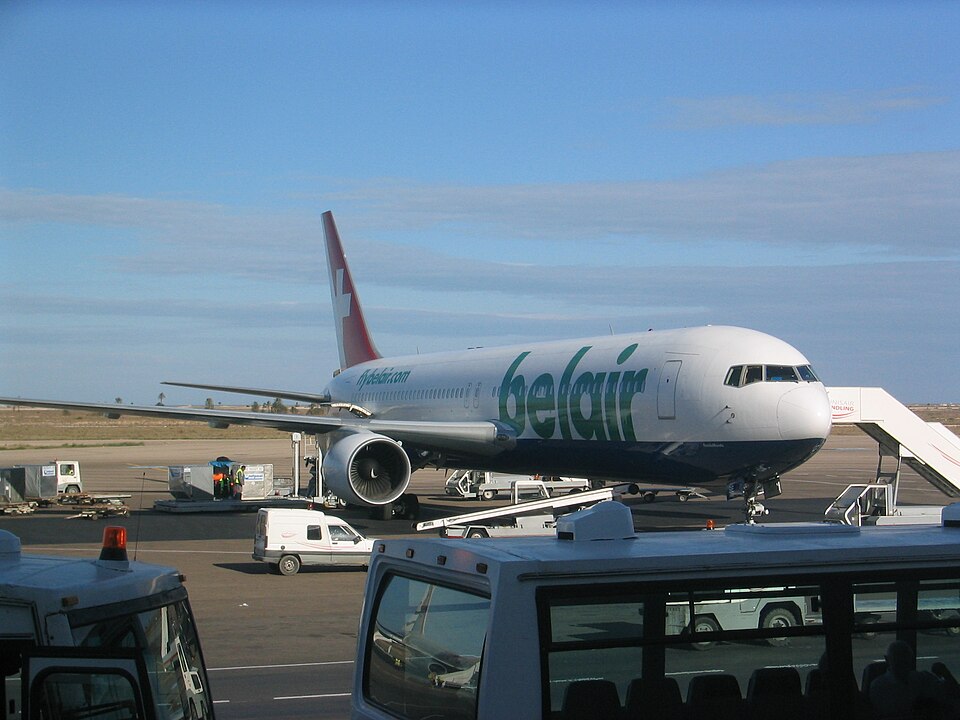
Fuel constraints led to unauthorized CAT I approach at Zurich Airport

Casualties unknown • Zürich Flughafen (LSZH), ZH, CH

A Belair Airlines Boeing 767 performed a landing under low visibility procedures despite weather conditions not meeting required minimums, following ground technical failures.

What happened

On 21 February 2006, a Belair Airlines Boeing 767-300, registration HB-ISE, arrived at Zurich Airport from Cancun, Mexico. While holding in the GIPOL pattern, the crew faced a complex operational environment due to recent ground technical issues. Although the aircraft was capable of CAT III approaches, the airport's operational capability had been compromised.

During the holding period, a failure in the display of wind and Runway Visual Range (RVR) data occurred on air traffic control screens. This technical malfunction necessitated the downgrading of runway 16 to CAT I operations. Facing limited fuel reserves and a desire to avoid diverting to the alternate airport in Basel, the crew decided to proceed with an approach. Despite the weather conditions not being suitable for a CAT I approach, the crew requested and executed a landing on runway 16.

The investigation

The investigation focused on why the crew proceeded with an approach that did not meet the required visibility minimums. Investigators examined the airport's electrical infrastructure, discovering that a previous short circuit on 18 February had caused issues with the emergency power supply. Specifically, a failure to correctly connect data transfer devices to uninterruptible power supply (UPS) sockets meant that when power was interrupted, the RVR and wind data displays failed for approximately 40 minutes.

Furthermore, the investigation looked into the communication of runway status. It was established that while runway 16 had been downgraded, the crew was unaware that runway 14 had also been restricted to CAT I due to the same technical issues. This lack of information meant the crew's decision-making regarding the 'commitment to proceed' was based on an inaccurate assumption of available runway capabilities.

Findings

  • Technical failures on the ground, caused by improper power supply connections to meteorological data transfer devices, led to the loss of RVR and wind data visibility on controller screens.
  • The flight crew performed an approach and landing under low visibility procedures despite the weather not meeting the requirements for the downgraded CAT I status of runway 16.
  • The crew was not informed via ATIS or radio that runway 14 had also been downgraded to CAT I.
  • The crew's decision to continue the approach was driven by the need to manage remaining fuel levels and avoid an immediate diversion.

Probable cause

The incident was caused by ground-based technical failures that prevented a landing under the required visibility minimums, combined with a lack of communication regarding the downgraded status of runway 14, which led the crew to attempt a landing under inadequate weather conditions due to fuel constraints.

Frequently asked questions

What happened in the 2006-02-20 THE BOEING COMPANY 767-3Q8 accident near Zürich Flughafen (LSZH), ZH, CH?

A Belair Airlines Boeing 767 performed a landing under low visibility procedures despite weather conditions not meeting required minimums, following ground technical failures.

What aircraft was involved and where did it happen?

The accident on 2006-02-20 involved a THE BOEING COMPANY 767-3Q8, registration HB-ISE, at Zürich Flughafen (LSZH), ZH, CH.

What was the probable cause of the accident?

The incident was caused by ground-based technical failures that prevented a landing under the required visibility minimums, combined with a lack of communication regarding the downgraded status of runway 14, which led the crew to attempt a landing under inadequate weather conditions due to fuel constraints.

Investigation report by the Swiss Transportation Safety Investigation Board (STSB / SUST). Original record: https://www.sust.admin.ch/inhalte/AV-berichte/1953_e.pdf. This page is a structured re-presentation; facts and quotes are in the Swiss Transportation Safety Investigation Board (STSB), Switzerland.

Loading the flight search…

What you can do on Flight Finder

  • Search flights between any two airports with live fares.
  • By aircraft — pick a plane model (e.g. Boeing 787, Airbus A350) and see every route it flies from your origin.
  • Route map — click any airport worldwide to explore its destinations, or draw a radius to find nearby airports.
  • Global aviation safety — aviation accident database, 40,000+ records since 1980, with map and rankings by aircraft and operator.
  • NTSB safety feed — recent U.S. aviation accidents and incidents from the official NTSB CAROL database, updated daily.