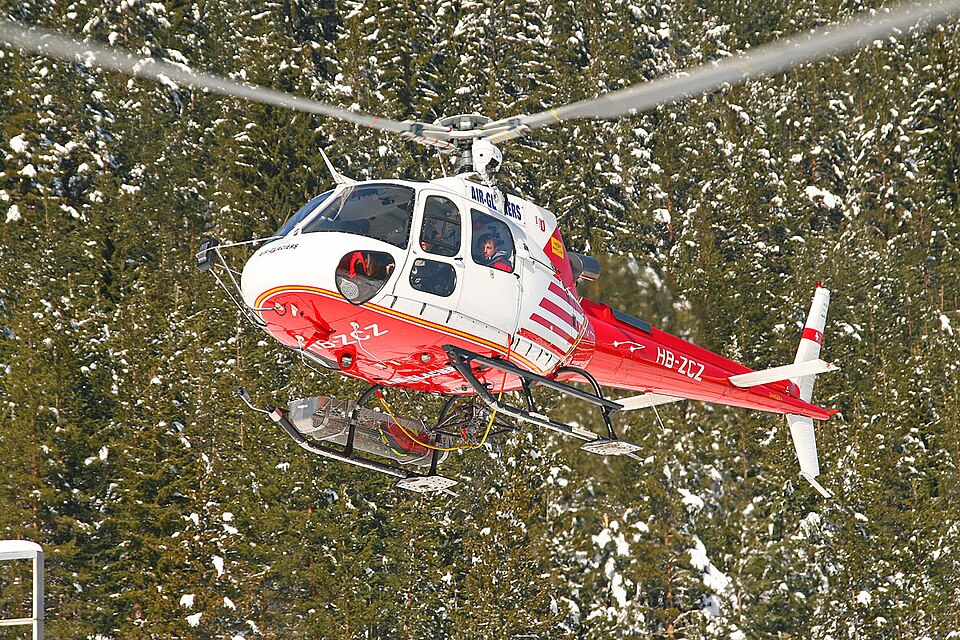
On March 11, 2019, an EUROCOPTER AS 350 B3 (registration HB-ZCZ) was involved in an aviation accident near Barrage de Tseuzier, VS, CH. This summary draws on records from the Swiss Transportation Safety Investigation Board (STSB / SUST).
On 11 March 2019, an AS 350 B3 helicopter (HB-ZCZ) operated by Air-Glaciers SA struck a power line during approach to Tseuzier Dam. The aircraft landed safely, with minor damage to a rotor blade.
Incident Overview and Aircraft Details On 11 March 2019, at 09:57 local time, an AS 350 B3 helicopter, registration HB-ZCZ, operated by Air-Glaciers SA, struck a power line during a commercial visual flight rules (VFR) approach to Tseuzier Dam, located 5 km northwest of Crans-Montana, Switzerland. The aircraft was owned by Air-Glaciers SA and departed from Sion Airport (LSGS). The pilot, a Swiss citizen born in 1955, held a Commercial Pilot Licence (Helicopter) issued by the Federal Office of Civil Aviation (OFAC) under EASA regulations. The pilot had 15,140 total flight hours, including 4,036 hours on the AS 350 B3 type. ## Operational Context and Approach The flight was a routine commercial mission to transport three workers to the dam for monthly inspection work. After takeoff from Sion, reduced visibility conditions forced the pilot to initiate an approach from the left bank of the dam. The pilot had previously landed at Tseuzier Dam approximately 50 times, including once in the preceding 90 days, but this was the first time using the left-bank approach. The pilot intended to overfly a known power line and then complete the final approach along the dam wall. However, the pilot was surprised by the line's position, estimating it to be further north and lower in the valley than its actual location. ## Impact and Aftermath The helicopter struck the power line, but the pilot reported no vibration or engine parameter exceedances. The approach was continued, and the aircraft landed without incident on the designated landing zone. Due to deteriorating weather, the pilot did not perform a full engine shutdown, only idling the engines. After a five-minute return flight to base, damage was discovered on the leading edge of one main rotor blade. No other parts of the helicopter were affected. All three crew members and three passengers were uninjured. ## Contributing Factors and Obstacle Data The approach was conducted in accordance with the operator's Operations Manual, which permits direct approaches when surroundings are reasonably clear and familiar, and ground speed is sufficiently slow. The helicopter was equipped with a Wire Strike Protection System (WSPS) and a Flarm obstacle alert system. The obstacle alert was active but was only audible in the cabin, not through the pilot's headset. The power line in question was registered in the Swiss obstacle database with a maximum height of 100 m above ground and a total length of 200 m. However, the database recorded the line's position with an offset of approximately 20 to 50 meters from its actual location. The line was unmarked and nearly invisible to the naked eye. ## Weather Conditions At the time of the incident, the sky was overcast with light snow showers moving from the west toward the Rhône Valley. Cloud base was diffuse and continuously lowering, with visibility below 1,000 m. Wind was variable at 4 to 9 kt, temperature and dew point were both -5 °C, and QNH was 1,022 hPa. Conditions were transitioning from visual meteorological conditions (VMC) to instrument meteorological conditions (IMC). ## Safety Lessons The investigation, conducted as a summary report under Article 46 of the Swiss Safety Investigation Ordinance, aimed to draw lessons from the incident. Key factors included the pilot's misjudgment of the power line's position, the inaccuracy of the obstacle database, and the lack of audible obstacle alerts in the pilot's headset. The report also noted the limitations of current LIDAR-based obstacle detection systems for light helicopters, citing high cost, weight, and physical constraints, while highlighting emerging electromagnetic field-based detection technologies as a potential future solution.