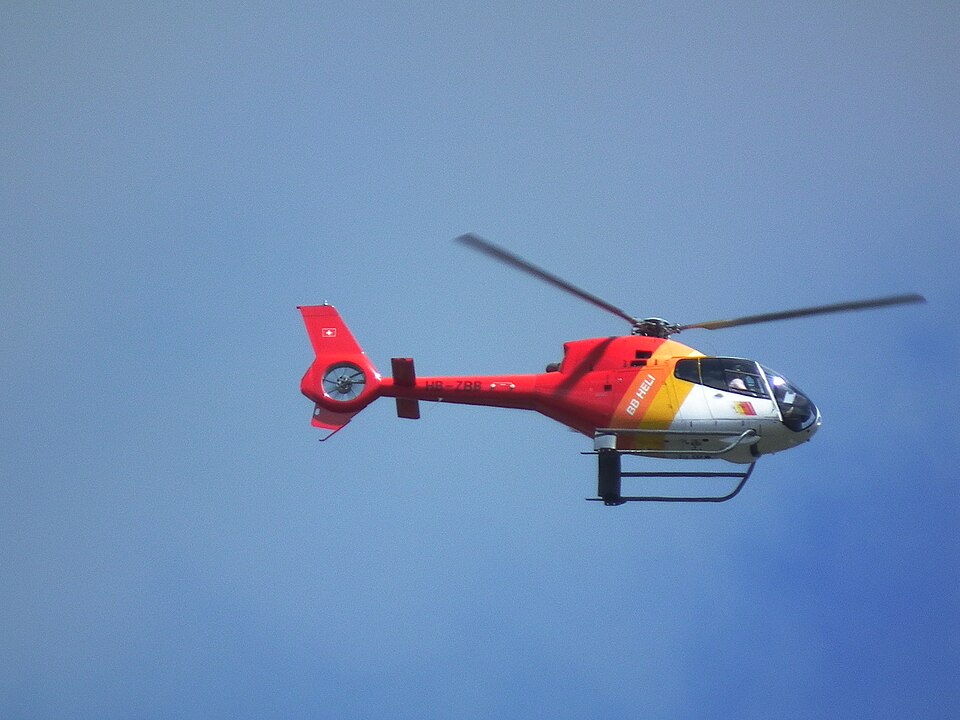
Near-collision of two helicopters near Mollis airfield

Casualties unknown • 3 NM südwestlich des Flugplatzes Mollis (LSMF), GL, CH

An investigation into a near-collision between two helicopters near Mollis revealed that late visual detection and limited collision warning range were primary causes.

What happened

On June 21, 2013, a near-collision occurred approximately 3 nautical miles southwest of Mollis airfield. The incident involved an Eurocopter EC 120B, registration HB-ZBB, operated by BB Heli AG, and an AgustaWest and Westland AW109SP, registration HB-ZRY, operated by Schweizerische Luft-Ambulanz AG.

The crew of the HB-ZBB was conducting a training flight and had decided to land at Vorauen. As they descended and turned toward Klöntal, they were focused on approach preparations. Simultaneously, the HB-ZRY was performing a long-line training maneuver, lifting a 160-meter line with a sandbag weight.

While the crew of the HB-ZRY initially spotted the other aircraft, the pilot of the HB-ZBB did not immediately see the approaching helicopter. The collision warning system (Flarm) in the HB-ZBB eventually triggered an alarm when the distance dropped to approximately 0.1 km. The crew of the HB-ZBB observed the other helicopter and its long-line directly ahead and performed an abrupt right-hand evasive maneuver. The two aircraft passed each other with a horizontal separation of between 10 and 30 meters and a vertical separation of 5 to 20 meters.

The investigation

SUST examined the flight recorders, communication logs, and the technical functionality of the onboard equipment. The investigation looked into the visibility of the aircraft, the effectiveness of the traffic advisory systems, and the operational procedures of both operators.

Investigators analyzed the performance of the collision warning devices, specifically the Flarm on the HB-ZBB and the Floice/Traffic Advisory System (TAS) on the HB-ZRY. The investigation also reviewed the radio communications and the choice of the training location and takeoff site.

Findings

The near-collision was caused by the late visual detection of the second helicopter by the crew of the HB- ZBB, compounded by the insufficient receiving range of the Flarm collision warning device in the HB-ZBB.

Several contributing factors were identified:

  • The selection of a training site that required the HB-ZRY to repeatedly cross the valley.
  • Reduced airspace monitoring capabilities for the HB-ZRY pilot due to the complexities of flying with a long-line load.
  • Difficulties in mutual visual recognition due to a fixed bearing.
  • A temporary reduction in airspace monitoring by the HB-ZBB crew while performing approach checklists.

Additional risk factors included the lack of blind transmissions on the Mollis airfield frequency by the HB-ZBB crew and the choice of a takeoff site for the HB-ZRY that offered limited visibility toward the main valley. While the TAS on the HB-ZRY failed to provide a warning, investigators found no specific technical defects, noting instead that such systems can have directional limitations during approaches from certain angles.

Probable cause

The near-collision resulted from the crew of the first helicopter failing to detect the second aircraft in time, a situation exacerbated by the limited detection range of the onboard collision warning system.

Frequently asked questions

What happened in the 2013-06-21 EUROCOPTER EC 120 B accident near 3 NM südwestlich des Flugplatzes Mollis (LSMF), GL, CH?

An investigation into a near-collision between two helicopters near Mollis revealed that late visual detection and limited collision warning range were primary causes.

What aircraft was involved and where did it happen?

The accident on 2013-06-21 involved a EUROCOPTER EC 120 B, registration HB-ZBB, at 3 NM südwestlich des Flugplatzes Mollis (LSMF), GL, CH.

What was the probable cause of the accident?

The near-collision resulted from the crew of the first helicopter failing to detect the second aircraft in time, a situation exacerbated by the limited detection range of the onboard collision warning system.

Investigation report by the Swiss Transportation Safety Investigation Board (STSB / SUST). Original record: https://www.sust.admin.ch/inhalte/AV-berichte/2233_d.pdf. This page is a structured re-presentation; facts and quotes are in the Swiss Transportation Safety Investigation Board (STSB), Switzerland.

Loading the flight search…

What you can do on Flight Finder

  • Search flights between any two airports with live fares.
  • By aircraft — pick a plane model (e.g. Boeing 787, Airbus A350) and see every route it flies from your origin.
  • Route map — click any airport worldwide to explore its destinations, or draw a radius to find nearby airports.
  • Global aviation safety — aviation accident database, 40,000+ records since 1980, with map and rankings by aircraft and operator.
  • NTSB safety feed — recent U.S. aviation accidents and incidents from the official NTSB CAROL database, updated daily.