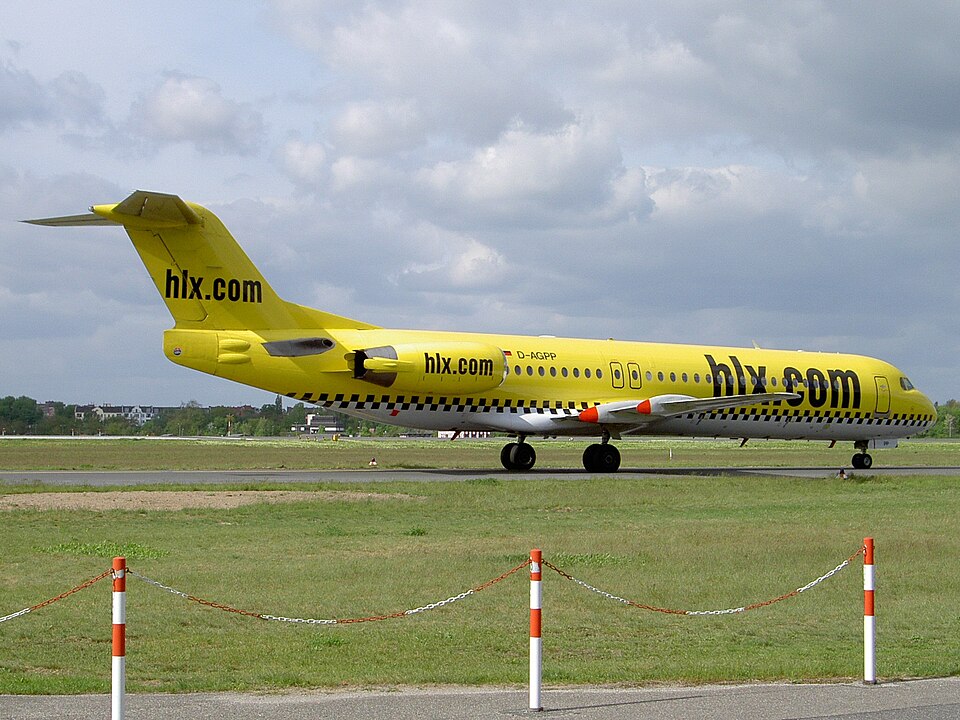
On June 16, 2006, a FOKKER F100 (registration D-AGPP) was involved in an aviation accident near 10 NM East of KLO/DVOR, CH. This summary draws on records from the Swiss Transportation Safety Investigation Board (STSB / SUST).
On 17 June 2006, a serious airprox occurred near Zurich between Air Berlin flight BER 1315 (Boeing 737-86J, D-ABAP) and Hapag-Lloyd Express flight HLX 3680 (Fokker 100, D-AGPP).
Incident Overview On 17 June 2006, a serious airprox occurred approximately 10 nautical miles east of KLO/DVOR near Zurich. The incident involved Air Berlin flight BER 1315, a Boeing 737-86J registered D-ABAP, and Hapag-Lloyd Express flight HLX 3680, a Fokker 100 registered D-AGPP. ## Flight Details BER 1315 was operating a scheduled IFR flight from Tenerife Sur/Reina Sofia (GCTS) to Nuremberg (EDDN). HLX 3680 was operating a scheduled IFR flight for Hapag-Lloyd Express from Cologne/Bonn (EDDK) to Genoa/Sestri (LIMJ). ## Sequence of Events At 10:10:32 UTC, the HLX 3680 crew contacted Zurich Sector Upper U. The controller instructed the aircraft to fly to FL 250 via the TRA navaid to waypoint ODINA. The crew stated they had selected FL 250 as their cruising level for operational reasons, despite a flight plan request for FL 310. At 10:14:17 UTC, the BER 1315 crew contacted the same controller, reporting a descent to FL 290 while passing FL 300. The aircraft was on route BERSU KUDES ROMIR and was required to be handed over to Langen Radar at FL 220. The controller instructed HLX 3680 to climb to FL 280, but corrected this to a heading instruction of 175°. One minute later, HLX 3680 was cleared direct to Saronno (SRN VOR/DME) in own navigation. At 10:17:13 UTC, the controller instructed BER 1315 to descend to FL 250 at a rate of 2,000 ft/min or more. At 10:18:59 UTC, as BER 1315 passed FL 258, the controller instructed the crew to change to Sector East frequency 133.900 MHz. The aircraft was approximately 16 nautical miles from the crossing point with HLX 3680. At 10:19:48 UTC, nearly simultaneously with a short-term conflict alert (STCA), the controller provided traffic information to HLX 3680: “Excellence three six eight zero traffic information, at your one o’clock is äh… range five miles descending through your level.” The HLX 3680 crew responded: “ja, we just had a resolution advisory climbing, Excellence three six eight zero.” The aircraft subsequently climbed to FL 254 according to radar records. After contacting Radar Executive Lower Sector East (RE-E), the BER 1315 crew received clearance to continue descending to FL 220. The crew reported that the airborne collision avoidance system (ACAS) generated a resolution advisory (RA) while the first officer was repeating the descent instruction. At 10:19:45 UTC, the crew reported: “Air Berlin one three one five TCAS descent.” Fourteen seconds later, BER 1315 crossed the flight path of HLX 3680, passing FL 238 in descent while HLX 3680 was climbing to FL 253 due to ACAS instructions. ## Contributing Factors The second air traffic controller in Sector Upper U, serving as Radar Planner (RP-U), stated he did not hear the instruction for BER 1315 to descend to FL 250 or the handover to Sector East because he was occupied with coordination tasks. He noted that the STCA alarm first alerted him to the potential conflict. The controller stated that shortly before the STCA alarm, he realized the two aircraft were on conflicting courses. The controller had been significantly occupied with ensuring minimum separation between BER 1315 and another climbing Boeing 737. During the 95 seconds between issuing the descent clearance to BER 1315 and the handover to Sector East, 14 radio transmissions occurred on the Sector Upper U frequency. This concentration of communications may have caused the controller to temporarily lose focus on HLX 3680. The controller’s control strip for HLX 3680 showed a requested cruising level of FL 310. The controller intended to climb the aircraft to FL 280 but recognized during the transmission that FL 250 had been coordinated with Milan for this aircraft. A climb above FL 250 would have avoided the separation problem with BER 1315.