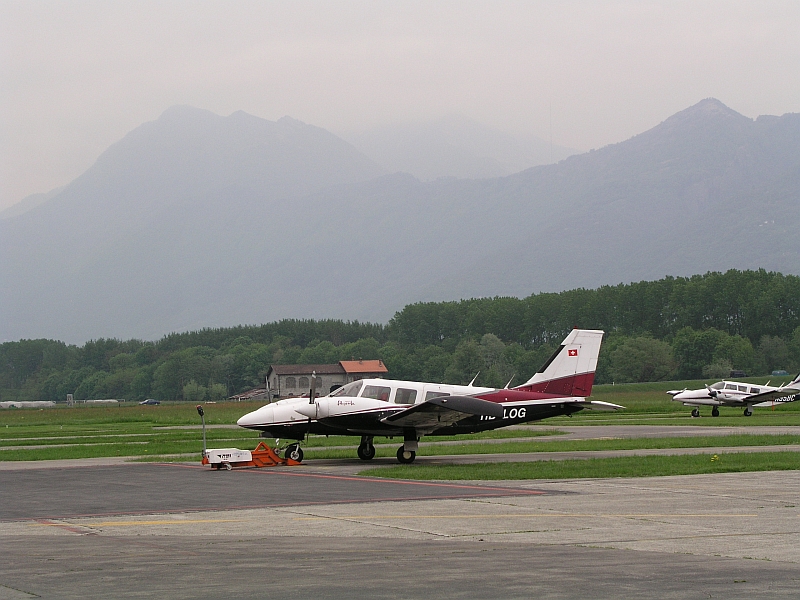
Factual Information
On 2 March 2006, a serious incident occurred involving a Piper PA-34-200T Seneca II aircraft, registration HB-LOG, during a flight from Egelsbach (EDFE, Germany) to Locarno (LSZL, Switzerland). The aircraft was operated by Akzenta Suisse SA, based in Lugano, Switzerland. The pilot, a German citizen born in 1951, held a private pilot's licence (PPL(A)) issued by the Swiss Federal Office for Civil Aviation, with ratings for multi-engine piston land aircraft and instrument flight. He had accumulated 1931 flying hours, of which 415 hours on the accident type. The pilot was the sole occupant. No injuries were reported and the aircraft was not damaged.
History of the Flight
On 1 March 2006, the aircraft flew from Lugano-Agno to Egelsbach. During the night, it was parked in the open. On the morning of 2 March, the pilot arrived at 08:50 LT. The weather was overcast with snow showers. After receiving a forecast of temporary improvement, the pilot filed a combined VFR/IFR flight plan and took off at 09:48 LT. Shortly after take-off, he contacted Langen Radar and requested IFR clearance due to clouds. At 10:05 LT, the pilot reported that both alternators were not working and that battery capacity would soon be exhausted. He declined a suggestion to return to Egelsbach, citing navigation difficulties without battery power, and preferred to continue to Lugano where weather was good. He climbed to FL 110 and later requested climbs to FL 150 and FL 190. At 10:22 LT, he asked to forward a message to Locarno that he would land there. At 10:27 LT, he announced he would squawk 7600 if contact was lost and requested the Locarno frequency. The last radio communication was at 10:35 LT, when Langen Radar noted that a handheld radio was advisable for transalpine IFR flights. At that time, the aircraft was at FL 192 near waypoint GAGSI. The cabin heating had failed, causing side windows to ice up.
At 10:45 LT, the Daily Ops Manager at Zurich ACC informed the Air Defence and Direction Center about the situation. Two Swiss Air Force F/A-18 aircraft were scrambled and intercepted HB-LOG. The military pilots established visual contact and instructed the pilot to follow them to Locarno. The pilot acknowledged by rocking his wings. The aircraft landed at Locarno at 11:37 LT without further incident.
Technical Aspects
Investigation revealed that the serious incident resulted from a complete failure of the aircraft's electrical power supply. Causal factors included the inadequate technical condition of the aircraft and the failure to apply the emergency procedures published in the Aircraft Flight Manual (AFM). The pilot reported a starting problem on 21 February, requiring an external power source. During the flight, the AFM with emergency checklists and navigation documents were placed on the rear seats, making them difficult for the pilot to reach.