Factual Information
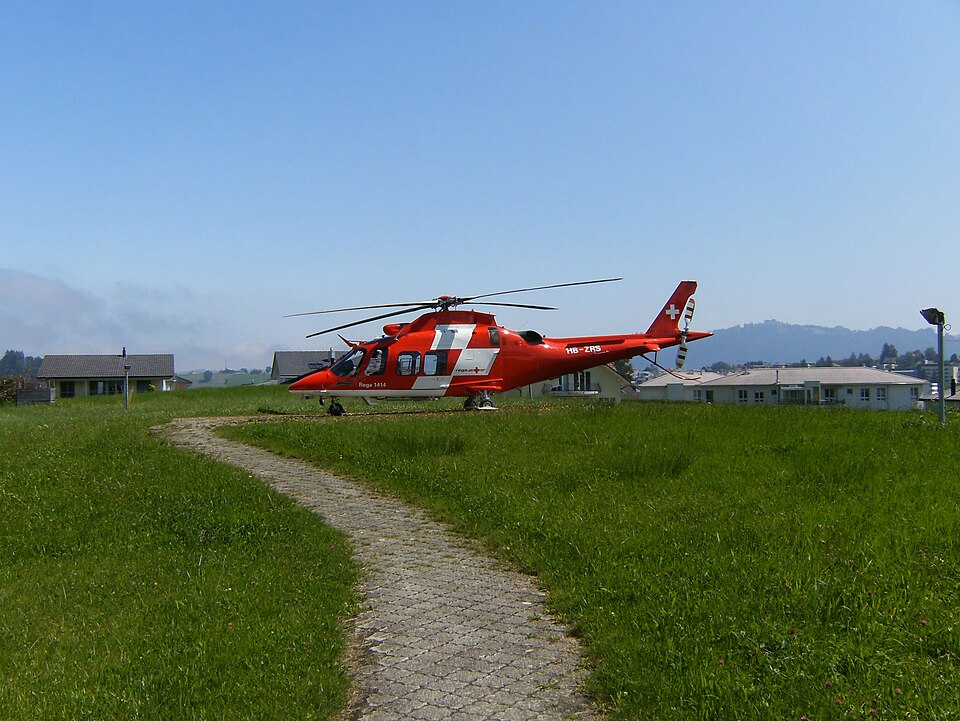
On 6 June 2013, at 15:05 UTC, an AgustaWestland AW109SP helicopter, registration HB-ZRS, operated by Schweizerische Luft-Ambulanz AG (Rega), was involved in a serious incident at Zurich Airport (LSZH). The flight was a technical flight to perform a functional check of the rescue hoist after a six-month (200-hour) maintenance check. The helicopter was hovering at an altitude of approximately 7 m above ground level when the hoist cable broke.
History of the Flight
Prior to the flight, a briefing was conducted between the pilot, the hoist operator, and a mechanic. The plan was to lift a test load of 250 kg attached to the hoist cable, extend the cable to its maximum length, and then retract it. At 15:03, the helicopter took off. The hoist operator extended the cable to about 7.5 m. The mechanic had difficulty attaching the load, so the cable was extended further until it touched the ground. After attaching the load, the hoist operator instructed the pilot to move forward about one metre while slowly retracting the cable. When the helicopter was directly above the load, the operator continued retracting and informed the pilot that the cable was under tension. The pilot then noticed a sudden change in attitude to the left and heard a bang. The hoist operator reported that the cable had broken. Neither the pilot nor the hoist operator observed anything unusual before the break. The pilot hovered until assessing the situation, then landed at the Rega-Center.
Personnel Information
The pilot held an airline transport pilot licence helicopter (ATPL(H)) issued by the Federal Office of Civil Aviation (FOCA), with a total of 4348 flying hours, including 292 hours on the type. The hoist operator was a helicopter mechanic at Rega, authorized after a two-day training program, and had performed this function for three years, typically two to three times per year on AW109SP helicopters.
Meteorological Information
At the time of the incident, the weather was sunny with isolated fair-weather cumulus clouds. Visibility was 35 km. Wind was from 030 degrees at 7 kt, variable between 340 and 120 degrees. Temperature was 23 °C, dewpoint 8 °C, QNH 1018 hPa. No hazards were reported.
Aircraft Information
The helicopter, manufactured in 2009, had 1129:16 operating hours. It was equipped with a Goodrich rescue hoist mounted on the right side. The maximum hoist load was 272 kg, and the cable length was 88.4 m (85 m available). The hoist had been installed on 9 June 2011 and had undergone 702 total operations, with the cable used 240 times. During the incident, the hoist load was 250 kg.
Examination of the Rescue Hoist Attachment
After the incident, damage was found on the upper edge of the aft flat bracket of the handle assembly, as well as on the nut (Item 29) and corresponding washer (Item 28). The damage indicated contact with the hoist cable under load. The handle assembly, part of the rescue hoist attachment, consists of a cylindrical handle bar and flat brackets bolted to the attachment assembly. The nuts on the bolts protrude, and cotter pins project approximately 2 mm beyond some nuts. The edges of the flat brackets have a small radius (about 1 mm), making them almost sharp-edged. Signs of abrasion were detected on similar brackets on other helicopters of the same operator.
Causes
The serious incident occurred because the hoist cable became entangled behind the nut of the retaining bracket and broke when the load was lifted. The design of the rescue hoist attachment assembly was identified as a causal factor. Restricted visibility from the hoist operator's working position was a contributing factor.