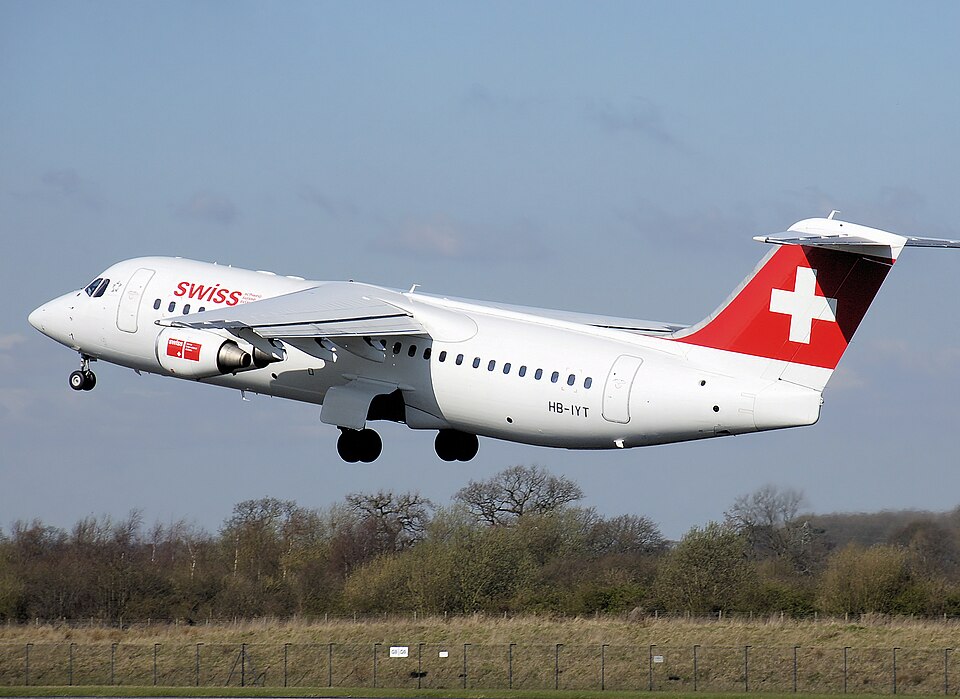
On June 3, 2015, a BRITISH AEROSPACE (REGIONAL AIRCRAFT) LTD AVRO 146-RJ100 (registration HB-IYT) was involved in an aviation accident near Rund 25 km nordwestlich von Bozen/It, CH. No fatalities were reported. This summary draws on records from the Swiss Transportation Safety Investigation Board (STSB / SUST).
On June 3, 2015, an Avro 146-RJ100 (HB-IYT) operating flight LX1716 from Zurich to Bari experienced hydraulic system warnings. The crew returned to Zurich and landed safely on runway 28.
Incident Overview and Aircraft Details On June 3, 2015, at approximately 17:15 UTC, a four-engine commercial aircraft, an Avro 146-RJ100 with registration HB-IYT, was involved in a serious incident while climbing at flight level 302, roughly 25 kilometers northwest of Bozen, Italy. The aircraft was operated by Swiss Global Air Lines AG and was on a scheduled instrument flight rules (IFR) flight from Zurich (LSZH) to Bari (LIBD) under flight number LX1716. The aircraft was owned by Triangle Regional Aircraft Leasing Limited. The flight crew consisted of a Swiss captain born in 1985 and a Swiss first officer born in 1984, both holding EASA ATPL(A) licenses issued by the Federal Office of Civil Aviation (BAZL). The captain had 3,496 total flight hours, while the first officer had 3,777 total flight hours. The aircraft carried 75 passengers and 4 crew members, with no injuries reported to any persons on board or on the ground. ## Flight Progression and Crew Actions The aircraft departed Zurich runway 32 at 16:50 UTC. Approximately 25 minutes after takeoff, just before reaching the planned cruising altitude of flight level 310, a “HI TEMP” warning light for the green hydraulic system illuminated in the cockpit. Following the applicable checklist, the crew shut down the green hydraulic system. To avoid a technical aircraft-on-ground situation in Bari, the crew decided to return to Zurich. They issued a PAN PAN urgency call and were cleared to fly to the GIPOL holding point. At that time, Zurich runway 28 was active for landings, with wind reported at 280 degrees at 9 knots. The crew inquired with air traffic control about the possibility of landing on runway 34. The controller declined, explaining that the terminal control area south of Zurich was inactive and had significant visual flight rules (VFR) traffic, and that an approach to runway 34 would only be approved if the crew declared a MAYDAY emergency. The controller offered a landing on runway 16 instead. However, the crew estimated that an approach to runway 16 would involve a tailwind of approximately 10 knots and decided to land on runway 28. During the downwind leg for runway 28, a “HI TEMP” warning light for the yellow hydraulic system illuminated. The crew consulted the relevant checklist and decided not to shut down the yellow hydraulic system to avoid creating an emergency situation. The landing gear was deliberately extended early using the emergency lowering system. The aircraft landed uneventfully in good visibility conditions and was stopped on the runway. Because the nose wheel steering was inoperative, the aircraft was subsequently towed to a stand using a tractor. The runway was blocked for approximately five minutes, and the passengers were rebooked on another flight. ## Hydraulic System Description and Findings The aircraft's hydraulic system is divided into two subsystems, the yellow and green systems, to ensure necessary redundancy. Pressure in both systems is continuously monitored, with a nominal pressure of 3,100 PSI. If the pressure in a system drops below 1,400 PSI, the corresponding “LO PRESS” warning light illuminates on the hydraulic panel. The temperature of the hydraulic oil in both reservoirs is also monitored; if the temperature in a reservoir exceeds 95 °C, the corresponding “HI TEMP” warning light illuminates. The green system is normally pressurized by the engine-driven pump (EDP) on engine 3. If the EDP fails or the engine must be shut down, the green system can be pressurized via the power transfer unit (PTU) from the yellow system. The PTU is activated when the pressure in the green system drops below 2,600 PSI and is deactivated when the pressure rises above 2,600 PSI. The PTU ensures the independence of the two hydraulic systems, with no fluid transfer occurring. The yellow system is normally pressurized by the EDP on engine 2. In the event of a failure, the pressure in the yellow system can be supported or maintained by an alternating current (AC)-driven pump. This AC pump starts automatically when the “AC PUMP” switch on the hydraulic system control panel is in the “AUTO” position and one of the following conditions occurs: the pressure in the yellow or green system drops below 1,500 ±100 PSI, the EDP in the yellow or green system fails, or engine 2 or 3 is shut down. A fan (heat exchanger cooling fan) is available to cool the AC pump, which switches on when the temperature in the yellow reservoir reaches 90 ±5 °C. Essential systems such as the rudder, landing flaps, and wheel brakes are supplied by both hydraulic systems. However, after the green system was shut down, the nose wheel steering failed, and the landing gear had to be extended using the emergency lowering system. The landing flaps moved at half speed. A portion of the lift spoilers also failed, which had an impact on the landing distance. ## Post-Landing Investigations and Maintenance A visual inspection revealed no obvious defects that could have caused the “HI TEMP” warning lights in both hydraulic systems. However, the two reservoirs felt warmer than usual. During a test of the hydraulic system with the engines running by the aircraft maintenance team, it was found that the EDP of the green system was delivering a pressure of 3,300 PSI instead of the nominal 3,100 PSI. The EDP also produced an unusually loud noise. Further inspection revealed that the heat exchanger cooling fan for the AC pump of the yellow system was defective. The EDP of the green system and the heat exchanger cooling fan were replaced, and a sample of the hydraulic fluid from both systems was taken for later analysis. No obvious contamination was visually detected in the samples. The aircraft was then released for further operation. The following components were replaced: the engine-driven pump (EDP), part number 521449, and the heat exchanger cooling fan, part number 70AA6-521. The incoming inspection of the EDP at the manufacturer revealed that the drive shaft had severe wear. A query to the operating company showed that the EDP generally has a relatively low mean time between unscheduled removal (MTBUR), which is likely due in part to the increasing aging of these components. The incoming inspection of the heat exchanger cooling fan revealed that the stator of the motor was defective and the electrical wiring was in poor condition. According to the operating company, the component has a relatively high MTBUR on the order of 40,000 flight hours. The analysis of the hydraulic fluid samples showed no evidence of contamination, excessive water content, or viscosity problems. The quality of the hydraulic fluid is checked once a year by taking and analyzing samples (Task 290000-CHK-10000-6LX). The heat exchanger cooling fan is inspected together with the AC pump every three years or after 7,000 flight cycles (Task 292000-FUT-10000-1). This inspection was last performed on February 9, 2015, during the C08 check, and no defects were found. The hydraulic system, like other aircraft systems, is operated on an on-condition basis, meaning that malfunctions and exceedances of tolerance values are reported by the flight crew and corrected by the aircraft maintenance. This concept is possible because an adequate redundancy is built into the design of flight-critical systems. An exception is made for aircraft systems that are not used in normal operation (hidden functions), such as the AC pump in this case. For such systems, availability is checked periodically. ## Meteorological Conditions West winds, which prevailed near the ground due to a weak cold front, were replaced by northeast winds at higher altitudes. At the time of the serious incident, at approximately 17:15 UTC, the aircraft was outside clouds and in good visibility conditions at flight level 302 in a climb. The wind was blowing at 10 knots from an east-northeasterly direction. At the time of the landing of HB-IYT on runway 28, the following weather conditions were observed at Zurich Airport: wind 270 degrees at 8 knots, meteorological visibility 10 kilometers or more, no precipitation, and CAVOK, meaning no clouds below 8,000 feet above ground level, no cumulonimbus (CB) or towering cumulus (TCU) at any altitude, and no significant weather phenomena. In summary, the weather had no influence on the serious incident.