Incident Overview
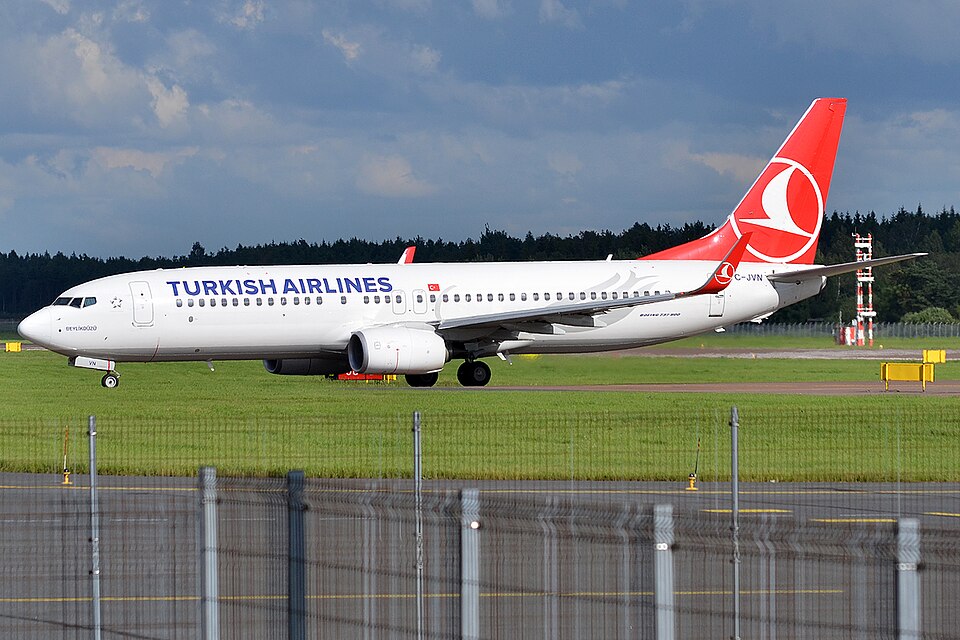
On 6 October 2022, a Boeing B737-8F2 aircraft registered as TC-JVN, owned by TCL Orange Co. Ltd. and operated by Turkish Airlines (THY), experienced a serious incident during landing at Hatay Airport (LTDA). While touching down on runway 04, all four main landing gear tires burst. There were no fatalities or injuries, and the aircraft sustained only minor damage.
Flight Details
The aircraft was operating scheduled flight TK2256 from Istanbul Airport (LTFM) to Hatay Airport. The flight carried 2 pilots, 4 cabin crew, and 105 passengers. Departure from Istanbul was planned at 01:20 local on 5 October 2022, with arrival at Hatay scheduled for 02:55 local. The alternate airport was Gaziantep Airport (LTAJ). The crew had reviewed NOTAMs and weather prior to departure.
Aircraft and Crew Information
The aircraft was a Boeing 737-8F2 (MSN 60018). The cockpit crew consisted of a captain and a first officer. Both held valid licenses and qualifications. Before the flight, the crew noted that the aircraft had a Minimum Equipment List (MEL) item: "ANTISKID INOP" (antiskid system inoperative). They reviewed the relevant procedures and calculated landing performance using the Electronic Flight Bag (EFB) with the CDL option for antiskid inoperative. The captain briefed the first officer to remind him about manual braking during landing.
Sequence of Events
During the approach, the crew confirmed via ATIS that runway 04 was in use and set up for an ILS approach. They performed a normal landing on runway 04. After touchdown, the captain applied manual braking, as required by the MEL for an inoperative antiskid system. The first officer made standard callouts: "Manual braking – Speed Brake – Reverser – 60 knots." Shortly after, the tower controller transmitted a fire warning, stating: "THY8AS you are on fire" and later confirming that tires had burst. The crew initiated an evacuation. Cabin crew reported hearing a loud bang, seeing sparks and intense orange flames outside, and noted passengers moving toward the forward part of the aircraft. Evacuation was conducted via the left side.
Aftermath
Airport fire services responded. The aircraft was later examined. Damage was limited to the tires and minor components. The Cockpit Voice Recorder (CVR) and Flight Data Recorder (FDR) were analyzed by the investigation team, though specific findings from those recordings are not documented in this summary. No injuries were reported among passengers or crew.
Conclusions
The incident resulted from the failure of all four main tires during landing. The investigation focused on the manual braking technique given the inoperative antiskid system, but no causal statement was issued by the investigation authority in the provided source.