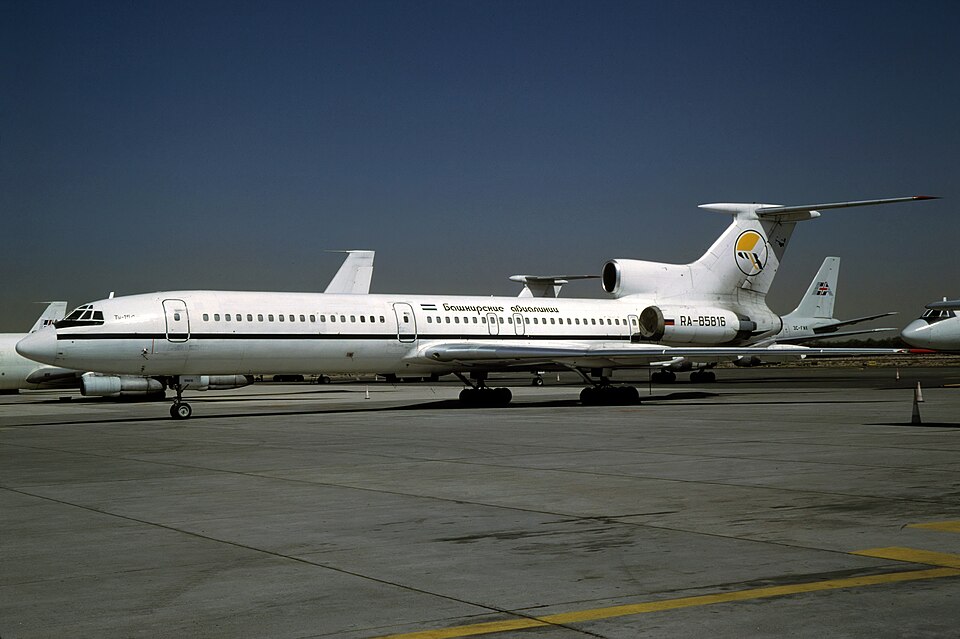
On July 1, 2002, a Tupolev TU-154 (registration RA-85816) operated by Bashkirian Airlines - Bashkirskie Avialinii was involved in an aviation accident near Überlingen, Germany in flight. 69 people were killed. Investigators recorded the probable cause as: The following immediate causes have been identified: • The imminent separation infringement was not noticed by ATC in time. This summary draws on records from the Bureau of Aircraft Accidents Archives (B3A).
On 1 July 2002, a Tupolev TU-154M and a Boeing B757-200 collided near Überlingen, Germany, after a TCAS resolution advisory. Both aircraft crashed north of the town.
Accident Overview and Immediate Sequence of Events On 1 July 2002 at 21:35:32 hrs, a Tupolev TU-154M operating a charter flight from Moscow-Domodedovo to Barcelona and a Boeing B757-200 on a cargo flight from Bergamo to Brussels collided in mid-air near the town of Überlingen, Germany, on a dark night. In-flight visibility at the relevant flight level was reported as 10 km or more. Both aircraft impacted the ground north of Überlingen. Witnesses reported explosive noises, prolonged roaring and rumbling, and reflections of fire, with many observing burning debris falling from the sky. ## Reconstruction of the Flights The histories of both flights were reconstructed using airborne flight data recorders (FDR) and cockpit voice recorders (CVR), TCAS data stored in the aircraft, radio communications between the Swiss Air Traffic Control Centre (ACC Zurich) and the crews, and ground radar data recorded by Swiss Air Navigation Services. ## Boeing B757-200 Flight Details The B757-200 was operated by a two-pilot crew that had flown together throughout June 2002, including multiple Bahrain–Bergamo–Brussels–Bahrain routes. Their last flight before this cycle was on 28 June 2002 from Brussels to Bahrain. The crew was off duty for 75 hours before checking in at 11:50 hrs in Bahrain. The aircraft departed Bahrain (OBBI) at 13:30 hrs for a cargo flight to Brussels (EBBR) with an intermediate stop at Bergamo (LIME). The landing at Bergamo occurred at 19:10 hrs after a flight time of 5 hours 40 minutes. The aircraft was refuelled, unloaded, and reloaded with cargo before taking off for Brussels at 21:06 hrs, flown by the copilot as pilot flying (PF) under instrument flight rules (IFR). The flight plan listed a scheduled departure time of 21:00 hrs, a cruise speed of 463 kt, a cruise level of FL 360, and a route via ABESI-UN851-TGO-UL608-LAMGO-UZ738-ANEKI-UZ917-BATTY to EBBR, with an estimated flight time of 1:11 hrs and Cologne (EDDK) as the alternate aerodrome. At 21:21:50 hrs, the pilot-in-command (PIC) contacted ACC Zurich on 128.050 MHz at FL 260, in direct approach to waypoint ABESI. At 21:21:56 hrs, transponder code 7524 was assigned. The aircraft was cleared for a direct approach to the TANGO VOR and a climb from FL 260 to FL 320. The PIC requested a climb to FL 360, which was approved at 21:26:36 hrs. The aircraft reached FL 360 at 21:29:50 hrs without the pilots reporting the level. At 21:34:30 hrs, the copilot handed over control to the PIC to go to the lavatory. At 21:34:42 hrs, TCAS issued a Traffic Advisory (TA): “traffic, traffic.” Fourteen seconds later, at 21:34:56 hrs, TCAS issued a Resolution Advisory (RA): “descend, descend.” Approximately two seconds later, the autopilot was switched off, the control column was pushed, and engine thrust was reduced. FDR data showed pitch reduced from 2.5° to approximately 1.5° and vertical acceleration lowered from about 1.0 g to 0.9 g. The aircraft reached a descent rate of 1,500 ft/min 12 seconds after the autopilot was switched off. At 21:35:05 hrs, the copilot remarked “traffic right there,” confirmed by the PIC with “yes.” At 21:35:10 hrs, TCAS issued an “increase descent, increase descent” advisory. The copilot had returned to his station and put on his headset, reacting with “increase.” The descent rate reached approximately 2,600 ft/min 10 seconds later. Pitch decreased to –1° and thrust was reduced to approximately 1.2 EPR. A Master Caution aural warning was heard at 21:35:14 hrs. The autothrottle was switched off at 21:35:18 hrs. At 21:35:19 hrs, the crew reported the “TCAS descent” to ACC Zurich. The copilot requested the PIC to descend twice, first with “descend” at 21:35:26 hrs and then “descend hard” at 21:35:30 hrs. Approximately two seconds before the collision, the control column was pushed fully forward. At 21:35:32 hrs, the aircraft, flying a magnetic heading of 004° with a pitch angle of approximately –2° and no bank angle, collided with the TU-154M at 34,890 ft. ## Tupolev TU-154M Flight Details The TU-154M crew was off duty for 24 hours before take-off for the charter flight to Barcelona (LEBL). They checked in at 17:30 hrs, and the aircraft departed Moscow-Domodedovo (UUDD) at 18:48 hrs. Nine crew members and 60 passengers were aboard. The flight was conducted under IFR in accordance with the filed flight plan, which listed a planned departure time of 18:30 hrs, a cruise speed of 880 km/h, a cruise level of 10,600 m, and a route via KLIMOVSK-KAMENKA-ZAKHAROVKA-R11-YUKHNOVB102-BAEVO, then at 470 kt and FL 360 via UL979-MATUS-UM984-BOLMU-UT43-STOCKERAU-UR23-SALZBURG-UL856-TRASADINGEN-Z69-OLBEN-UN869-OLRAK-UN855-PERPIGNAN-UB384-GIRONA-UB38-SABADELL to LEBL, with an estimated flight time of 4:20 hrs and Girona (LEGE) as the alternate aerodrome. Five flight crew members were in the cockpit: the commander (under supervision), who was the pilot flying (PF) and occupied the left-hand seat; an instructor in the right-hand seat, who was the pilot non-flying (PNF), conducted radio communications, and was the pilot-in-command (PIC); the flight navigator between and slightly behind the pilots; the flight engineer behind the instructor; and a further pilot (copilot) with no function on the flight, seated behind the commander. At 21:11:55 hrs, near Salzburg over Austrian territory, the crew received clearance from Vienna radar for a direct approach to the Trasadingen VOR at FL 360. At 21:16:10 hrs, the aircraft entered German airspace and was controlled by Munich Radar. At 21:29:54 hrs, Munich instructed the crew to change over to ACC Zurich on 128.050 MHz. At 21:30:11 hrs, at FL 360, the PNF contacted ACC Zurich. At 21:30:33 hrs, ACC Zurich assigned transponder code 7520, acknowledged six seconds later. Between approximately 21:33:00 hrs and 21:34:41 hrs, the CVR recorded crew discussions about an approaching aircraft displayed on the vertical speed indicator (VSI/TRA), part of the TCAS. All flight crew members except the flight engineer were involved, and the recordings suggest the crew attempted to localize the other aircraft’s position and flight level. At 21:34:36 hrs, the commander stated, “Here it is in sight,” and two seconds later, “Look here, it indicates zero.” From 21:34:25 hrs to 21:34:55 hrs, the aircraft turned at a bank angle of approximately 10° from a magnetic heading of 254° to 264°. At 21:34:42 hrs, TCAS generated a TA (“traffic, t