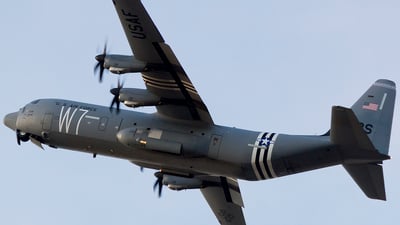
Summary of Accident
On 23 April 2020, at approximately 17:24:22 hours local time, a C-130J-30 Super Hercules, tail number 11-5736, assigned to the 37th Airlift Squadron, 86th Airlift Wing, Ramstein Air Base, Germany, conducted a routine periodic evaluation flight. The aircraft experienced a hard landing with a vertical acceleration load factor (g-load) exceedance of 3.62 times the force of gravity (g) and a landing sink rate of 834 feet per minute (FPM), exceeding the maximum allowable limits of 540 FPM and 2.0 g. Immediately after touchdown, the mishap crew executed a go-around and coordinated for a visual approach and full-stop landing, which was completed safely at 17:37:23 local time. There were no fatalities, injuries, or damage to civilian property.
Sequence of Events
The mishap crew (MC) was scheduled to fly in a formation of three C-130Js for two training routes. The primary objective was to complete the evaluation of Mishap Pilot 1 (MP1). The MC planned to take off as a single-ship, conduct a maximum effort takeoff, then a maximum effort landing using the painted landing zone on the runway, followed by a full-stop and rejoining the formation. Preflight, engine start, taxi, and visual traffic pattern procedures were executed within good flying standards. The mishap occurred during the maximum effort landing.
The Accident Investigation Board President found, by a preponderance of the evidence, that the cause of the mishap was MP1’s early engine power reduction (power pull), beginning at 70 feet above ground level (AGL) and fully flight idle at 45 feet AGL. Additionally, MP1 and Mishap Pilot 2’s failure to identify the excessive sink rate and their failure to arrest the excessive sink rate or go-around in a timely manner were found to be substantially contributing factors.
Damage and Costs
The landing g-load exceedance resulted in significant damage to the center wing, both outer wings, left and right main landing gear assemblies, and engines, including mounting structures. The estimated damage costs are $20,917,089.
Human Factors
The investigation identified human factors including overcontrolled/undercontrolled aircraft/vehicle/system (AE104), breakdown in visual scan (AE105), and rushed or delayed a necessary action (AE107).
Crew Qualifications and Medical
Mishap Pilot 1 (flight pilot in the left seat), Mishap Pilot 2 (aircraft commander in the right seat), Mishap Pilot 3 (evaluator pilot in jump seat), and the Mishap Loadmaster were all qualified. Toxicology tests were conducted with no reported findings. Crew rest and duty time were within limits.
Weather and Operations
Weather conditions were not characterized. Operations and supervision were reviewed without noted deficiencies.
Governing Directives
Relevant directives include publicly available and non-publicly available publications governing C-130J operations.