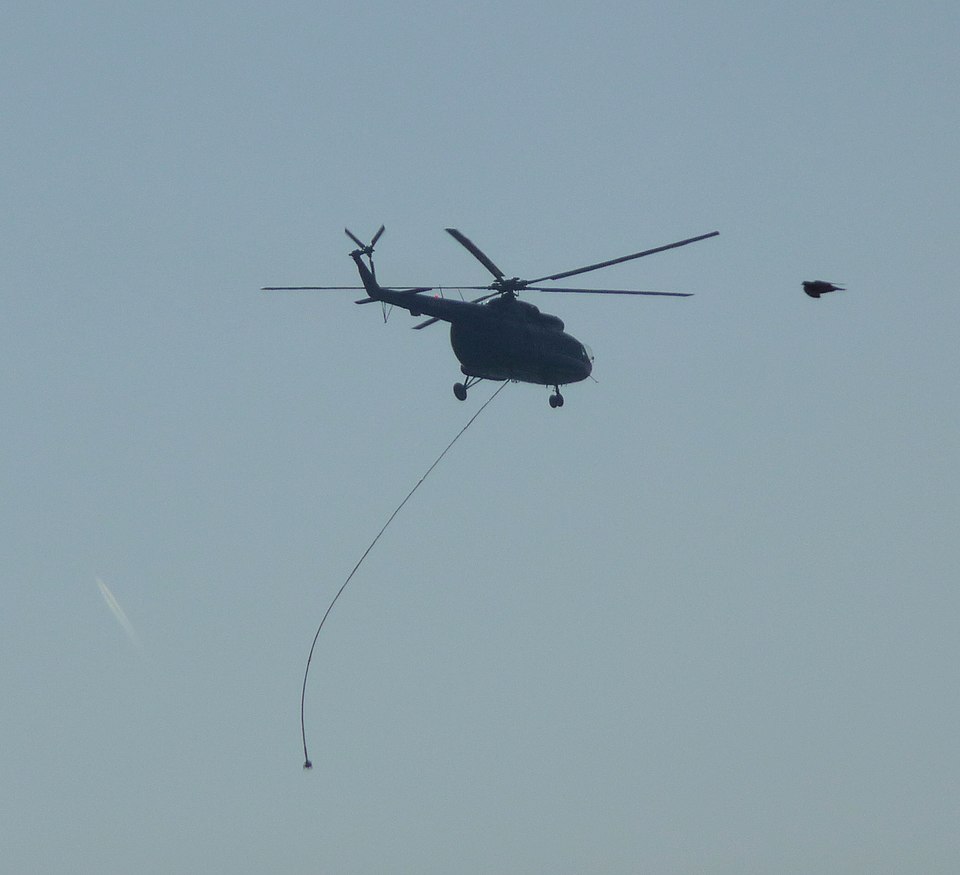
Incident Overview
On 10 November 2008, at approximately 10:55 local time (09:55 UTC), a Mi-8T helicopter, registration OK-XYC, was involved in an incident during aerial transport of a containerized object from Letenská pláň to the roof of a building at Karlovo náměstí in Prague. Over the Vltava River, the transported load suffered structural failure, and parts of it fell into the river.
Flight Sequence
The containerized object consisted of three separate parts: two identical outer containers and a smaller middle connecting container. The incident occurred during the transport of the middle container, which was the second to be moved. During flight in a sling load configuration, the container began to rotate. As the helicopter flew over the Vltava River, the rotation increased, leading to structural failure. The roof and one side wall detached and fell into the river. The crew returned the remaining portion of the load to the loading site at Letná.
Container Configuration and Damage
The containerized object was assembled from three units. The left container weighed 2,680 kg, the right container 2,480 kg, and the middle container 970 kg. The overall height was 3,108 mm. The middle container, which was damaged, lost its roof and one side wall. These parts were recovered: one piece lodged near Staroměstský jez, another downstream near Dvořákovo nábřeží. The remaining floor and one side wall were flown back to the loading site. No damage to the helicopter was reported.
Personnel
Three crew members were on board: a 57-year-old Slovak PIC with 5,704 total flight hours (4,294 on type), a 52-year-old German co-pilot with 6,188 total hours (81 on type), and a 59-year-old Czech flight engineer with 6,049 total hours. All held valid licenses and medical certificates. No injuries were reported among crew or on the ground.
Weather
According to the Czech Hydrometeorological Institute, the weather at the time featured warm air advection from the southwest. Surface wind was 150–200° at 6–10 knots, visibility over 10 km, scattered clouds at 4,000–5,000 ft, broken clouds above 9,000 ft. The PIC reported visual flight conditions with visibility over 10 km and southeast wind up to 10 knots.
Aircraft Information
The Mi-8T helicopter (manufactured in 1993) had accumulated 3,100 flight hours. Its empty weight was 7,260 kg, maximum takeoff weight 12,000 kg, and was powered by two TV2-117-A engines. The helicopter was not equipped with a flight data recorder.
Organizational Context
The transport was ordered by a customer and contracted through a transport organization, which hired an aerial carrier. The container was manufactured by a company whose technical documentation stated that the container type was not designed for use with a tubular mast and was intended only as a single-story structure. The manufacturer specified handling procedures using a crane with four equal-length lines and spreader.