Factual Information
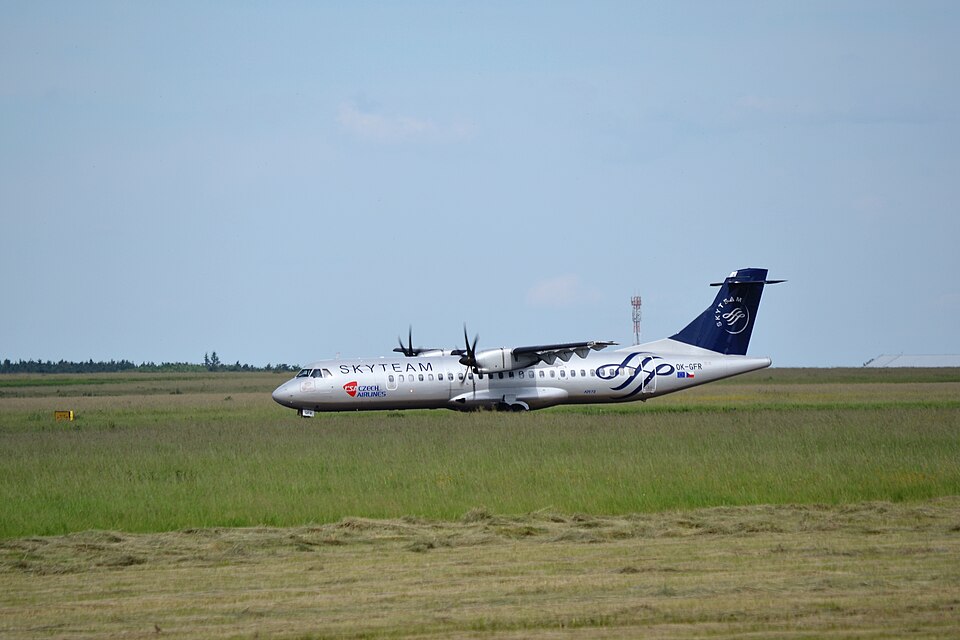
On 13 May 2014 at approximately 14:36 UTC, a serious incident involving a loss of radar separation occurred in the Prague Terminal Maneuvering Area (TMA) over point RATEV (IAF for Runway 24) at flight level 100. The aircraft involved were two ATR72-500s, registrations OK-GFR (callsign CSA973) and OK-GFS (callsign CSA025), both operated by ČSA a.s.
At the time, air traffic controllers (ATCo) at the positions AEC and APC were managing a priority landing for flight SVR740 (Airbus A320), which had diverted to Prague Ruzyně Airport (LKPR) after a bird strike during takeoff from Karlovy Vary (LKKV), resulting in an engine malfunction. To accommodate the priority aircraft, the AEC controller decided to hold other arriving traffic, including CSA973 and CSA025, over point RATEV. Weather conditions were complicated by significant thunderstorm activity in the TMA and Prague FIR.
Analysis
Radar and audio recordings were used to reconstruct the event. The AEC controller planned to hold CSA973 and CSA025 in a holding pattern over RATEV, with CSA973 cleared to FL100 and CSA025 initially at FL120. At 14:36, as CSA973 continued its descent into the holding pattern, the AEC cleared CSA025 to descend to FL100. However, FL100 was already occupied by CSA973. The vertical separation decreased, and at 14:36:55 the automatic STCA (Short Term Conflict Alert) was activated when the aircraft were 3.9 NM apart horizontally.
The APC controller first alerted the AEC, who then issued immediate avoidance instructions: CSA025 was told to turn left to heading 360°, and CSA973 to turn left to heading 180°. Both flight crews reported TCAS RA (Traffic Alert and Collision Avoidance System Resolution Advisory) and responded accordingly. The AEC further instructed CSA973 to turn left to heading 060°. The conflict was resolved with a minimum horizontal separation of 1.83 NM and vertical separation of 475 ft, which was 61% of the required minimum.
Investigation revealed that the AEC controller had a correct plan for managing the traffic, but the clearance for CSA025 to descend into occupied FL100 was issued either due to a slip of the tongue or confusion caused by incorrectly filled flight progress strips. The strips for CSA973 showed overwritten altitude assignments, and the AEC could not explain the discrepancy. The APC controller was occupied with coordination and did not notice the erroneous clearance.
Conclusion
The serious incident resulted from a loss of radar separation between two ATR72-500 aircraft during holding operations in Prague TMA. The minimum separation was 1.83 NM horizontally and 475 ft vertically. No injuries or aircraft damage occurred. The primary contributing factor was an incorrect descent clearance issued by the AEC controller, possibly due to confusion with flight progress strips.