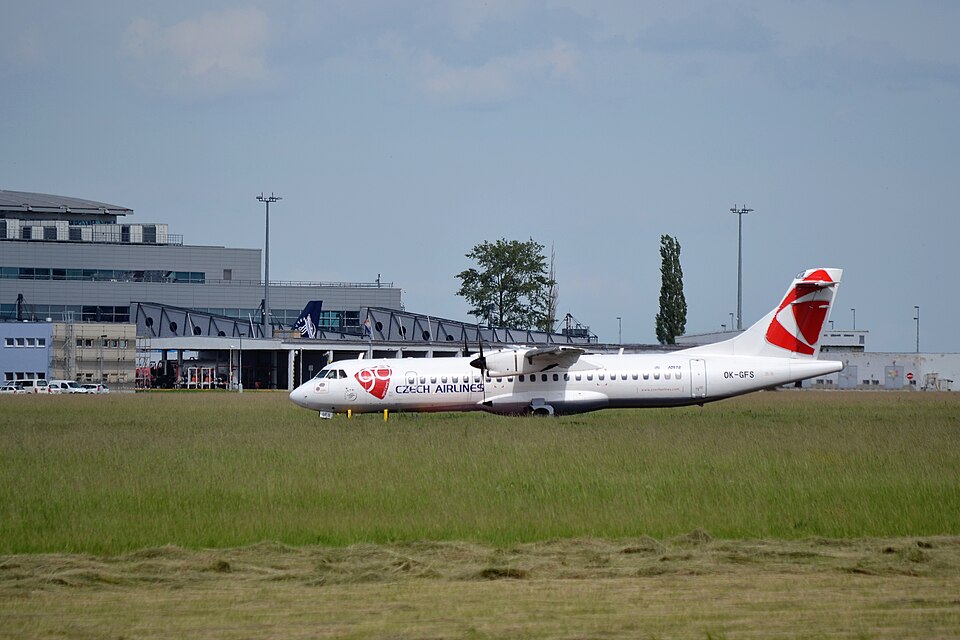
Aircraft and Flight Details
The aircraft involved was an ATR 72-500, registration OK-GFS, operated by České aerolinie a.s. (CSA). On 17 September 2015, it was scheduled to perform a commercial flight from Prague Ruzyně (LKPR) to Hamburg (EDDH). The pre-flight preparations were normal.
Sequence of Events
During ground operations, due to an outside temperature of 31°C, the crew used engine 2 in 'HOTEL MODE' for cabin cooling. While taxiing, after stopping at holding point on taxiway B, a 'BLEED No. 2 FAULT' indication appeared on the overhead panel. The crew switched off the bleed air from engine 2 and decided to reset the system after takeoff.
Takeoff from runway 24 occurred at 16:02:23 UTC with flaps at 15°. At 1,760 ft altitude, the crew turned to heading 340° following the VENOX 2M departure, climbing to Flight Level 140. At 3,000 ft, the bleed system was reset and operated normally.
At approximately 3,800 ft, the 'AIR' and 'TEMP SEL OVHT CABIN' warnings illuminated, accompanied by a temperature rise in the air conditioning duct. At 16:05:36 and 4,140 ft, the cabin crew leader reported smoke in the passenger cabin. The captain decided to return to Prague. Climbing was stopped at 4,520 ft, and the aircraft descended to 3,000 ft. The captain flew manually and initiated smoke procedures. The crew did not don smoke goggles as only a smell was present in the cockpit.
The captain declared 'MAY DAY' and ATC vectored the aircraft for an ILS approach to runway 24. The transponder was set to squawk 7700. During descent, the selected altitude on the ADU was not updated, causing the aircraft to descend to 2,860 ft with speed decreasing to 137 kt (VminLB0 was 136 kt). The captain increased power, and the aircraft climbed to 4,420 ft.
The first officer executed the 'EMERGENCY SMOKE' and 'AIR COND SMOKE' checklists. The captain checked the cabin; the cabin leader reported that smoke was no longer forming and was decreasing. The crew then removed oxygen masks and switched to standard radio communication.
Approach and Landing
At 5.0 NM from the threshold, the captain instructed the cabin to complete emergency preparations. The approach was stabilized; wind was 320°/14 kt gusting 20 kt. The landing at 16:15:43 was normal; no 'BRACE FOR IMPACT' command was given.
Post-Landing
After landing, the aircraft stopped on runway 24. The cabin leader confirmed no smoke but residual smell. The crew requested taxi to the stand. Firefighters (HZS) inspected the aircraft. After a short delay, the aircraft taxied to stand 60 and engines were shut down at 16:21:27. Passengers disembarked onto the apron; buses were requested. No injuries occurred.
Probable Cause
The final report did not specify a probable cause in the provided excerpt.