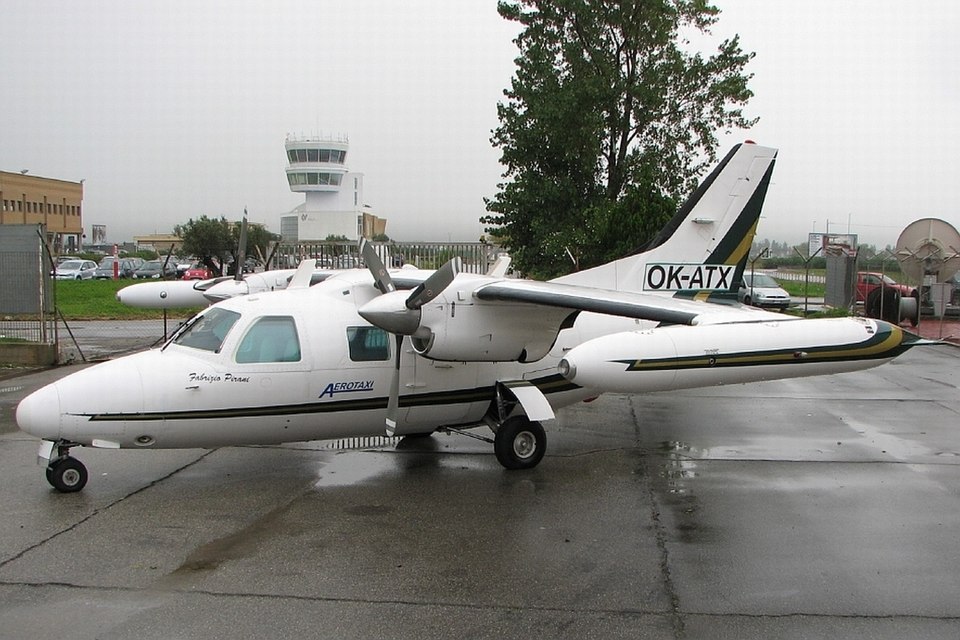
Overview
On 23 October 2005, at 10:45 UTC, a Mitsubishi MU-2B-25, registration OK-ATX, operated by AEROTAXI, s.r.o., encountered a bird strike shortly after departing from Prague-Kbely Airport (LKKB). The flight was a VFR flight to Kolín Airport (LKKO). The incident occurred over the southern edge of the village of Úvaly.
Flight Sequence
After takeoff from the auxiliary runway 24, the pilot-in-command (PIC) executed a left turn toward Úvaly, the VFR exit point of the LKKB control zone. At an altitude of 2100 feet, the PIC felt a jolt and simultaneously heard a loud impact on the forward fuselage. The windshield became nearly opaque, covered with blood and bird feathers. The PIC diagnosed a bird strike.
Upon checking the cockpit, the PIC observed that the left engine temperatures were approaching critical limits. He reduced power on both engines and declared an emergency to the tower, requesting priority landing. The tower offered emergency and fire services, but the PIC declined as the left engine temperatures stabilized at maximum permissible values without further increase.
The PIC executed a landing on the auxiliary runway 24 at Prague-Kbely. The landing was firm due to restricted visibility. After landing at 10:49 UTC, the PIC taxied to the operator's hangar.
Injuries
No injuries were reported. The crew (1) and passenger (1) were uninjured.
Aircraft Damage
Post-flight inspection revealed damage to the left engine, left propeller, and left cockpit windshield.
Weather
Meteorological conditions: wind from 250° at 10-12 knots, CAVOK.
Pilot Information
The PIC, aged 46, held a valid PPL with MU-2 and IR ratings. He had a total of 1360 flying hours, including 67 hours 37 minutes on the MU-2 as PIC. He was not under the influence of alcohol, as indicated by a breath test.
Aircraft Information
The Mitsubishi MU-2B-25 (OK-ATX) had a total airframe time of 5123 hours 07 minutes. The last annual/100/200/600-hour inspection was performed on 8 September 2005 at 5091 hours 30 minutes. The aircraft had a valid airworthiness certificate.
Airfield Information
At the time, the main runway 24/06 was closed due to concrete repairs, and operations were conducted from the auxiliary grass strip. The airfield was not a factor in the accident.
Bird Strike Context
According to Appendix 12 (Ornithological Situation of CTR/TMA Kbely) of the MIL AIP LKKB, no bird activity was anticipated in the area.
Conclusions
The investigation commission concluded the following:
- The PIC was properly qualified and held a valid medical certificate.
- The takeoff from LKKB was normal.
- The bird presence could not have been predicted by the PIC.
- The departure and landing airfields did not contribute to the occurrence.
- Weather was suitable for the flight.
- The aircraft was maintained per regulations and was airworthy before the flight.
- The aircraft's technical condition did not influence the event.
- The PIC had no influence on the event's cause.
The probable cause was determined to be a collision with a flock of birds.