Flight Details
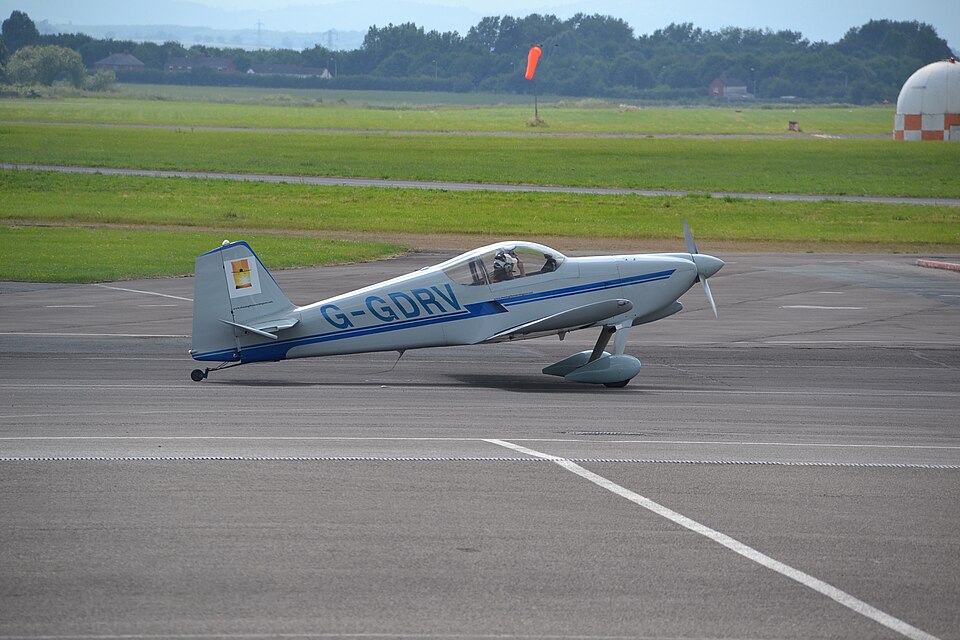
The aircraft, a Vans RV-6 (registration G-GDRV), was built in 1993 and powered by a single Lycoming O-320-E2D piston engine. On 11 April 2009, it was being flown in the circuit at Enstone Aerodrome, Oxfordshire, for the purpose of familiarising a new pilot member of the group which owned it. The flight was private, with one pilot and one passenger on board.
History of the Flight
The pilot, who occupied the left seat, held a Private Pilot’s Licence and had 1,400 hours total flying experience, of which only 3 hours were on type. He had previous experience of tailwheel aircraft but not of the RV-6. A more type-experienced pilot occupied the right seat as an observer. Control of the brakes was possible only from the left seat.
On the fourth landing on asphalt Runway 26, the observer made rudder inputs to correct a swing during the ground roll. On the fifth landing, the observer again made rudder inputs to correct a more pronounced swing, which developed into what he described as a ground loop. After bringing the aircraft to rest, the occupants inspected the landing gear and found that the left spat was scuffed and its mounting plate bent. They then flew the aircraft back to its base at Gloucester Staverton Airport, where the observer completed the landing without incident. During subsequent ground manoeuvres, the occupants noticed that the aircraft was not responding to rudder control inputs, and the pilot steered using differential braking.
Inspection
Subsequent inspection revealed that the tail wheel steering linkage was broken and that the left landing gear leg was bent. The full extent of damage included damage to the left landing gear leg, wheel spat and mounting plate, and the tail steering linkage broken.
Pilot's Assessment
The pilot and observer did not determine when the steering linkage became detached or if it was the cause or result of the control difficulties. The pilot assessed the cause of the accident as his lack of experience of this type and of tailwheel aircraft generally. The AAIB bulletin does not state an official probable cause.