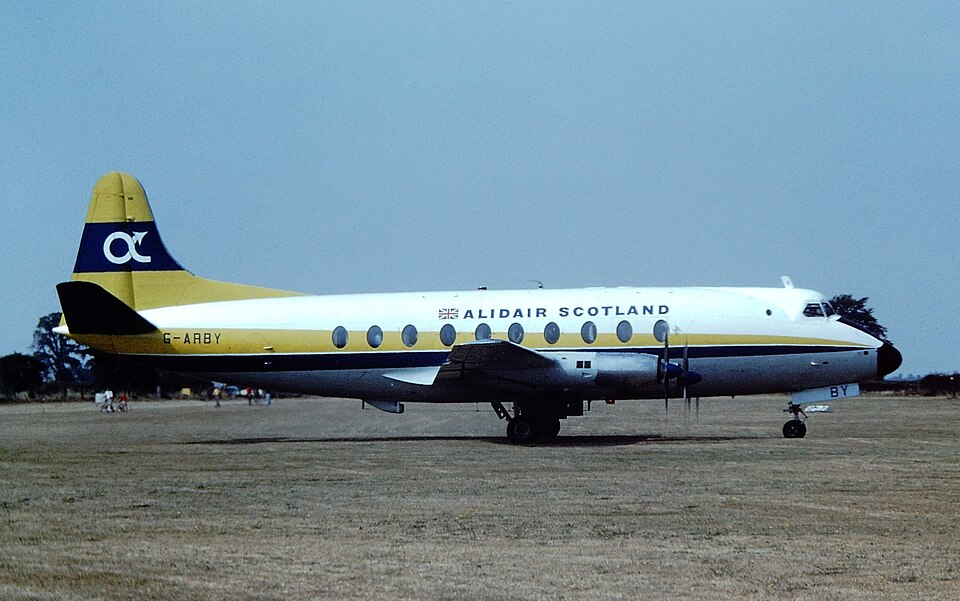
On July 17, 1980, a Vickers Viscount (registration G-ARBY) operated by Alidair Scotland was involved in an aviation accident near Exeter, United Kingdom during landing or approach. No fatalities were reported. Investigators recorded the probable cause as: The accident was caused by the aircraft running out of fuel due to the crew's erroneous belief that there was on board sufficient fuel to complete the flight. This summary draws on records from the Bureau of Aircraft Accidents Archives (B3A).
A Vickers Viscount on a passenger charter from Santander to Exeter suffered a total engine failure due to fuel exhaustion. The crew believed sufficient fuel remained, but all tanks were empty on examination.
Flight and Refuelling at Santander A Vickers Viscount was operating a passenger charter flight from Santander (SDR), Spain, to Exeter (EXT). The aircraft arrived at Santander eight minutes ahead of schedule at 16:22. The aircraft commander recorded a fuel state on shutdown of 3,178 litres and ordered a total fuel load of 5,902 litres for the return flight, which was 454 litres less than full tanks. While the commander was with the handling agents, the co-pilot supervised refuelling. He requested a total uplift of 2,720 litres and showed the figures to the senior operator of the refuelling vehicle. That operator had not refuelled the aircraft on its earlier flight that day. On the previous flight, intermittent contact at the external electrical supply socket had caused the aircraft’s refuelling valve to open and close intermittently, interrupting the process. Refuelling was then completed using electrical power from the aircraft batteries. During the later refuelling, the aircraft again obtained electrical power from the same ground power unit. The operators refuelled the two sides of the aircraft one after the other, using the same hose each time. When the refueller finished pumping, its indicators recorded a total delivery of 2,720 litres. The co-pilot, who had watched the operation, checked the figures and signed the delivery note. Neither pilot made a physical check of the aircraft’s tanks using the dripsticks. ## Fuel Gauge Defects Both fuel contents gauges had a history of defects. A recurrent problem with the port fuel gauge was recorded in the Technical Log as a deferred defect, described as “port fuel contents gauge fluctuating occasionally, ie full scale deflection; rectification being carried forward until the next check.” The starboard gauge also had a defect. The aircraft commander did not draw the co-pilot’s attention to the entry, and the co-pilot remained unaware of it. Before starting engines, the pilots again set the flow meter totals at zero. ## En Route Fuel Indications The aircraft left Santander at 17:33 and was shortly afterwards cleared to its planned cruising level of Flight Level 180. The planned flight time was 2 hours and 9 minutes, with an expected fuel consumption of 3,375 litres, leaving a reserve of 2,527 litres. At 18:46, the aircraft passed over Nantes. The flow meters then indicated that 1,964 litres had been consumed, which was exactly according to the navigation plan. The crew therefore recorded that at that moment 3,320 kg (4,150 litres) remained in the aircraft tanks. At approximately 19:10, while in the area of Dinard, the fuel contents gauges began to cause concern. The port gauge, with various fluctuations, occasionally fell to zero but sometimes read full. The starboard gauge gave a reading equivalent to 500 litres and continued to fall steadily as the flight progressed. The pilots reviewed the fuel situation. Although uneasy, they considered that, in light of the recorded uplift and the totals on the flow meters, they must have ample fuel on board. As the aircraft approached Guernsey, the aircraft commander considered diverting there to take on more fuel but decided against it after further thought. ## Approach to Exeter At 19:28, while between Guernsey and Berry Head, the aircraft received initial descent clearance and was shortly afterwards further cleared to Flight Level 40 on a direct track for the Exeter NDB. At 19:42, the crew changed frequency to Exeter approach and started to receive radar positioning for runway 26. The weather was reported as one okta at 700 feet, five oktas at 1,000 feet, and seven oktas at 2,500 feet, with visibility of 13 kilometres and a surface wind of 280 degrees at 7 knots. At 19:44, the crew performed the approach checks, which included selecting flap to 20 degrees and switching on the fuel heaters. As fuel heat was selected, there was a momentary flash from one of the two low pressure warning lights. After a brief discussion, the crew opened the fuel crossfeed cocks, which had been closed since their pre-flight checks at Exeter. ## Engine Failure and Forced Landing At 19:50, the aircraft was at 2,000 feet QFE, just below cloud and about 8 miles from touchdown. The flap was still at 20 degrees and the undercarriage was retracted. Suddenly, both low pressure fuel warning lights illuminated and, in rapid succession, all four engines lost power. The aircraft commander made an immediate Mayday call to Exeter and gave a warning on the passenger address system. Knowing the local terrain, the commander turned left in the best hope of finding a suitable area for a forced landing. With the flap still set at 20 degrees, the aircraft descended on a heading of approximately 190 degrees magnetic along a small grassy valley studded with trees, the average elevation of which was 130 feet above mean sea level. As the aircraft crossed the boundary of the field, the port wing struck a tree, damaging the underskin and removing the mid section of the port flap. The aircraft then touched down with the nose well up, with the stall warning in operation and the control column hard back. The rear of the fuselage struck the ground first, and almost simultaneously the port wing struck a tree, causing a noticeable yaw to the left as the nose pitched down. Without hitting any further obstruction, the aircraft came to rest after 307 metres on a heading of 074 degrees magnetic. The crew assisted with the subsequent evacuation, which was orderly, and there were no injuries. The total flight time since takeoff from Santander had been 2 hours and 20 minutes, with a fuel consumption, according to the flow meters, of 3,458 litres. On examination, all fuel tanks were found to be empty.
Probable cause
The accident was caused by the aircraft running out of fuel due to the crew's erroneous belief that there was on board sufficient fuel to complete the flight. The aircraft's unreliable fuel gauges, the company pilots' method of establishing the total fuel quantity and lack of precise company instructions regarding the use of dripsticks were major contributory factors. Meter indications on the refuelling vehicle at Santander, which cannot have reflected the quantity of fuel delivered, are also considered to have been a probable contributory factor.