Incident Description
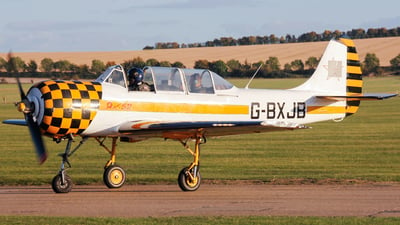
On 17 November 1998 at 1115 UTC, a Yakovlev Yak 52 registered G-BXJB was completing an aerobatic detail with a pilot and passenger on board near Raydon Airfield, Suffolk. During the descent at an indicated airspeed of 350 kph to join the circuit, at approximately 1,500 feet above ground level, the control stick suddenly jerked forward and the aircraft pitched down with severe stick vibration. A loud report was heard from the rear of the aircraft a short time later. The pilot reduced power and recovered to level flight at about 400 feet agl. Flying at minimum safe speed, an emergency call was made and the aircraft returned to its departure airfield for an uneventful landing. The rear-seat occupant confirmed that a section of the right elevator was missing.
Aircraft and Pilot Information
The aircraft was a single-engine Yak 52, powered by an Ivchenko Vedeneyev M-14P piston engine, manufactured in 1987. It was on a private flight with one crew and one passenger; no injuries were sustained. The 50-year-old pilot held a Private Pilot's Licence with 382 total flying hours, including 158 hours on type, with 35 hours in the last 90 days and 2 hours in the last 28 days.
Examination Findings
The right elevator's framework consisted of aluminium alloy ribs attached to a tubular spar, with a folded sheet trailing edge and formed sheet leading edge, covered with fabric. Examination revealed the fabric was cotton, with mould growth, particularly near the tip. The upper surface fabric had eleven chordwise tears, only one at a rib position. The aft edges of the fabric were feathered from flapping. Ribs 1 through 4 and the tip rib showed fractures consistent with very low cycle fatigue, with the trailing edge also fractured. A fatigue crack was found in the lower skin of the tip fairing.
It was concluded that the elevator break-up was initiated by a chordwise tear in the upper fabric at the No 2 rib, due to in-service degradation of the cotton fabric. Ballooning of the fabric under airloads contributed to the subsequent structural failures, all involving very low cycle fatigue mechanisms. The maintenance organisation responsible had shipped suitable fabric to the manufacturer before the aircraft's UK import, but the type of cotton fabric used suggests the replacement was not carried out. The aircraft had been repainted, precluding direct inspection.
Conclusion and Regulatory Action
As a result of this event, the UK Civil Aviation Authority issued Mandatory Permit Directive (MPD) No. 1998-020, requiring operators of imported aircraft to verify that control surface fabric has been inspected and, if necessary, replaced per earlier MPD 1997-019 R1. That directive requires fabric to meet specified standards, excluding the cotton fabric found on G-BXJB.