Introduction
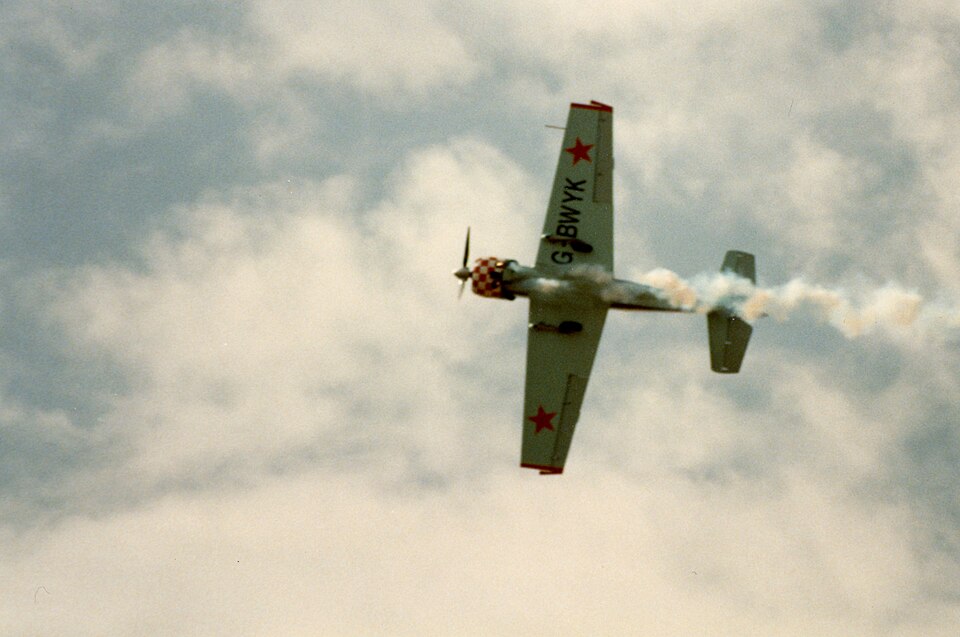
On 8 April 1998, a formation aerobatic training flight involving two aircraft resulted in a collision over Boreham Airfield, Essex. The aircraft involved were a Yak 52, registration LY-AMU, and a Yak 50, registration G-BWYK. Both aircraft were powered by a single Vedeneyev M-14P piston engine, with the Yak 52 manufactured in 1983 and the Yak 50 in 1981.
Aircraft and Pilots
The pilot of LY-AMU, aged 35, held an Airline Transport Pilot's Licence and had accumulated 7,760 total flying hours, including 250 hours on type. In the preceding 90 days he had flown 130 hours, and in the last 28 days, 50 hours. The pilot of G-BWYK, aged 47, also held an Airline Transport Pilot's Licence, with 7,000 total hours, of which only 7 were on the Yak 50. His recent flying experience included 100 hours in the last 90 days and 25 hours in the last 28 days.
Flight Details
The flight was a training session for a seven-aircraft formation aerobatic display. The pilot of LY-AMU served as the formation leader, while the pilot of G-BWYK flew as No 6. The planned manoeuvre was a "1/2 Cuban" performed in line astern, with No 6 following the leader. This manoeuvre had been practised previously without incident and was considered safe provided No 6 dropped back from close formation before the leader applied forward elevator at the 45° inverted line and rolled erect.
On the accident flight, the formation initially consisted of the leader, No 6, and two other aircraft (Nos 2 and 3) in a Box formation at 1,500 feet above ground level. The formation then pulled up, and as planned, Nos 2 and 3 broke away just before the vertical, leaving the leader and No 6 in line astern.
Accident
As the leader made a 'check' call to indicate the roll out was about to begin, he felt and heard three impacts at the rear of his aircraft. With difficulty, he rolled the aircraft erect and informed No 6 that a collision had occurred. No 6 acknowledged and reported a brief propeller impact but no evident vibration. He also informed the leader that about one-third of the right elevator of LY-AMU was missing.
Aftermath
No 6 returned to North Weald Airfield and landed without incident. The leader performed a handling check, which revealed no issues aside from a slight elevator buffet. He then landed without incident from a flapless approach. The Yak 52 sustained destruction of approximately 30% of its right elevator structure and skin, while the Yak 50 suffered damage to its propeller. No injuries were reported among the two pilots.
Cause
The accident was attributed to the fact that No 6 was too close to the leader when the leader rolled erect. In his report, the leader acknowledged that he may have contributed to the accident by not re-emphasising during the pre-flight briefing the need for No 6 to drop back from close line astern before the roll erect started.