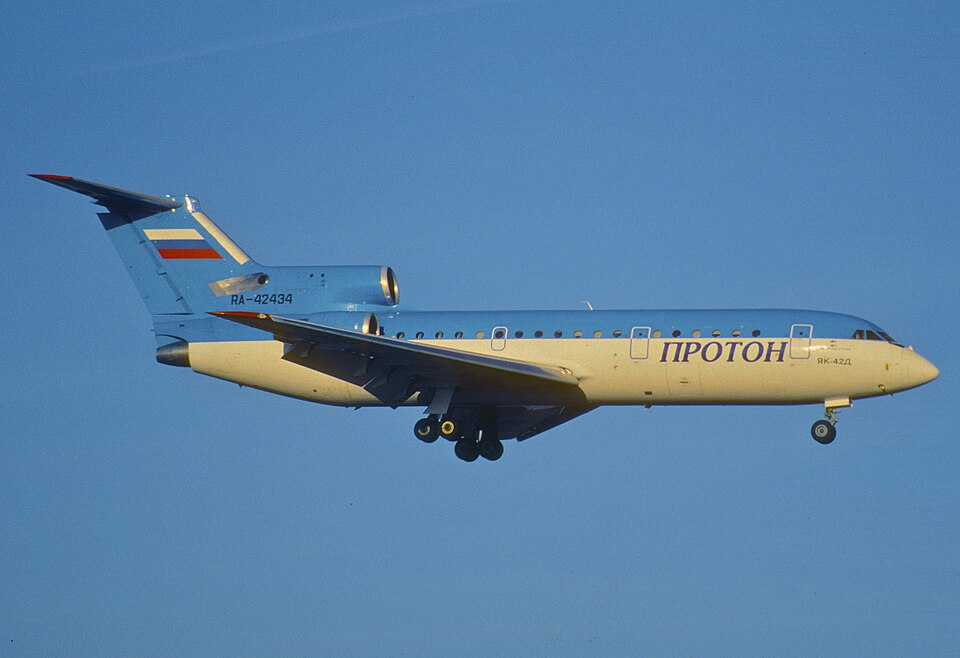
On September 7, 2011, a Yakovlev Yak-42 (registration RA-42434) operated by Yak Service was involved in an aviation accident near Yaroslavl, Russia during takeoff. 44 people were killed. Investigators recorded the probable cause as: Erroneous actions on part of the crew, especially by applying brake pedal pressure just before rotation as result of a wrong foot position on the pedal during the takeoff run. This summary draws on records from the Bureau of Aircraft Accidents Archives (B3A).
A Yak-42 chartered by Lokomotiv Yaroslavl overran the runway during takeoff, struck obstacles, and crashed into the Volga River, killing 44 people.
Incident Overview and Context A Yak-42 aircraft was chartered by the Lokomotiv Yaroslavl ice hockey team to transport staff to Minsk for the first game of the Russian 2011-2012 championship. The aircraft departed from Yaroslavl-Tunoshna Airport. ## Takeoff Sequence During the takeoff roll from runway 23, the crew selected flaps down at 20° and the stabilizer in a nose-up position of 8.7°. The aircraft accelerated slowly to 165 km/h due to residual pressure on the brake pedal. At 185 km/h and 1,350 meters from the runway end, the nose gear lifted off. The aircraft continued, passed the runway end, and rolled for about 400 meters before taking off. ## Collision and Crash After takeoff, the aircraft collided with various approach lights and the localizer antenna, lost height, and crashed on the shore of the Volga River, bursting into flames two minutes after the takeoff roll was initiated. ## Casualties A passenger and the flight engineer were seriously injured, while 43 other occupants were killed. Almost a week later, the injured passenger died from his injuries. Among the passengers were 26 players from the Lokomotiv Yaroslavl ice hockey team, Russian citizens, and also Canadian, Czech, Ukrainian, German, and Slovak nationals. The Canadian coach Brad McCrimmon, his both assistants, the cameraman, three masseurs, one admin, and two doctors were among the victims. ## Official Findings The official probable cause was erroneous actions by the crew, especially applying brake pedal pressure just before rotation due to a wrong foot position on the pedal during the takeoff run. This led to braking forces on the main gear requiring additional time for acceleration, a nose-down moment preventing proper rotation, and preventing the aircraft from reaching a proper pitch angle for becoming airborne. The aircraft overran the runway at high speed with the elevator fully deflected for nose-up rotation, producing more than double the elevator forces required for normal takeoff rotation. The aircraft finally achieved a high rate of nose-up rotation, became airborne 450 meters past the runway end, and rotated up to a supercritical angle of attack at a large rate of pitch-up, causing the aircraft to stall at low altitude, impact obstacles and ground, break up, and catch fire, killing all but one occupant. ## Contributing Factors Contributing factors included serious shortcomings in the re-training of the crew members with regards to the Yak-42, which did not take place in full, was spread out over a long period of time, and took place while the crew remained in full operation on another aircraft type (Yak-40), leading to a negative transfer of skills, especially a wrong position of the foot on the brake pedal on the Yak-42. Other factors included lack of supervision of the re-training, errors and missed procedures by the crew in preparation and execution of the takeoff, and inconsistent, uncoordinated actions by the crew in the final stages of the takeoff.