The animals aircraft hit most are not the ones that damage them
347,000 FAA wildlife strike reports, grouped by animal family — for all civil aviation, for airliners, and by aircraft model
The FAA has logged 354,556 wildlife strikes on civil aircraft since 1990. Group the strikes identified to an animal family and a counterintuitive split appears: the families aircraft hit most are almost never the ones that damage the aircraft.
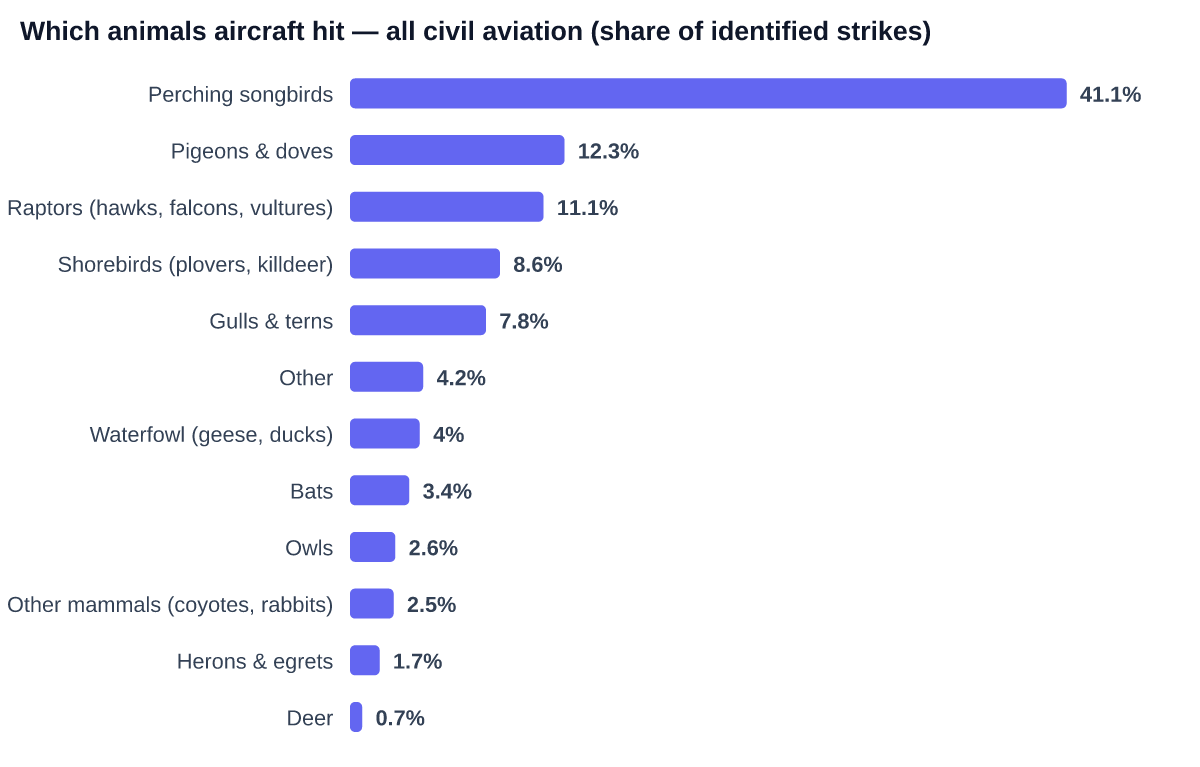
Which animals aircraft hit — all civil aviation (share of identified strikes)
| Animal family | Strikes | Share of strikes |
|---|---|---|
| Perching songbirds | 88,471 | 41.3% |
| Pigeons & doves | 26,371 | 12.3% |
| Raptors (hawks, falcons, vultures) | 23,721 | 11.1% |
| Shorebirds (plovers, killdeer) | 18,264 | 8.5% |
| Gulls & terns | 16,621 | 7.8% |
| Other | 9,123 | 4.3% |
| Waterfowl (geese, ducks) | 8,362 | 3.9% |
| Bats | 7,284 | 3.4% |
| Owls | 5,491 | 2.6% |
| Other mammals (coyotes, rabbits) | 5,278 | 2.5% |
| Herons & egrets | 3,526 | 1.6% |
| Deer | 1,573 | 0.7% |
Perching songbirds — swallows, larks, starlings — are the single biggest slice at 41.3% of identified strikes, yet they damage the aircraft just 1.5% of the time: a small, light bird is mostly absorbed by the airframe. The damage comes from the heavy families that are struck far less often. The single most dangerous thing to hit is not a bird at all — white-tailed deer damage the aircraft 81.8% of the time, a runway collision with 60 kg of mammal. Among birds, waterfowl lead: geese and ducks are only 3.9% of strikes but damage the aircraft 36.1% of the time.
All civil aviation: share of strikes vs how often the family damages the aircraft
| Animal family | Share of strikes | Damage rate |
|---|---|---|
| Deer | 0.7% | 81.8% |
| Waterfowl (geese, ducks) | 3.9% | 36.1% |
| Raptors (hawks, falcons, vultures) | 11.1% | 11.8% |
| Gulls & terns | 7.8% | 11.1% |
| Herons & egrets | 1.6% | 9.6% |
| Other | 4.3% | 8.7% |
| Owls | 2.6% | 4.2% |
| Pigeons & doves | 12.3% | 2.9% |
| Other mammals (coyotes, rabbits) | 2.5% | 2.6% |
| Shorebirds (plovers, killdeer) | 8.5% | 1.7% |
| Perching songbirds | 41.3% | 1.5% |
| Bats | 3.4% | 0.7% |
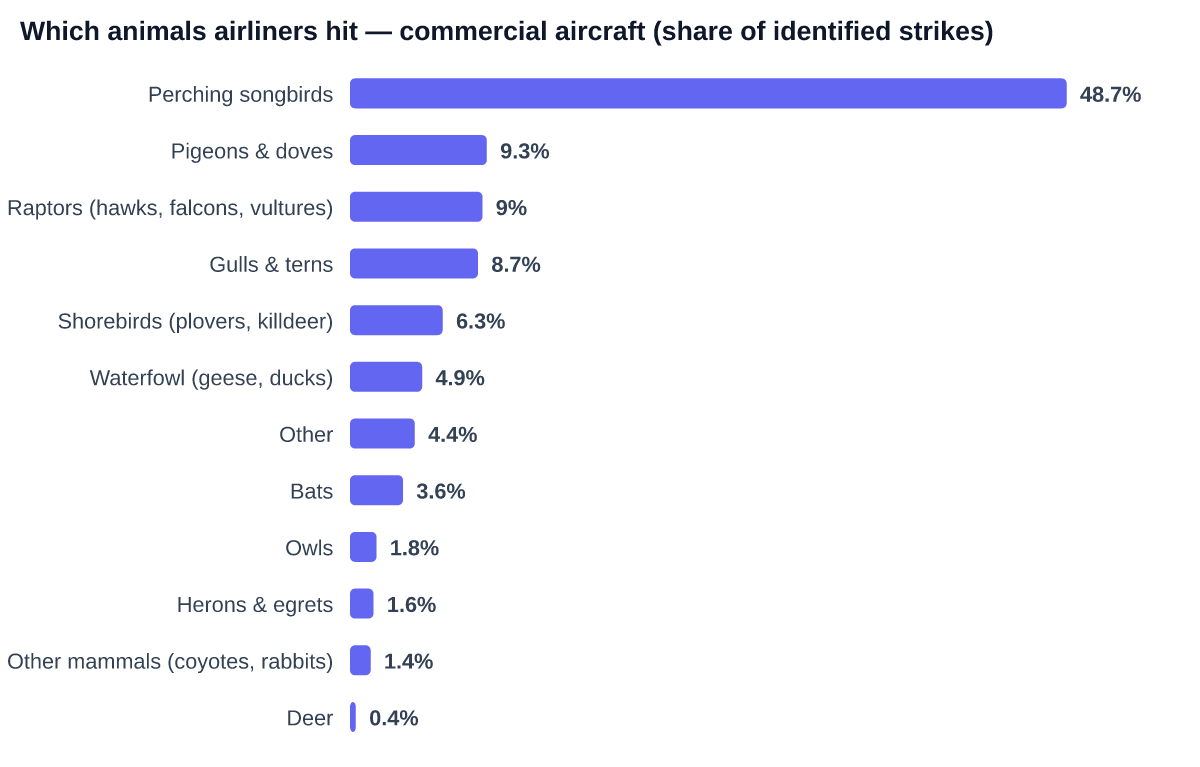
Narrow it to commercial aircraft — regional jets, airliners and heavies — and the mix shifts. Deer all but vanish: they are just 0.4% of airliner strikes, because jets fly from big, well-fenced airports where a deer on the runway is rare. Birds fill the gap, and the heaviest ones get worse: geese and ducks damage a commercial aircraft 40.9% of the time — the deer of the airline world.
Which animals airliners hit — commercial aircraft (share of identified strikes)
| Animal family | Strikes | Share of strikes |
|---|---|---|
| Perching songbirds | 50,061 | 48.9% |
| Pigeons & doves | 9,492 | 9.3% |
| Raptors (hawks, falcons, vultures) | 9,139 | 8.9% |
| Gulls & terns | 8,816 | 8.6% |
| Shorebirds (plovers, killdeer) | 6,356 | 6.2% |
| Waterfowl (geese, ducks) | 4,907 | 4.8% |
| Other | 4,519 | 4.4% |
| Bats | 3,680 | 3.6% |
| Owls | 1,834 | 1.8% |
| Herons & egrets | 1,634 | 1.6% |
| Other mammals (coyotes, rabbits) | 1,456 | 1.4% |
| Deer | 386 | 0.4% |
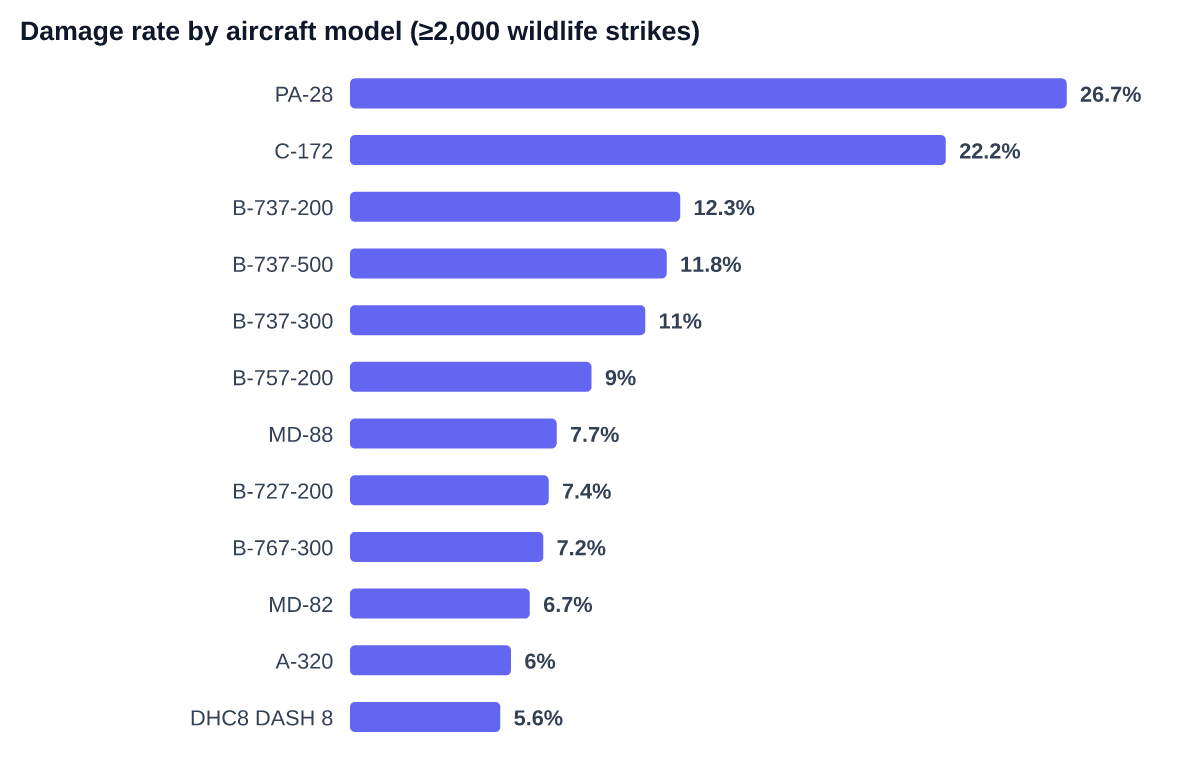
Damage risk rides on the airframe itself, too. Light general-aviation singles — the Piper PA-28, the Cessna 172 — are damaged in more than a fifth of their strikes: a small airframe has little margin, the same reason a deer on the runway is so dangerous. Among the jets, the older, smaller narrowbodies — the 737-200, -300 and -500 — report damage two to three times as often as current-generation types like the A320 flying the same routes into the same airports.
Damage rate by aircraft model (≥2,000 wildlife strikes)
| Aircraft | Strikes | Damage rate |
|---|---|---|
| PA-28 | 2,561 | 26.3% |
| C-172 | 4,550 | 22.1% |
| B-737-200 | 2,503 | 12.3% |
| B-737-500 | 2,136 | 11.8% |
| B-737-300 | 9,353 | 11% |
| B-757-200 | 8,960 | 8.9% |
| MD-88 | 2,099 | 7.7% |
| B-727-200 | 3,460 | 7.4% |
| B-767-300 | 5,615 | 7.2% |
| MD-82 | 2,979 | 6.7% |
| A-320 | 17,533 | 5.9% |
| DHC8 DASH 8 | 3,041 | 5.6% |
The practical reading: raw strike counts — the number airports usually publish — measure exposure, not risk. A goose on the approach path is a different problem from a swallow, a deer fence can be worth more than either, and the aircraft on the far end matters too. Wildlife-hazard programs work from damage risk; public reporting mostly counts strikes.
Methodology
Source: FAA National Wildlife Strike Database (public domain), all 354,556 reported strikes on civil aircraft, 1990–present, as normalized in the FlightFinder safety corpus. Strikes are grouped into animal families by the FAA species code (a hierarchical code whose prefix identifies the family); shares are computed over the ~210,000 strikes identified to a family, excluding records logged only as 'unidentified bird'. "Commercial" is aircraft mass class 3–5 (regional jets, airliners, heavies); the per-model chart uses the reported aircraft type. "Damaging" follows the FAA damage classification (minor through destroyed). Reporting is voluntary below Part 139 thresholds, so counts undercount reality; damage rates are less affected because damaging strikes are far more likely to be reported. Numbers on this page are recomputed nightly from the live database.
Cite this
FlightFinder analysis of FAA National Wildlife Strike Database, 2026. Underlying data: FlightFinder Data API.
Sources: FAA National Wildlife Strike Database (public domain) · FlightFinder wildlife-strikes vertical: /safety/wildlife-strikes
Research paper
Species struck most often are not those that most often damage aircraft: an open aggregation of FAA wildlife-strike reports (1990–2025)
We converted the public FAA wildlife-strike export into versioned, machine-readable aggregates (1990–2025: 343,565 reports, 21,809 damaging) and analyzed damage rates by animal family, aircraft model, and airport. Species that dominate strike counts are not those that damage aircraft: perching songbirds account for 41.1% of identified strikes but damage aircraft in 1.5% of reports, while deer damage aircraft in 81.8% of theirs. Across the 452 airports with at least 50 reports, strike volume and conditional damage rate are negatively rank-correlated (Spearman ρ = −0.44, p < 0.001) — volume-ranked lists are a poor guide to hazard. All aggregates and analysis code are released under CC BY 4.0.
Preprint (arXiv) · Dataset & paper (Zenodo, DOI) · Analysis code
Query this data yourself — Data API from $49/mo · Litigation research dossiers