What actually breaks on a Boeing 737
264,000 mechanic reports to the FAA, sorted by aircraft system
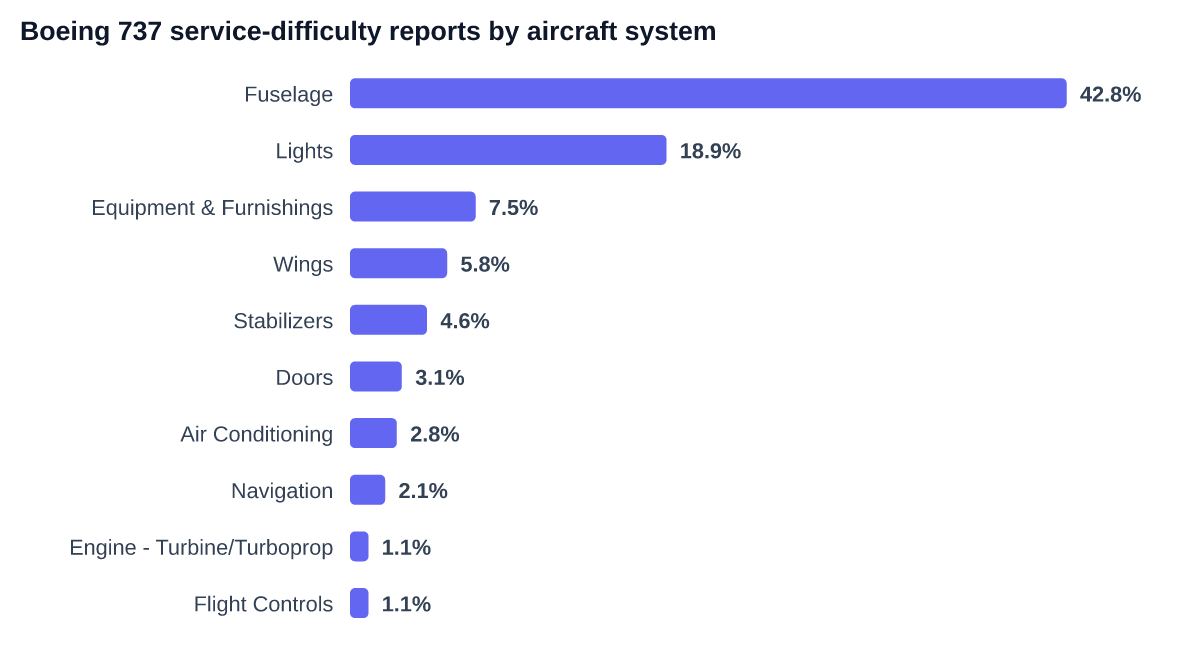
Every time a US mechanic finds a defect serious enough to report, it becomes a Service Difficulty Report — a public FAA record naming the aircraft, the system and the failure. For the Boeing 737 family there are 263,998 of them (1998–2026). Aggregate them by ATA system chapter and you get something rare: an empirical answer to "what actually breaks on the world's most common airliner".
Boeing 737 service-difficulty reports by aircraft system
| System (ATA) | Reports | Share |
|---|---|---|
| Fuselage | 113,064 | 42.8% |
| Lights | 49,810 | 18.9% |
| Equipment & Furnishings | 19,907 | 7.5% |
| Wings | 15,205 | 5.8% |
| Stabilizers | 12,197 | 4.6% |
| Doors | 8,308 | 3.1% |
| Air Conditioning | 7,305 | 2.8% |
| Navigation | 5,432 | 2.1% |
| Engine - Turbine/Turboprop | 2,955 | 1.1% |
| Flight Controls | 2,828 | 1.1% |
The headline: 42.8% of everything reported is the fuselage — skin cracks, corrosion, dents; the structure that pressurizes and depressurizes on every cycle. It is not the engines, not the avionics, not the landing gear that dominate the paperwork: it is aluminum fatigue, found during inspections, fixed, and reported. The number two system — lights — is the opposite story: components that fail constantly and matter rarely.
Most-reported components on the Boeing 737
| Component | Reports |
|---|---|
| BATTERY PACK | 11,717 |
| LIGHT | 10,689 |
| FLOOR PANEL | 9,361 |
| FRAME | 8,692 |
| ANGLE | 7,564 |
| LENS | 7,232 |
| INTERCOSTAL | 6,405 |
| FLOOR SUPPORT | 6,396 |
| FLOORBEAM | 6,250 |
| SLIDE | 6,222 |
Two readings coexist. One: the 737 is an aging-airframe program and the reports show exactly where the maintenance effort goes. Two — and this is the one the raw counts support — the system works: cracks get found on the ground, written up and repaired, hundreds of times a day, which is why they so rarely become news. A high report count is not a safety indictment; a silent fleet would be scarier.
Methodology
Source: FAA Service Difficulty Reporting System (public domain), 263,998 reports referencing the Boeing 737 family (1998–2026), as normalized in the FlightFinder reliability corpus. Reports are grouped by ATA chapter as filed. SDR reporting practices vary by operator and era; shares are of reports, not of failures — systems whose defects are found by inspection (structures) are over-represented relative to fly-to-failure components. Numbers recomputed nightly from the live database.
Cite this
FlightFinder analysis of FAA Service Difficulty Reports, 2026. Underlying data: FlightFinder Data API.
Sources: FAA Service Difficulty Reporting System (public domain) · FlightFinder 737 reliability vertical: /aircraft/boeing-737/reliability
Query this data yourself — Data API from $49/mo · Litigation research dossiers