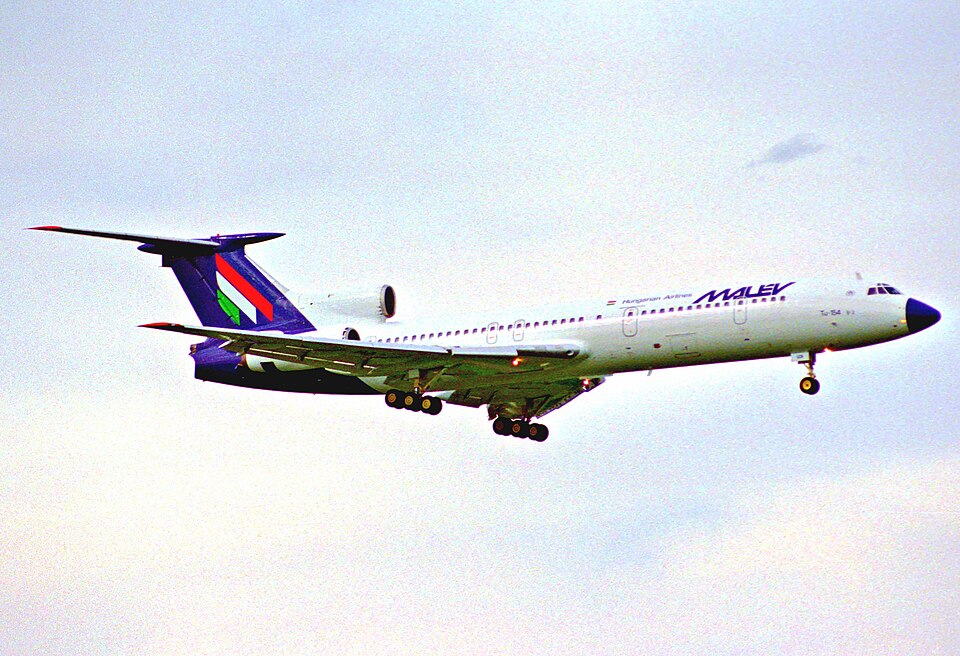
Background
On 4 July 2000, a Tupolev Tu-154B-2 (registration HA-LCR) operated by MALEV Hungarian Airlines was conducting flight MAH 262 from Budapest to Thessaloniki. The aircraft carried a crew of eight (captain, co-pilot, flight engineer, and five cabin crew) and 86 passengers.
Accident Sequence
The flight departed Budapest at 12:35 UTC. Approaching Macedonia Airport, Thessaloniki, the crew was cleared for a VOR/DME approach to runway 34, then a circling approach to runway 28, as runway 34 was closed for construction. The aircraft was sequenced as number two behind flight TVS 564. After TVS 564 landed, the controller cleared flight CFG 851 for takeoff on runway 28. MAH 262 was instructed to extend its downwind leg to allow time for both the landing aircraft to vacate and the departure. However, MAH 262 turned base early at 3.3 nautical miles from the threshold. At 2 nautical miles, the aircraft performed S-turns to align. At 13:57:09, with the aircraft 0.7 nautical miles from the threshold at 330 feet, the controller cleared it to continue. At 13:57:16, at 0.3 nautical miles and 230 feet, landing clearance was given. Nine seconds later, at about 60 feet, the controller ordered a go-around, noting the landing gear was not down. The crew acknowledged but the aircraft contacted the runway. The aircraft slid on its belly for about 650 meters, starting about 1,100 meters from the threshold. The slide left grooves 350 meters long, 30 cm wide, and 6 cm deep. Two large flap pieces detached. Sparks, smoke, and dust were observed. The aircraft's fire extinguishers activated. No control problems were reported. The aircraft climbed and began the go-around.
Aftermath and Second Approach
During the go-around, the controller instructed MAH 262 to proceed to the northern holding point at 3,500 feet. Instead, the crew went to the southern holding. The crew twice declared a PAN-PAN-PAN emergency and requested landing priority. The controller initially directed them to contact approach control, but the crew remained on tower frequency. After several exchanges, the controller cleared the aircraft for another approach. The second landing was normal, with the landing gear extended and locked. Fire vehicles escorted the aircraft after landing.
Investigation
The Hellenic Air Accident Investigation and Aviation Safety Commission investigated. The report documented the sequence of events. The investigation's findings are not detailed in the source.