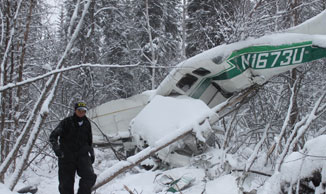
Accident Overview
A pilot and three passengers were on an air taxi flight over remote terrain. While cruising at about 2,200 feet, the engine oil pressure began to drop and the oil temperature began to rise. The pilot decided to divert to the nearest airport, but the engine subsequently quit running. The pilot selected an emergency landing area on a sand bar along a river, which contained several willow trees. During the landing, the airplane sustained damage to the wings and fuselage.
Engine History and Examination
The engine had accrued 1,491 hours since its last overhaul. During that period, company maintenance personnel performed seven cylinder changes. An examination of the engine revealed that the crankshaft was broken along the aft, lower edge of the number two cheek journal, at the forward radius of the number two main bearing journal. The fracture line was straight and flat, running through the full dimension of the number two cheek journal, and was oriented perpendicular to the longitudinal axis of the crankshaft. The number two main bearing was broken and flattened, and the number two main bearing saddle was also flattened and distorted. Additionally, the left and right engine case halves mating surface exhibited galling and fretting at the number two main journal bolt holes.