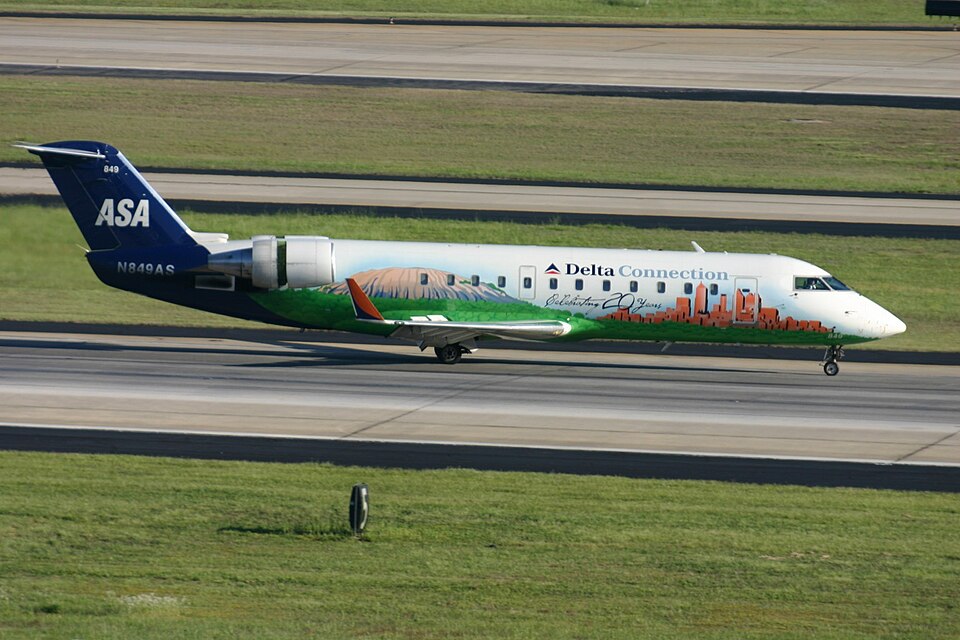
Incident Overview
A Bombardier CL600-2B19, registration N849AS, operated by Atlantic Southeast Airlines, Inc., as flight 4509, experienced a left main landing gear failure during landing on runway 26R at Atlanta Hartsfield International Airport in Atlanta, Georgia. According to the flight crew and confirmed by the flight data recorder, the approach to landing was uneventful. Upon touchdown, the pilot deployed the thrust reversers and the left main landing gear collapsed.
Investigation Findings
Fracture of the main fitting for the left main landing gear was caused by a fatigue crack that emanated from multiple origins at the external surface of the wall at the shock strut radius run out area. No evidence of material anomalies, such as corrosion or gouge damage, was found at the fatigue origin area. Because the stresses leading to the fatigue crack of the main fitting have not clearly been identified, the root cause of the fatigue cracking has not been determined.
Industry and Regulatory Actions
During the investigation, Atlantic Southeast Airlines conducted a fleet-wide inspection of all their Bombardier Model CL600-2B19 aircraft landing gear assemblies, which included visual and eddy current inspections. Their inspections found no additional cracked landing gear. Transport Canada issued a revised airworthiness directive (AD) that eliminated the escalation of the eddy current inspection intervals as allowed in their previous AD. Additionally, the Federal Aviation Administration (FAA) issued a notice of proposed rulemaking (NPRM) in response to the Transport Canada AD, which would require repetitive detailed visual and eddy current inspections of the main landing gear main fitting. The NPRM, if adopted, would produce another AD applicable to certain Bombardier Model CL600-2B19 (Regional Jet Series 100 & 440) airplanes. The proposal would require repetitive detailed and eddy current inspections on the main fittings of the main landing gears to detect discrepancies, and related investigative/corrective actions if necessary. The proposal also requires servicing of the shock strut of the main landing gears, including inspection for nitrogen pressure, visible chrome dimension, and oil leakage, and servicing of any discrepant strut. Transport Canada has accepted Messier-Dowty’s redesign of the main fitting, on condition that testing of the new design would be completed successfully. Testing was scheduled to commence in July 2004. Once testing is complete, Transport Canada will mandate installation of the new design as the terminating action for the ADs.