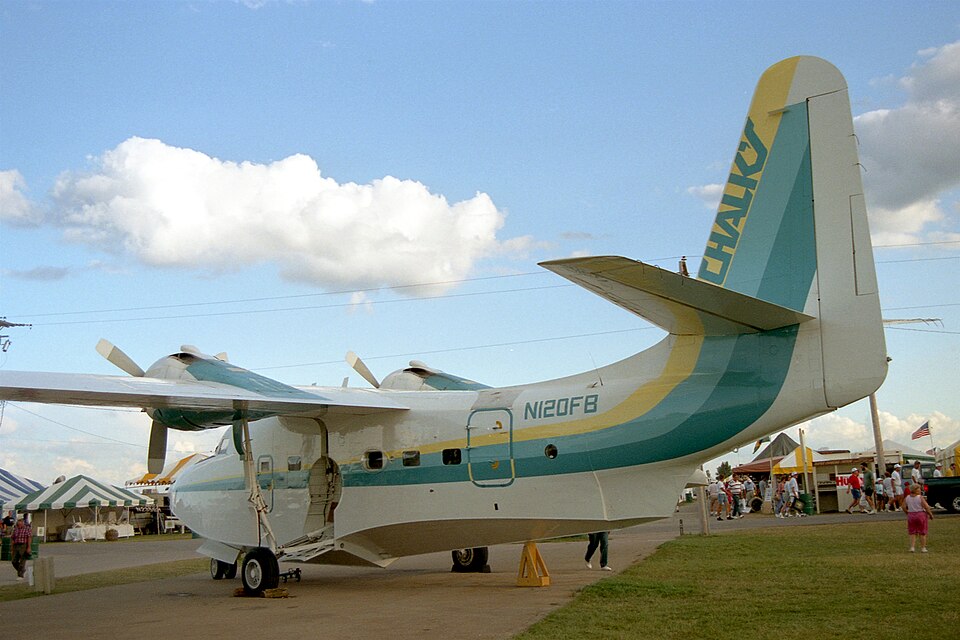
Accident Overview
On November 5, 2009, at approximately 1534 eastern standard time, a Grumman G-111, registration N120FB, was substantially damaged during a forced landing following a total loss of power in the left engine. The event occurred shortly after takeoff from St. Lucie County International Airport (FPR) in Ft. Pierce, Florida. The intended destination was Okeechobee County Airport (OBE) in Okeechobee, Florida. Day visual meteorological conditions prevailed, and no flight plan had been filed. The ferry flight was conducted under Title 14 Code of Federal Regulations Part 91.
Occupant Injuries
The two pilots received no injuries, and one additional crew member received minor injuries.
Eyewitness Account
An eyewitness reported seeing the airplane depart from runway 32 and become airborne near the intersection of taxiway "C7." As the landing gear began to retract, the left engine emitted several loud pops, followed by white smoke from the exhaust. The witness heard an increase in engine noise and observed the airplane begin a left turn. The airplane then impacted terrain, went through an airport boundary fence, and came to rest near an airport service road. Upon arrival at the accident location, the witness observed fuel coming out of the right wing and assisted the occupants in exiting the airplane.
Pilot Reports
In an interview with the Safety Board, the captain reported that during takeoff preparation, they advanced the power levers to 30 inches of manifold pressure, checked engine gauges, then advanced to 40 inches and released the brakes for a normal takeoff. During initial climb, the captain commanded gear retraction. Shortly after the gear handle was placed in the up position, a loud bang followed by three to four smaller bangs was heard. The captain ordered the checklist for an engine failure in flight. The first officer confirmed the left engine was affected and began feathering the propeller. Once feathered, the captain confirmed by sight. According to the first officer, airspeed stagnated around 95 knots, and increasing power to 52 inches manifold pressure did not accelerate the airplane. The airplane turned slightly left, as if on the backside of the power curve. Unable to exceed 95-96 knots indicated, the crew confirmed gear and flaps retracted, but the captain could not center the slip/skid indicator. During an attempt to return to the airport for an emergency landing, the airplane could not maintain altitude. The captain attempted to land on an airport perimeter road, impacting a fence and a sand berm. After coming to rest, the captain shut down engines and fuel pumps, and observed fuel from the right wing onto the ground.
Aircraft Fuel and Weight
The airplane had been fueled on October 29, 2009, with 284 gallons of 100LL aviation fuel. The captain reported that both engines had approximately 3 hours since overhaul, and the takeoff weight was about 27,100 pounds.
FAA Inspection
An FAA inspector reported that the left engine propeller was in the feathered position, and the right engine exhibited little damage. Approximately 150 gallons of fuel was removed from the left fuel tanks; samples from both engines indicated 100LL fuel with no water or contaminants. The right wing tank was breached, and an estimated 150 gallons of fuel had spilled on the ground under the right wing. Control continuity could not be verified due to underside damage. A cursory examination revealed no evidence of preimpact mechanical malfunction. The inspector calculated the maximum allowable takeoff weight as 30,605 pounds.
Flight Crew Details
The captain, age 58, held an airline transport pilot certificate with ratings for single-engine land and sea, multiengine land and sea, and a type rating for the accident airplane. His most recent FAA first-class medical was issued January 22, 2009. He reported 9,095 total flight hours, with 14 hours in the accident airplane make and model, and 3 hours as pilot-in-command in that make and model.
The first officer, age 70, held an airline transport pilot certificate with ratings for airplane multiengine land and sea including a type rating for the accident airplane, and additional commercial and private certificates. His most recent FAA first-class medical was issued October 6, 2009. He reported 11,500 total flight hours.
Aircraft Information
The airplane was issued an airworthiness certificate on July 21, 1983, and registered to the owner on October 1, 2007. It was equipped with two Curtiss-Wright engines that underwent major overhauls on February 29, 2008. An entry dated October 12, 2009, indicated the airframe had 3,747.1 total hours in service, and the engines had 3.1 hours since major overhaul. On November 5, 2009, a special flight permit was issued for the flight to OBE.
Weather Conditions
The 1553 recorded weather observation at FPR included winds from 360 degrees at 9 knots gusting to 14 knots, visibility 10 miles, broken cloud layer at 4,000 feet above ground level, temperature 25°C, dew point 16°C, and altimeter 30.11 inches of mercury.