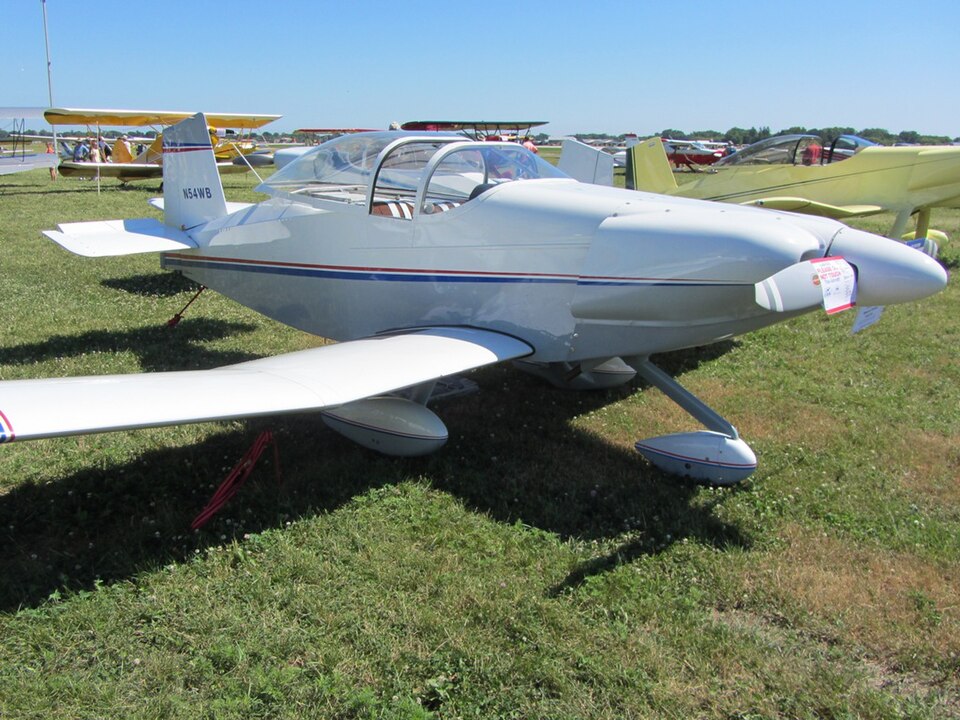
History of Flight
On September 23, 2011, at about 0853 eastern daylight time, an experimental amateur-built Thorp T-18 (N54WB) sustained substantial damage when it impacted a semi-trailer and terrain while on approach to runway 9 at Plainwell Municipal Airport (61D), near Plainwell, Michigan. A ground fire occurred. The pilot was fatally injured. Visual meteorological conditions prevailed at the time of the personal flight. The flight originated from Tulip City Airport, near Holland, Michigan, about 0830.
The accident airplane was the second in a flight of two airplanes destined for 61D. The pilot in the first airplane stated there were no radio transmissions from the accident pilot regarding mechanical malfunctions and that the accident pilot asked him to maintain speed on final. He reported a haze layer about 400 feet above ground level that was localized around the river and airport, with visibility under the haze of about three miles.
A witness working on a bridge near the accident site observed the second airplane close to the first, both low on approach. He noted the accident airplane struck the semi-trailer and flipped into a ditch embankment west of runway 9. Another witness in a southbound vehicle saw the impact and described visibility as "good" with no fog. A ground fire ensued upon impact.
Personnel Information
The pilot, aged 73, held a private pilot certificate with single-engine land and instrument airplane ratings. His most recent medical certificate was a third class issued on July 20, 2011, without limitations. A family member estimated the pilot had accumulated approximately 1,921 total flight hours, including 1,311 hours in the accident airplane.
Aircraft Information
The plans for the accident airplane were sold to the pilot on September 27, 1974. A logbook endorsement indicated the last condition inspection was completed on March 2, 2011, though no airframe hours were listed in that entry. A family member indicated the airplane had accumulated about 1,311 total flight hours.
Meteorological Information
At 0853, the recorded weather at Kalamazoo/Battle Creek International Airport, about 15 nautical miles and 165 degrees from the accident site, was: wind calm; visibility 6 statute miles; present weather mist; sky condition clear; temperature 11 degrees C; dew point 9 degrees C; altimeter 30.09 inches of mercury.
Airport Information
Plainwell Municipal Airport (61D) is a public, non-towered airport located about 2 miles north of Plainwell, Michigan, at an elevation of 722 feet mean sea level. It features runways 9/27 and 1/19. Runway 9, measuring 2,650 by 50 feet of dry asphalt, has a displaced threshold of 191 feet and obstructions including a 17-foot road 201 feet from the runway end, a 4-foot fence 50 feet from the runway end, and another 17-foot road 140 feet from the runway end.
Wreckage and Impact Information
Examination of the wreckage revealed all flight control surfaces were present. The cabin area was melted, charred, and deformed from ground fire. Outer portions of the flight control push-pull tubes were intact, and moving them by hand caused corresponding control surface movement. Rudder control cables were intact and the rudder moved when the cables were manipulated. No preimpact anomalies were detected in the flight controls. The engine produced thumb compression on all cylinders when the propeller was rotated by hand. The magneto sustained fire damage but produced spark at its center electrode when rotated. The mechanical fuel pump ejected liquid when its lever was manipulated. No preimpact engine anomalies were detected.
Medical and Pathological Information
An autopsy performed by the Allegan County Medical Examiner listed the cause of death as smoke and soot inhalation and thermal burns. The FAA Civil Aerospace Medical Institute prepared a Final Forensic Toxicology Accident Report, which was negative for the tests performed.