History of Flight
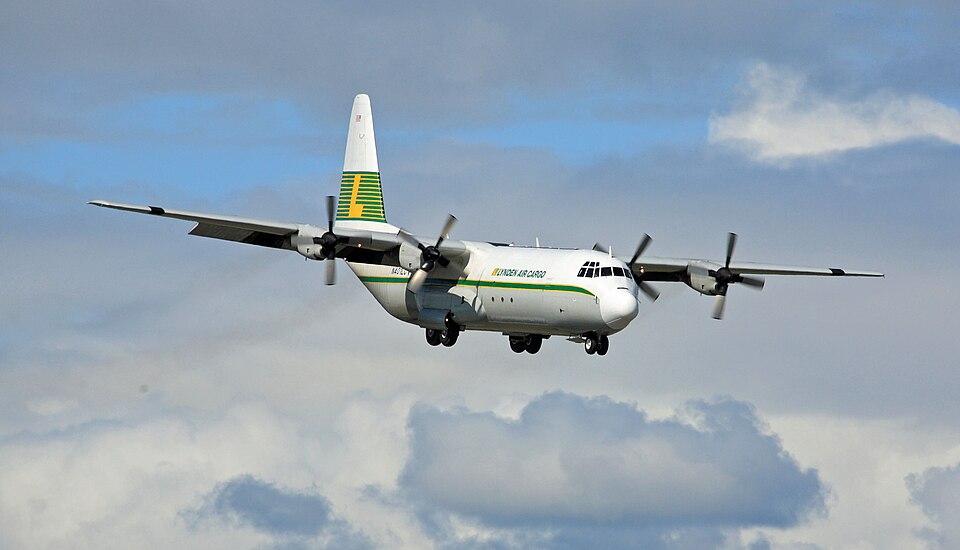
On February 12, 2016, at about 0745 Alaska standard time, a Lynden Air Cargo, LLC, Lockheed 382G airplane, registration N401LC, experienced a rapid depressurization while in cruise flight approximately 100 nautical miles east of Bethel, Alaska. The flight crew declared an emergency and diverted to Iliamna Airport (ILI) in Iliamna, Alaska, where they landed without further incident. There were no injuries to the five crew members on board. The airplane sustained substantial damage. The flight was conducted under 14 CFR Part 121 supplemental rules as a domestic cargo operation from Bethel Airport (BET) to Elmendorf Air Force Base (EDF) in Anchorage, Alaska.
Personnel Information
The captain, aged 47, held an Airline Transport Pilot certificate with single-engine land, multiengine land, and instrument airplane ratings, along with a type rating for the L-382. His most recent FAA first-class medical certificate was issued on October 23, 2015, without limitations. His last FAA proficiency check was on September 17, 2015, in a Lockheed 382G. He reported 20,528 total flight hours, with 3,769 hours as pilot-in-command in the accident airplane make and model.
The check pilot, aged 51, held an Airline Transport Pilot certificate with single-engine land and sea, multiengine land, and instrument airplane ratings, plus type ratings in DC-3, DC-7, DC-8, and L-382. His most recent first-class medical was issued on January 25, 2016, with a requirement to wear corrective lenses. His last proficiency check was on July 21, 2015, in a Lockheed 382G. He reported 25,503 total flight hours, with 8,508 hours as pilot-in-command in the accident airplane make and model.
The flight engineer held a Flight Engineer certificate with an L-382 type rating and reported 13,300 total flight hours.
Aircraft Information
The accident airplane, a Lockheed 382G (serial number 4606), was manufactured in 1975. At the time of the event, it had accumulated 55,422 total hours and 35,421 cycles. The most recent continuous airworthiness inspection occurred on February 8, 2016, at an aircraft total time of 55,393.5 hours.
Meteorological Information
The nearest official weather reporting station was an Automated Surface Observing System at Iliamna Airport, about 90 nautical miles northwest of the airplane at the time of the event. At 0753 Alaska standard time, approximately eight minutes after the incident, an Aviation Routine Weather Report (METAR) reported: wind from 260 degrees at 5 knots; visibility 10 statute miles; broken clouds at 12,000 feet; temperature 0°C; dew point -2°C; altimeter 29.32 inches of mercury.
Wreckage and Impact Information
Examination revealed a rupture (crack) in the forward pressure bulkhead canted web at fuselage station (FS) 93. The crack was located near a row of 24 vertically aligned rivets at the airplane centerline and intersected one of the rivet holes. The fracture also progressed outboard to the right side toward the next line of vertical rivets at the upper and lower ends. Photographs taken immediately after the accident showed evidence of dark staining emanating from the vertical fracture, with a streaked appearance toward the left side of the bulkhead. Four radome closure fasteners fractured, allowing the radome to partially open in flight; the radome remained attached at the upper hinge. The damage to the forward pressure bulkhead was determined to be substantial per NTSB regulations. The fractured portion of the canted bulkhead was removed for examination.
Additional Information
Lockheed Martin Aeronautics Company (LMAC) recommended inspection procedures for the canted bulkhead in Service Manual Publication (SMP) 515-C, card ST-1, which requires a detailed visual inspection of all fuselage external surfaces with fairings, access doors, and panels removed, but does not specifically require opening the radome to examine the canted bulkhead. LMAC recommends this inspection every 6 years. Lynden Air Cargo last performed the ST-1 inspection on March 25, 2013, at 51,527 hours and 29,831 cycles, with no findings. The canted bulkhead on the accident airplane had never been repaired, and no applicable Service Bulletins or Airworthiness Directives existed. Following the accident, Lynden Air Cargo examined the canted bulkheads on their other L-382 airplanes with no findings.
LMAC examined service history records for military and commercial operators of the airplane model and found no other similar occurrences. On March 10, 2016, LMAC issued Alert Service Bulletin (SB) A382-53-67, providing procedures for a detailed visual inspection of the upper canted bulkhead on all 382, 382B, 382E, 382F, and 382G airplanes. The SB was to be accomplished within 90 days for aircraft with more than 15,000 flight cycles and repeated at each C Check, not to exceed 3 years or 3,000 flight cycles.
Tests and Research
The fractured portions of the canted bulkhead were examined in the NTSB Materials Laboratory. Rivet hole locations were labeled H1 through H24, starting from the uppermost rivet. The fracture was to the right of a vertical row of rivets, where a C-channel stiffener was fastened to the aft side of the bulkhead. The fracture curved up and outboard above hole H1 and down and outboard below hole H23. The vertical portion aligned with the right outboard edge of the rivet heads on the forward face. Both faces were coated with green paint, with the forward face having a lighter shade. Cross sections revealed one layer of paint on the aft face and two layers on the forward face.
The mating vertical fracture faces showed black deposits over about 10.5 inches between holes H7 and H21, confirmed as aluminum oxide. These areas also contained chlorine. Examination using bench binocular and scanning electron microscopes revealed multiple fatigue cracking origins emanating from both forward and aft faces next to 21 consecutive rivet holes (H3 through H23). Fatigue from the aft face propagated through about 85% to 90% of the thickness, and from the forward face through the remainder. The fatigue crack regions at each hole were vertically separated by areas with micro-void coalescence typical of overstress separation. The vertical length of each fatigue region measured between 0.55 and 0.75 inch, with the largest near hole H10 at 0.75 inch. Detailed SEM examination showed initiation at isolated areas with intergranular cracking extending 0.0013 to 0.0023 inch below the surface. Fractures above hole H1 and below hole H23 showed rough texture on a slant plane consistent with overstress.
The forward and aft faces were examined. The aft surface exhibited multiple irregular cracks between rivet holes and the fracture face, and similar cracks were found under all rivet heads on the aft surface and some on the forward face. Isolated corrosion was found on both faces.
The manufacturer's drawing specified the web material as 7075-T6 aluminum alloy with a 7072 aluminum alloy cladding on both surfaces. During assembly, the web was to be Alodine-treated and coated with green epoxy primer. Tests verified material composition, electrical conductivity, hardness, and microstructure, as well as web, clad, and paint layer thicknesses, all within specifications.
A fatigue striation count study was conducted for a crack near hole H17. The fatigue crack propagated forward from the aft face, terminating between 0.0425 and 0.0495 inch from the origin. It was intersected by an opposing fatigue crack from the forward face. The accumulated cycles at 0.0425 and 0.0495 inch from the origin were calculated to be 4,615 and 5,079 cycles, respectively.