History
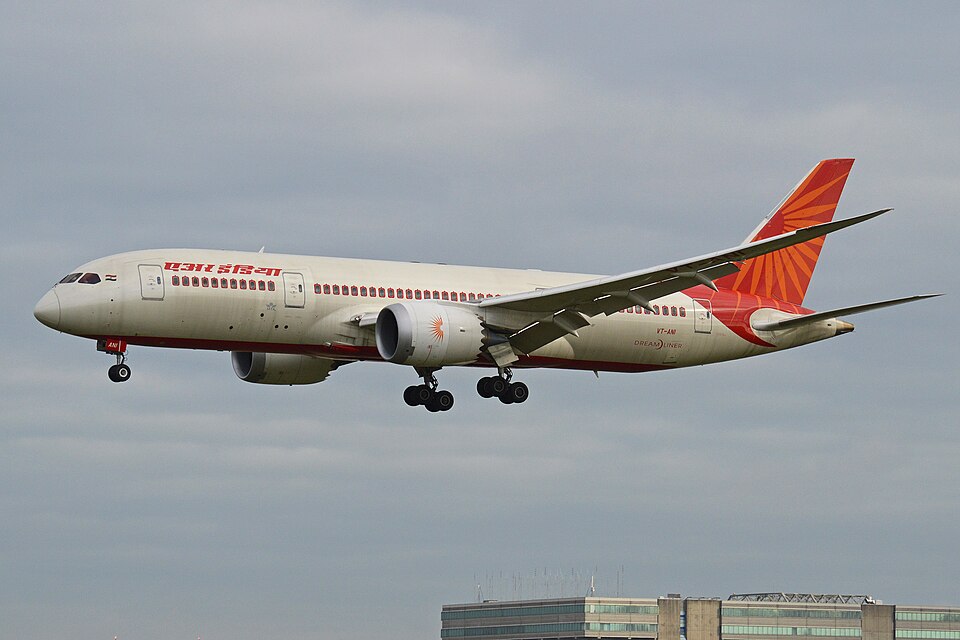
On 10 November 2016, two Air India Boeing 787-800 aircraft, VT-ANI operating flight AIC154 from Vienna and VT-AND operating flight AIC142 from Paris, were approaching Delhi. Both were on arrival route SAM6F between waypoints SAM and DP424. Initially spaced 9 minutes apart, a preceding aircraft was asked to orbit, altering the spacing so that VT-AND became 2 NM ahead of VT-ANI. VT-AND was maintaining flight level (FL) 250, and VT-ANI was maintaining FL230.
Communication and ATC Actions
The ACC-West radar controller, handling 18 aircraft, cleared VT-AND to descend to FL210. The transmission was not acknowledged, though garbled noise was heard. Subsequently, VT-ANI was cleared to descend from FL230 to FL210, which it acknowledged, and then from FL210 to FL190. The last clearance was not read back by VT-ANI, and it maintained FL210. VT-AND continued its descent to FL210. A Predicted Conflict Warning (PCW) was generated between 035933 UTC and 040020 UTC but likely not acknowledged. At 040035 UTC, AIC154 was cleared to FL190, but the transmission was not acknowledged. VT-AND, though cleared to FL210, continued descending.
TCAS and Evasive Actions
At 040142 UTC, a Current Conflict Warning (CCW) was generated while VT-AND was passing FL220. The controller instructed it to maintain FL220. Both aircraft received Traffic Advisory (TA) immediately followed by Resolution Advisory (RA) from their TCAS systems. Both flight crews took evasive actions as per the TCAS advisory. Radar data showed that at one point, both aircraft Mode C displayed FL217, and their radar position symbols overlapped, indicating 0 NM lateral separation. The minimum vertical separation was 700 feet.
Separation Restored
Standard separation was re-established at 040250 UTC when AIC154 was observed descending (passing FL183) and AIC142 was climbing (passing FL221). No injuries or damage were reported. The weather was fine and had no bearing on the occurrence. All navigational aids and communications were normal. The Ministry of Civil Aviation appointed a Committee of Inquiry to investigate.