History of Flight
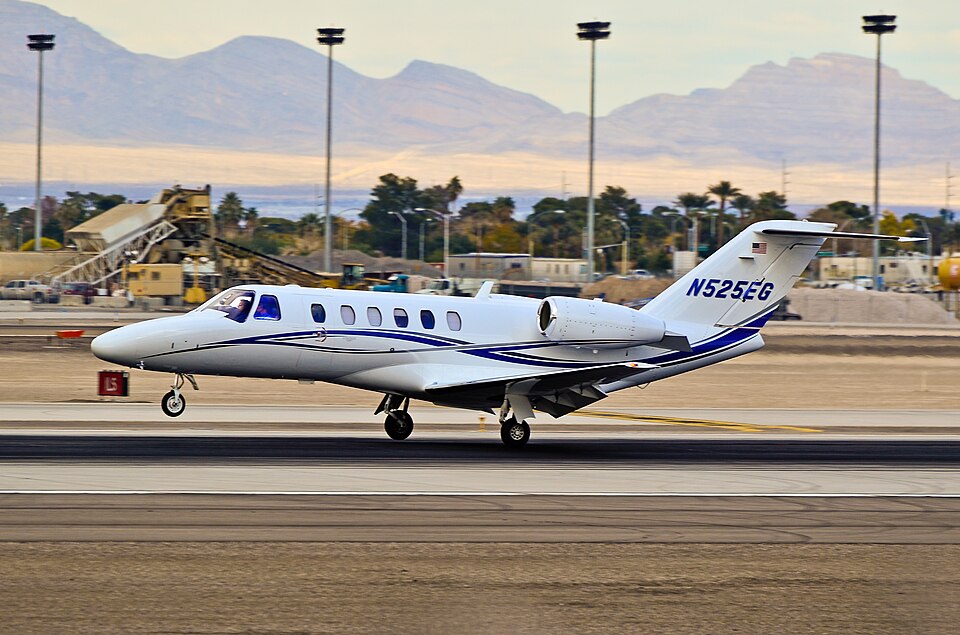
On November 30, 2018, about 1028 central standard time, a Cessna 525A (Citation) airplane, N525EG, was destroyed when it was involved in an accident near Memphis, Indiana. The pilot and two passengers were fatally injured. The airplane was operated as a Title 14 Code of Federal Regulations Part 91 business flight.
The cross-country flight originated from Clark Regional Airport (JVY), Jeffersonville, Indiana, and was en route to Chicago Midway International Airport (MDW), Chicago, Illinois. The airplane was equipped with automatic dependent surveillance–broadcast (ADS-B) and a cockpit voice recorder (CVR). It was not equipped with a flight data recorder.
Review of the CVR transcript showed that the pilot operated as a single pilot but verbalized his actions. He referenced items from the Before Taxi checklist and included in his crew briefing that in the event of a problem after takeoff decision speed, he would handle it as an in-flight emergency and “fly the airplane, address the problem, get the autopilot on, talk on the radios, divert over to Stanford.” The air traffic controller provided initial clearance for the pilot to fly direct to the STREP intersection and to climb and maintain 3,000 ft mean sea level. Before departure from JVY, the pilot announced on the common traffic advisory frequency that he was departing runway 36.
The flight departed JVY about 1024:36 into instrument meteorological conditions. The CVR recorded the pilot state that he set power to maximum cruise thrust, switched the engine sync on, and turned on the yaw dampers. The pilot also verbalized his interaction with the autopilot. According to the National Transportation Safety Board’s (NTSB) airplane performance study, the airplane climbed to about 1,400 ft msl before it turned left onto a course of 330° and continued to climb.
At 1025:39, the pilot was cleared up to 10,000 ft and asked to “ident,” and the airplane was subsequently identified on radar. The pilot verbalized setting the autopilot for 10,000 ft and read items on the After Takeoff/Climb checklist. The performance study indicated that the airplane passed 3,000 ft about 1026, with an airspeed between 230 and 240 kts, and continued to climb steadily.
At 1026:29, the controller instructed the pilot to contact the Indianapolis Air Route Traffic Control Center; the pilot acknowledged. At 1026:38, the pilot resumed the checklist and stated, “uhhh lets seeee. Pressurization pressurizing anti ice de-ice systems are not required at this time.” The performance study indicated that, at 1026:45, the airplane began to bank to the left at a rate of about 5° per second and that after the onset of the roll, the airplane maintained airspeed while it continued to climb for 12 seconds, consistent with engine power not being reduced in response to the roll onset.
At 1026:48, the CVR recorded the airplane’s autopilot disconnect annunciation, “autopilot.” The performance study indicated that about this time, the airplane was in about a 30° left bank. About 1 second later, the pilot stated, “whooooaaaaah.” Over the next 8 seconds, the airplane’s EGPWS annunciated six “bank angle” alerts. At 1026:57, the airplane reached its maximum altitude of about 6,100 ft msl and then began to descend rapidly, in excess of 11,000 ft per minute. At 1026:58, the bank angle was about 70° left wing down, and by 1027:05, the airplane was near 90° left wing down.
At 1027:04, the CVR recorded a sound similar to an overspeed warning alert, which continued to the end of the flight. The performance study indicated that about the time of the overspeed warning, the airplane passed about 250 kts calibrated airspeed at an altitude of about 5,600 ft. After the overspeed warning, the pilot shouted three expletives, and the bank angle alert sounded two more times. According to the performance study, at 1027:18, the final ADS-B data point, the airplane was about 1,000 ft msl, with the airspeed about 380 kts and in a 53° left bank. At 1027:11, the CVR recorded the pilot shouting a radio transmission, “mayday mayday mayday citation five two five echo golf is in an emergency descent unable to gain control of the aircraft.” At 1027:16, the CVR recorded the EGPWS annunciating “terrain terrain.” The sound of impact was recorded about 1027:20. The total time from the beginning of the left roll until ground impact was about 35 seconds.
The accident site was located about 8.5 miles northwest of JVY.
Pilot Information
The pilot received his single-pilot Cessna 525 type rating to his airline transport pilot certificate on February 28, 2018, after completing training at Simuflite and prior to the installation of the Tamarack Aerospace Group Active Technology Load Alleviation System (ATLAS) on the accident airplane. On his application to add the Cessna 525 type rating, the pilot reported 3,291 total hours of flight experience and 453 hours of instrument experience. On previous applications filed on February 14, 2017, and on August 29, 2016, the pilot reported the same hours. On his application for a Federal Aviation Administration (FAA) medical certificate dated March 15, 2018, the pilot reported 3,500 total hours. Logbooks for the pilot were not located, and no online logbook was discovered during the investigation. The pilot’s total hours and experience could not be verified.
Aircraft Information
The airplane was a Cessna 525A (Citation) equipped with an autopilot system, a Honeywell Mark VIII Enhanced Ground Proximity Warning System (EGPWS), and a Tamarack Aerospace Group Active Technology Load Alleviation System (ATLAS). The airplane was modified via Supplemental Type Certificate (STC) SA03842NY on May 27, 2018, to install the ATLAS. The ATLAS includes two wing extensions and two winglets with active aerodynamic surfaces called Tamarack Active Camber Surfaces (TACS). The system is designed to operate independently of other airplane systems. The left and right TACS Control Units (TCUs) were manufactured in late 2017 and had been returned to the manufacturer per Service Bulletin CAS/SB1467, which corrected a potential for a metal fastener inside the TCU to become loose and detach. Both TCUs were reinstalled on July 13, 2018. The last maintenance performed on the airplane occurred on November 20, 2018, at which time the airplane had 3,296.7 total flight hours. At the time of the accident, the ATLAS had accrued about 250 flight hours and about 193 flight hours since the service bulletin was accomplished. There were no reported discrepancies concerning the flight controls, autopilot, or ATLAS before the accident.
Meteorological Information
Weather information for the accident flight indicated instrument flight rules conditions in the vicinity of the accident site. Sounding data revealed conditions conducive for light turbulence from the surface to about 2,500 ft, where the intensity increased to moderate through about 7,000 ft. Cloud coverage was present between about 1,200 ft to 10,000 ft msl.
Wreckage and Impact Information
The debris field measured about 400 yards on an easterly heading through a wooded area. The first impact point consisted of treetops. The airplane was found fragmented in numerous pieces with the right engine being the farthest piece of wreckage. All major airplane components were accounted for at the accident site. There was evidence of a postimpact fire.
A layout reconstruction of the primary flight controls was conducted on scene. All flight control cables were broken in multiple locations, and all breaks displayed broomstrawing at the fracture points. No preimpact anomalies were noted with the flight controls.
Both engines’ full authority digital engine control units were recovered and sent to the manufacturer for download. Data extracted revealed that neither recorded any faults on the day of the accident. Each unit recorded a single data point at takeoff for the accident flight; no anomalies were recorded during the takeoff.
A portion of the EGPWS outer case was found along the wreckage path, but its internal components were not located. The aircraft recording system (AReS) unit was also found along the wreckage path. The outer case of the unit was compromised, and the outer case of the compact flash card was breached. Further examination revealed that the memory chip had separated from the compact flash card circuit board and was not located.
ATLAS Components
The ATLAS control unit (ACU) was found detached from its mounting location. The unit case showed signs of crush damage consistent with impact. The ACU cover screws were not present, and removal of the cover revealed multiple loose electrical components in the unit and missing components from the main circuit card. Damage to the ACU precluded any functional testing.
The ATLAS INOP button and annunciator LRU were not located in the wreckage.
Portions of the left TACS were located. The recovered control linkages exhibited failures consistent with overload. A visual examination showed a witness mark on the bellcrank consistent with contact with the trailing-edge-up mechanical stop. Additional damage consistent with overdeflection in the trailing-edge-up direction was noted to the inboard hinge fitting.
The left TCU was still attached to its wing-mounted location. Impact forces left an outline consistent with the TCU impressed into the wing access panel. The unit’s case did not exhibit deformation, and the top and bottom covers were secured. A CT scan found five screw heads loose within the unit, consistent with shearing due to deformation of the actuator housing. The scan also found six bent pins near the end of the 40-pin connector, corresponding to grounds, Servo Enable, Servo Command, Servo Fault, and Position Output. Of these, electrical continuity testing showed open connections between Servo Enable and the board and Servo Command and the board. As of August 10, 2021, the manufacturer had inspected 30% of in-service TCUs and had not found any bent pins like those in the accident unit.
Impact load testing conducted by Tamarack showed that the TCU circuit board could deform under loads and that impact forces could partially separate connector pins. The NTSB conducted a dimensional analysis indicating that if the circuit board deflected during impact so that it contacted the bottom cover of the actuator and the bottom cover deflected slightly, the pins could disengage.
Examination of the bottom cover of the TCU showed witness marks transferred from the TCU circuit board. However, under ultraviolet lighting, no areas of conformal coating transfer were found. The six bent pins would have been in the area of highest deflection if the circuit board flexed.
The ram tube was bent and could not be removed without excessive force. There were visible markings on the retract hard stop consistent with acceptance testing, but no marks consistent with a high-force impact. Examination of the extend hard stop found witness marks consistent with a high-energy impact.
CT scans revealed that the left TCU ball nut was near the actuator extension limit in the TACS trailing-edge-up position. A set of witness marks was found on the ram guide housing, consistent with contact from the ball screw nut that positions the TACS, in an area consistent with a TCU intermediate extension position.