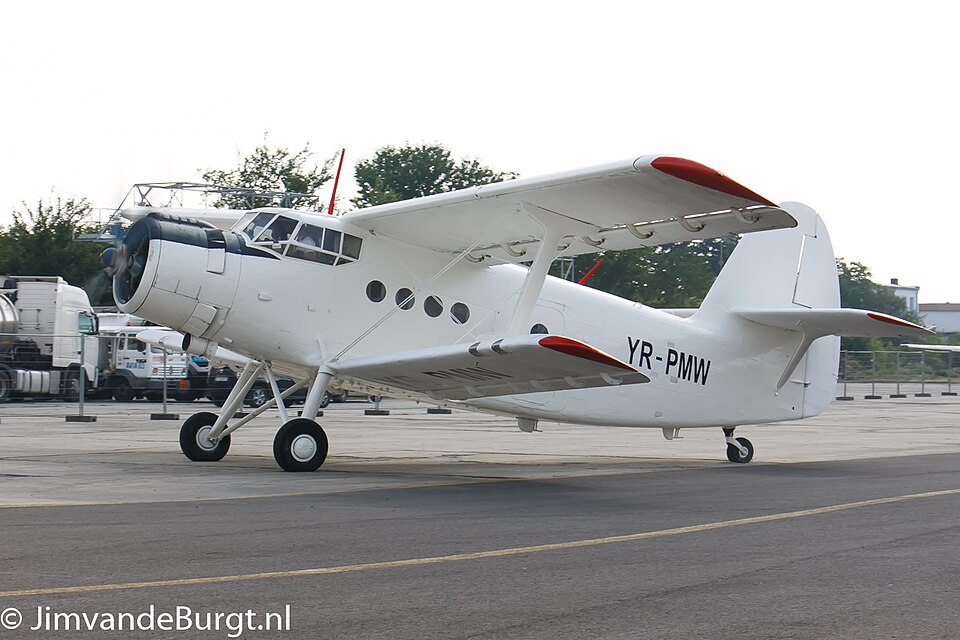
Event History
On 6 November 2021, at 11:35 local time, an Antonov AN-2 (registration YR-PMW) operated by the Asociația Club Sportiv Skydiving Center was performing a skydiving flight at the Letca Nouă airstrip in Giurgiu County, Romania. After a normal takeoff from runway 21, climb, parachute drop, and approach, the aircraft touched down and began to roll. Shortly after touchdown, the aircraft started tilting to the right. The pilot, suspecting a tire burst, applied left stick to keep pressure on the good tire, but the tilt continued until the right lower wingtip contacted the ground, causing the aircraft to pivot 180 degrees from its original direction.
Aircraft and Crew Information
The aircraft was an AN-2 biplane built in 1978 by WSK Mielec (serial number 1G18147), powered by an AS-62.IR engine with an AV-2 propeller. It was privately owned and operated by the skydiving club, authorized for parachute jumps. The crew consisted of a 58‑year‑old pilot with 8,800 total flight hours (3,500 on type) and a 61‑year‑old flight mechanic. Both held valid licenses and medical certificates. The aircraft’s technical maintenance was performed according to an approved program; the last annual inspection was on 23 July 2021, and the last non‑destructive testing (NDT) of the landing gear braces was in April 2021 when the aircraft had about 8,017 flight hours.
Meteorological Conditions
At the time of the accident, wind was from 90° at 10 knots, visibility over 10 km, temperature 16°C, and pressure 1026 mb. The weather was not a factor in the accident.
Damage and Technical Investigation
The right main landing gear leg collapsed, with the rear brace broken at its attachment near the tire. The right lower wing was also damaged. No crew injuries were reported. Investigation of the broken brace revealed weld points applied in the area of the attachment lug. Macroscopic, stereoscopic, and metallographic analyses indicated that the rupture was sudden, initiated by the presence of these weld points, which induced negative micro‑structural changes and altered the stress field in the material. The manufacturer’s maintenance instructions prohibit repairs to the landing gear braces; any cracks detected during NDT require replacement. The weld points were not documented in the aircraft’s technical records, and the timing of the weld intervention could not be determined.
Analysis
The brace rupture caused the collapse of the right main landing gear leg. The weld points created micro‑structural differences and stress concentrations that ultimately led to the fracture. The pilot’s attempt to counter the tilt by left stick input was ineffective as speed decreased and control authority diminished.
Probable Cause
The rupture of the rear brace of the right main landing gear, caused by the application of weld points that induced negative micro‑structural changes and stress fields.