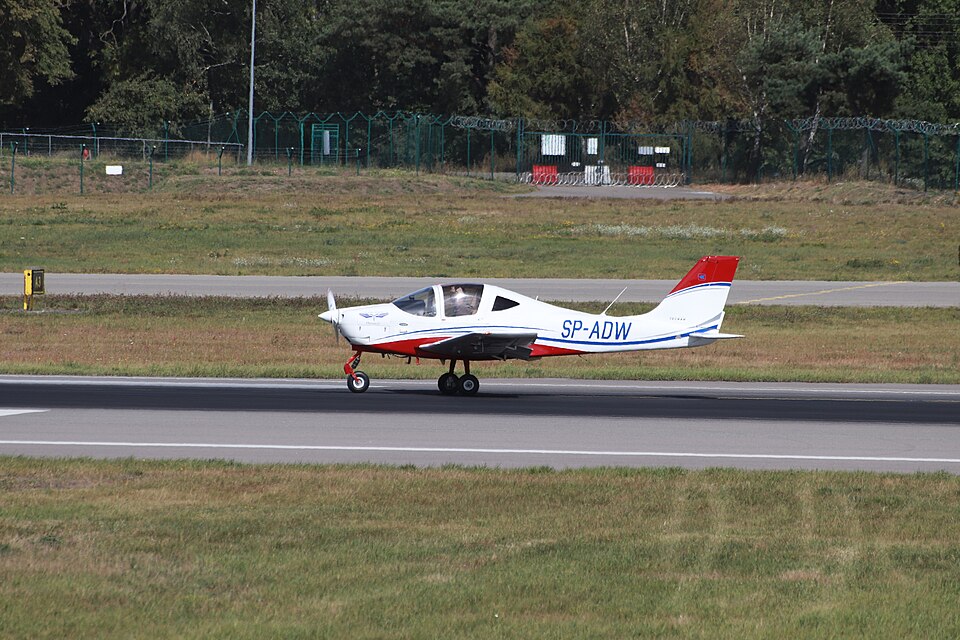
Event Description
On 1 September 2023, a Tecnam P2002 JF aircraft (registration SP-ADW) was conducting a training flight under PPL(A) exercise 19 at EPWT. The crew consisted of an instructor and a student pilot. After landing on runway 26 and traveling approximately 30 meters from the start of braking, the crew observed the nose of the aircraft drop. The propeller blades were damaged and the engine shut down. The crew sustained no injuries.
Investigation Findings
Examination of the aircraft revealed that the nose gear shock absorber mounting bolt had fractured, causing the fork and wheel to move rearward and collapse under the fuselage. The shock absorber detached from its upper mount and damaged the nose wheel rim. The lower part of the broken bolt was found 15 meters behind the aircraft; the upper part was not located.
The fracture analysis showed that the bolt had failed in fatigue. The fatigue zone had a smooth surface with concentric rings typical of progressive crack growth, and corrosion was present near the initial crack area. The fracture occurred on the threaded portion of the bolt, within the left fork wall. The thread crests along the entire length inside the fork hole were crushed, indicating gradual deformation that increased clearance and allowed movement under cyclic loads. The fracture was characterized as fatigue failure due to long-term cyclic loading. The bolt had been installed on 12 May 2017 and had accumulated 9,926 landings, of which 29 occurred on the day of the incident. Over 95% of the landings were training flights.
The investigation noted that the grass runway surface at the landing site was significantly uneven, which contributed to cyclic stresses on the nose gear. Additionally, periodic maintenance inspections did not include checking the condition of this bolt, and its location made detection of damage impossible during routine servicing.
Probable Cause
The probable cause of the incident was fatigue fracture of the nose gear shock absorber mounting bolt due to long-term, variable (cyclic) loads.
Contributing Factors
1. Uneven grass surface of the runway. 2. The aircraft's predominant use for training flights.
Safety Actions
The operator introduced a task into the Tecnam P2002 JF maintenance program requiring replacement of the front shock absorber mounting bolt and the front wheel fork bolt every 100 flight hours or annually, whichever occurs first.
No safety recommendations were issued.