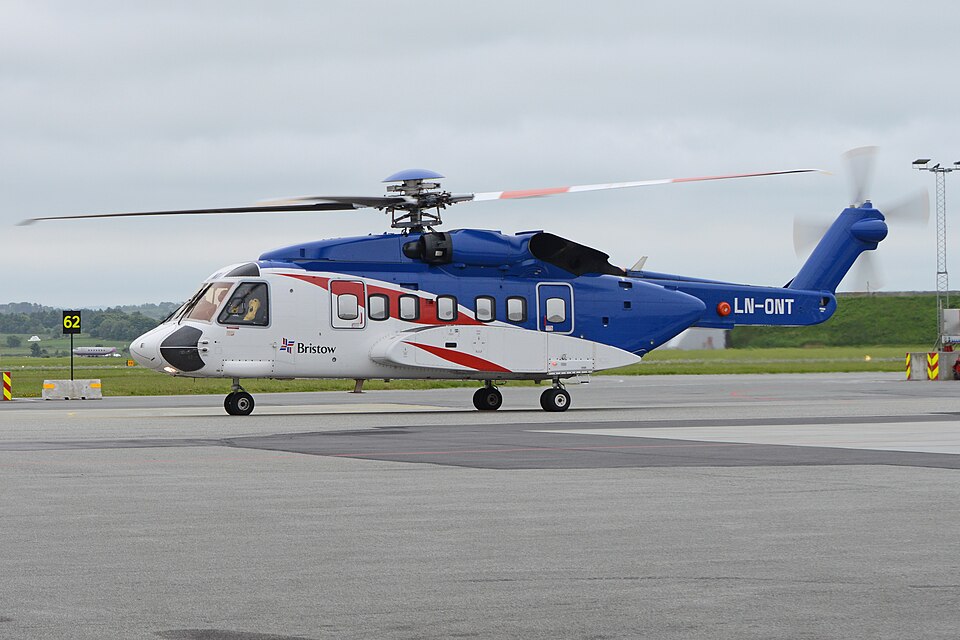
Incident Summary
On the evening of 24 February 2020, at 20:56 local time, a Sikorsky S-92A helicopter (registration LN-ONT) operated by Bristow Norway AS as flight BHL352 experienced a loss of control shortly after take-off from the helideck of the Maersk Invincible jackup rig in the North Sea. The helicopter was carrying two pilots and nine passengers, all uninjured. The planned departure was to climb to 1,000 ft while accelerating into the wind, then proceed to Stavanger Airport Sola.
Flight Conditions
The departure occurred in darkness with strong winds and rain. The flight crew had no external visual horizon or references; the oil rig was behind them, and only darkness was visible in the flight direction. The first officer, in the left-hand seat, was the pilot flying (PF), and the captain, in the right-hand seat, was the pilot monitoring (PM).
Sequence of Events
After take-off, the helicopter lost altitude, heading, and airspeed, deviating significantly from a normal departure profile. The helicopter accelerated rearwards with a high nose attitude, traveling about 210 m north of the platform and to the left of the planned route. The crew lost control for approximately 40 seconds. When control was regained, the helicopter was at an altitude lower than the height of the helideck from which it had taken off. The pilots then established a controlled climb and continued to Stavanger Airport Sola without further incident.
Investigation Findings
The Norwegian Safety Investigation Authority (NSIA) conducted the investigation. It found no technical errors or faults with the helicopter that could have influenced the event. The incident occurred in demanding weather conditions before the autopilot's minimum speed (V-min) had been reached. The crew did not conduct a separate briefing to identify specific threats for the departure. The NSIA determined that the first officer was probably affected by a sensory illusion resulting from head movement combined with vertical and horizontal acceleration during the transition to instrument flight after the Take-off Decision Point. This likely triggered spatial disorientation, leading to overcorrection of the flight controls and loss of control. The investigation also noted that the cyclic force trim release button had been used, though its intentionality was not determined.